
Hawkins Inc: Acquisition-Driven Expansion in Water Treatment Amidst Earnings Volatility
Hawkins Inc. posts record revenue on the back of water treatment acquisitions in Texas and Florida, but faces earnings volatility and integration risks as it seeks to balance growth with operational stability.
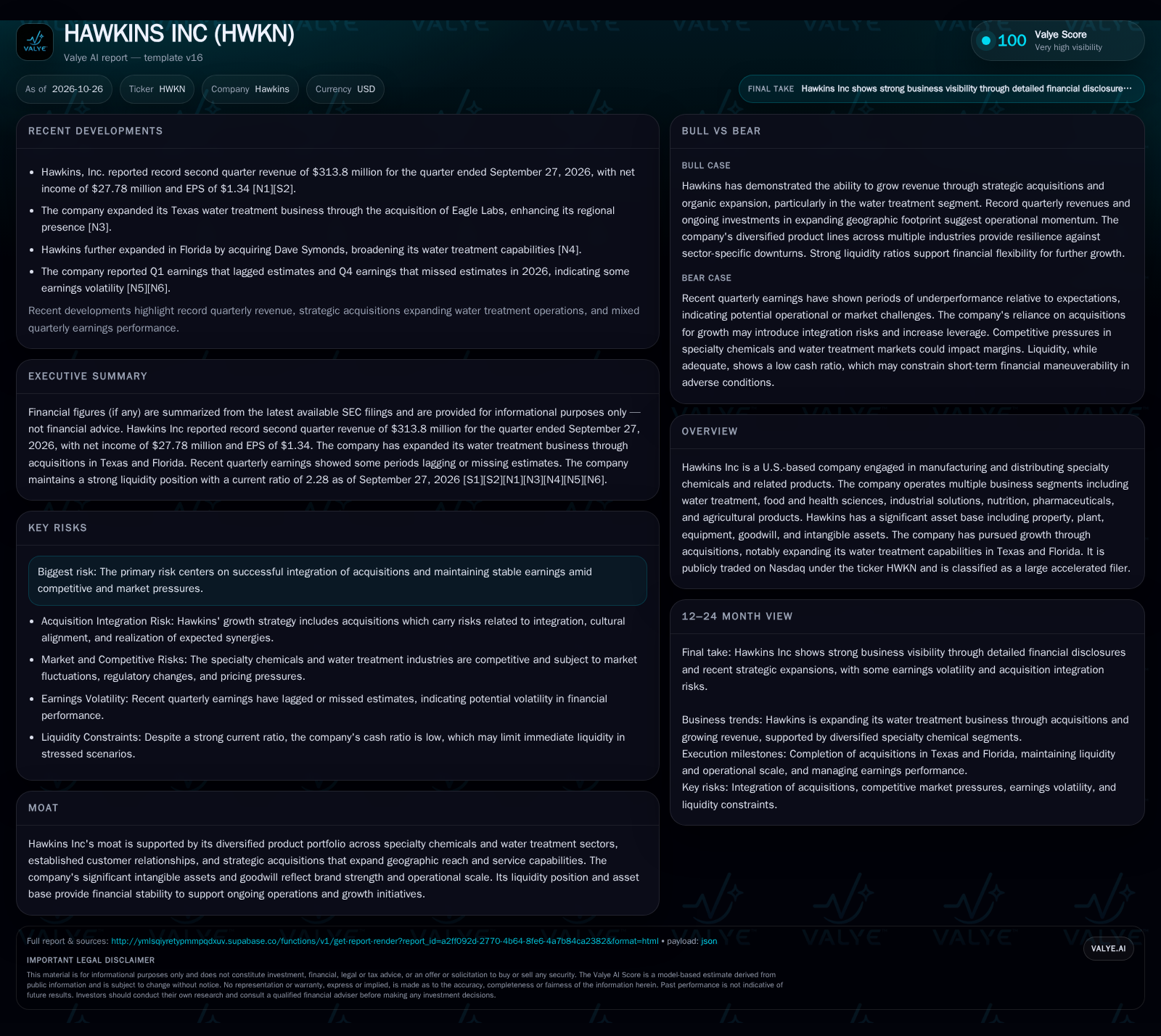
Hawkins has achieved record quarterly revenue, driven in part by recent acquisitions expanding its water treatment business in Texas and Florida. However, recent earnings have lagged estimates, highlighting volatility and integration risks. The company’s diversified segments and asset base provide some resilience, but future performance will hinge on successful integration, margin management, and the ability to sustain growth in competitive specialty chemical markets. [N1] [N3] [N4] [S2]
Hawkins Inc. finds itself at a strategic crossroads after reporting record quarterly revenue, fueled by targeted acquisitions in the water treatment sector. The company’s push into new regional markets in Texas and Florida has bolstered its top line, but a pattern of earnings misses raises questions about the sustainability of its growth trajectory. With a broad product portfolio and a significant asset base, Hawkins must now demonstrate that it can integrate new businesses effectively, capture operational synergies, and defend margins in a competitive environment where scale and execution matter.
Recent Acquisitions and Record Revenue Define Hawkins’ Current Phase
Hawkins Inc. reported record second quarter revenue of $313.8 million and net income of $27.78 million for the quarter ending September 27, 2026, equating to basic and diluted EPS of $1.34. This performance coincides with the company’s expansion of its water treatment business through the acquisitions of Eagle Labs in Texas and Dave Symonds in Florida, extending Hawkins’ geographic reach and service portfolio. However, despite these gains, Hawkins’ Q1 and Q4 earnings in 2026 lagged or missed estimates, underscoring recent volatility in profitability. The company reported cash and liquidity metrics for the period; these figures do not by themselves establish operating runway, investment capacity, financial flexibility, or financing capacity. [N1] [N3] [N4] [N5] [N6] [S2]
How Hawkins’ Multi-Segment Model Generates and Deploys Cash
Hawkins’ revenue streams are diversified across three principal segments: water treatment, food and health sciences, and industrial solutions. The water treatment segment—recently expanded through acquisitions—offers chemicals, equipment, and services to municipal, industrial, and agricultural customers, often on a recurring basis tied to large-scale facilities. This segment can benefit from relatively stable demand, as water treatment is a non-discretionary spend for many customers. However, margin profiles depend on product mix (bulk vs. specialty chemicals), service intensity, and the ability to scale regional operations post-acquisition.
The food and health sciences segment distributes and formulates a wide range of ingredients and solutions, serving manufacturers in nutrition, pharmaceuticals, and agriculture. Here, pricing power may be limited by commodity exposure, but value-added formulation and specialty products can support higher margins. Industrial solutions, focused on bulk chemical distribution and custom blending, is typically lower margin and capital intensive, requiring investment in storage, logistics, and compliance.
Operating leverage is plausible if Hawkins can drive incremental volume through existing infrastructure, particularly in water treatment, where acquisitions can create cross-selling and route-density benefits. However, integration costs and the need for ongoing capex in plant, equipment, and safety compliance can consume cash flow.
Defending Share in a Fragmented but Competitive Specialty Chemicals Landscape
Hawkins operates in highly competitive markets, especially in water treatment and specialty chemicals. Its recent acquisitions aim to strengthen regional presence and expand service offerings, which can provide a local scale advantage. However, the specialty chemical and water treatment sectors are populated by both national distributors and niche regional players, with competition based on price, reliability, service customization, and regulatory compliance.
Switching costs for customers can be moderate, particularly where Hawkins provides integrated services or bundled solutions, but commoditized bulk chemicals face ongoing price pressure. The company’s significant intangible assets and goodwill, accrued through past acquisitions, suggest established customer relationships and some brand strength. Still, these advantages are tested by the need to integrate new businesses and maintain service quality at scale.
Threats from substitutes (e.g., alternative water treatment technologies, direct procurement from manufacturers) and regulatory shifts could impact future margins. To sustain a moat, Hawkins must leverage its asset base and segment diversity to offer differentiated solutions and deepen customer lock-in, especially in the face of larger competitors and increasing customer sophistication.
If Integration Delivers: Pathways to Margin Expansion and Regional Scale
A favorable scenario would see Hawkins successfully integrating the Eagle Labs and Dave Symonds acquisitions, rapidly capturing operational synergies and cross-selling opportunities. If the company can improve cost discipline, realize procurement benefits, and drive higher-margin specialty sales across its expanded footprint, margin expansion could follow. Sustained growth in water treatment—where demand is less cyclical and more regulated—could provide a stable earnings base, enabling Hawkins to reinvest in further geographic expansion or adjacent services.
Confirmation of this scenario would come from sequential improvements in segment operating margins, evidence of revenue retention and growth in acquired regions, and a narrowing of the gap between reported results and analyst estimates. Additional signs would include reduced integration costs, rising free cash flow, and the ability to fund new growth initiatives without significant balance sheet strain.
Steady Growth with Integration Friction and Competitive Pressures
The most plausible outcome is that Hawkins maintains moderate revenue growth, driven by both organic expansion and incremental contributions from recent acquisitions. However, earnings volatility persists due to integration costs, uneven margin performance across segments, and ongoing competitive pressures—particularly in bulk and commoditized product lines. The company’s diversified model buffers against sharp downturns in any single segment, but aggregate margin improvement is gradual rather than dramatic.
This scenario would be confirmed by continued revenue gains, but with quarterly earnings that fluctuate around consensus expectations. Integration expenses may remain visible for several quarters, with only incremental margin gains. Watch for stable or slightly reported liquidity-ratio trends and cash flow from operations, but no major step-change in profitability or capital structure.
Integration Stumbles or Margin Squeeze Could Derail Recent Momentum
A negative scenario could unfold if Hawkins encounters significant challenges integrating its recent acquisitions—resulting in customer attrition, operational disruptions, or higher-than-expected costs. Failure to realize expected synergies, or the emergence of unforeseen liabilities in acquired businesses, could erode margins and dampen return on invested capital. Simultaneously, intensifying competition or unfavorable shifts in input costs could compress gross margins, especially in bulk chemical and industrial segments.
Evidence for this scenario would include persistent earnings misses, rising SG&A or integration charges, customer churn in newly acquired regions, or a marked deterioration in operating cash flow.
How to Gauge Hawkins’ Ability to Sustain and Scale Its Expansion Strategy
Quarterly operating margin trends by segment—particularly in water treatment—would help test the impact of recent acquisitions and any realized synergies.
Revenue retention and growth rates in regions served by Eagle Labs and Dave Symonds would clarify the effectiveness of integration and local market capture.
Disclosure of integration costs or realized synergies, if provided, would illuminate whether acquisition benefits are materializing as planned.
Cash flow from operations and changes in working capital would indicate whether Hawkins can self-fund growth and manage seasonal or acquisition-related cash needs.
Changes in customer concentration or segment mix could reveal shifts in business risk and diversification.
Updates on competitive pricing dynamics, input cost trends, or regulatory changes would inform margin outlook and strategic positioning.
A useful metric would be customer churn rates or contract renewal rates in the water treatment segment, if disclosed.
Disclaimer: This is research-only, informational analysis and not investment advice. It may include AI-generated interpretation and general industry context. Always verify important details using primary sources.

Comments