
Clearwater Paper After Restructuring: Can Cost Discipline and Specialty Focus Offset Industry Headwinds?
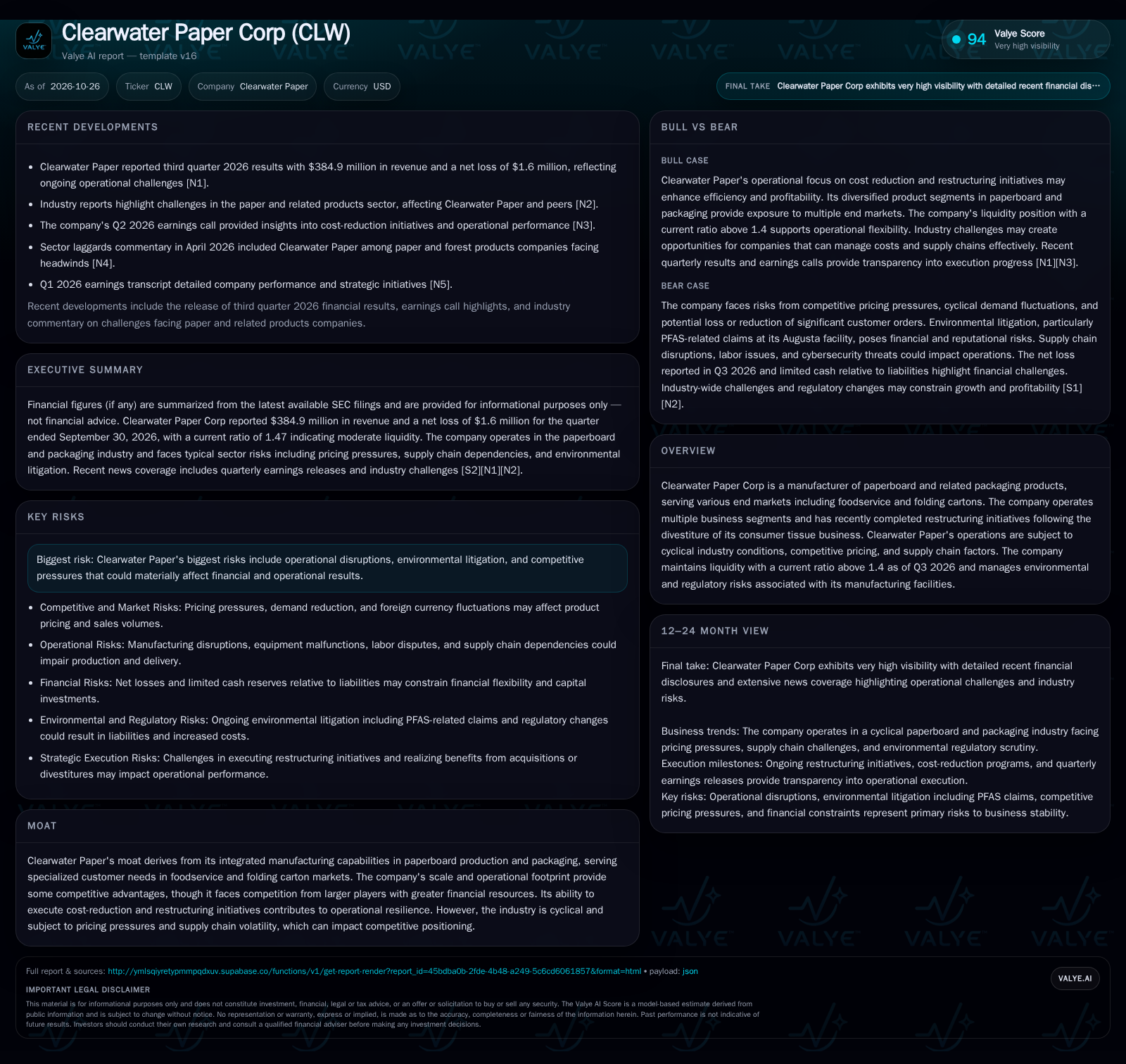
Clearwater Paper reported a Q3 2026 net loss of $1.6 million on $384.9 million in revenue, with cash reserves remaining modest.
Clearwater Paper reported a Q3 2026 net loss of $1.6 million on $384.9 million in revenue, with cash reserves remaining modest. The company has completed major restructuring, exiting consumer tissue to concentrate on foodservice and packaging paperboard. The critical question: can cost reductions and a more focused product mix deliver sustainable profitability amid cyclical, margin-squeezed market conditions? [S2] [S1]
Clearwater Paper Corp’s transformation—marked by the sale of its consumer tissue business and a sharpened focus on paperboard and packaging—has reset its strategic foundation, but not its risk profile. Despite cost-reduction efforts and operational streamlining, the company reported a net loss for Q3 2026 and continues to operate with reported cash balance relative to its liabilities. As environmental litigation and cyclical industry headwinds persist, Clearwater’s ability to translate efficiency gains and a specialty portfolio into sustained profitability remains the central uncertainty.
Recent Losses and Restructuring Define Clearwater’s Strategic Crossroads
Clearwater Paper reported Q3 2026 revenue of $384.9 million and a net loss of $1.6 million, with basic and diluted EPS of -$0.10 per share [S2]. This loss follows the company’s completion of a major restructuring, notably the divestiture of its consumer tissue business. The company now concentrates on paperboard and packaging, with segments serving foodservice, folding carton, and distribution channels [S2]. The company reported cash and liquidity metrics for the period; these figures do not by themselves establish operating runway, investment capacity, financial flexibility, or financing capacity. [S2] Environmental litigation, particularly PFAS-related claims at the Augusta, Georgia facility, continues to pose potential financial and reputational risk [S1]. These facts together set the immediate context: a company refocused but still exposed to cyclical demand, tight margins, and legal uncertainty.
Paperboard Profitability Hinges on Volume, Mix, and Cost Discipline
Clearwater Paper’s core business economics now revolve around converting wood pulp into value-added paperboard products for packaging and foodservice. Revenue is driven by a combination of volume (tons shipped), product mix (standard vs. specialty grades), and pricing, which is highly sensitive to both input costs (pulp, energy, logistics) and end-market demand. Fixed costs are significant, given capital-intensive mills and distribution infrastructure, creating high operating leverage: small changes in utilization or pricing can swing profitability sharply.
The company’s cost-reduction and operational efficiency initiatives are critical levers, especially as its scale is smaller than the largest industry competitors. After the divestiture, Clearwater is less diversified and more exposed to cyclical swings in paperboard demand and pricing. Realizing margin improvement depends on sustaining high capacity utilization, controlling input costs, and maintaining favorable product mix toward higher-margin specialty grades. However, the absence of a large recurring consumer tissue revenue base also means less buffer against market downturns.
In this context, any operational disruption or legal settlement could quickly strain liquidity unless offset by improved cash flows from operations.
Specialization Offers Some Insulation, but Scale and Substitution Risks Persist
Clearwater Paper’s competitive position is defined by its integrated manufacturing capabilities and focus on specialized paperboard products for foodservice and folding carton markets. This specialty orientation can provide some insulation from pure commodity price swings, as customers in these segments may value quality, reliability, and regulatory compliance—especially for food-contact materials.
However, the company faces competition from larger, better-capitalized paper and packaging conglomerates that benefit from greater operational scale, broader product portfolios, and more robust supply chains. These peers can often weather downturns more easily, invest more aggressively in innovation, and negotiate better terms with suppliers and large customers. Substitution risk is also present: packaging buyers may shift to alternative materials (plastic, metal, or bio-based substrates) if relative pricing or regulatory incentives change.
Switching costs for Clearwater’s customers are moderate; while relationships and technical requirements in foodservice and specialty segments create some stickiness, they are not insurmountable. The question is whether Clearwater can maintain sufficient differentiation, cost discipline, and service levels to retain share and defend margins in a consolidating and price-sensitive industry.
Operational Discipline and Specialty Focus Drive Margin Recovery
In a favorable scenario, Clearwater’s restructuring pays off: cost-reduction programs successfully lower manufacturing and SG&A expenses, while a tighter focus on foodservice and specialty packaging enables a shift to higher-margin products. Industry conditions stabilize, allowing for modest pricing power in niche segments where quality and regulatory compliance are valued. Supply chain improvements reduce input cost volatility, and the company’s mills run at high utilization.
Confirmation of this scenario would include a return to sustained quarterly profitability, rising gross margins (especially in specialty product lines), and stable or growing sales in end markets less exposed to commoditization. Evidence of successful litigation resolution or manageable environmental liabilities would also reduce balance-sheet overhang.
Efficiency Gains Offset Some Headwinds, but Margin Pressure Remains
The most plausible path for Clearwater Paper is one of incremental improvement but continued vulnerability. Cost-reduction and operational efficiency efforts help limit losses or deliver thin profits, but persistent pricing pressure and cyclical demand swings in the paperboard sector keep margins under pressure. Environmental litigation remains unresolved, requiring ongoing accruals or reserves, while low cash levels constrain strategic flexibility.
The company is able to service its obligations and maintain operations, but lacks the financial strength to invest significantly in growth, innovation, or large-scale modernization. Product mix may gradually tilt toward specialty grades, but any volume gains are offset by competitive responses and limited pricing power. Confirmation would come from a pattern of breakeven or slightly profitable quarters, stable revenue, and a slow but steady improvement in operating metrics—without major shocks or breakthroughs.
Legal, Operational, or Demand Shocks Trigger Liquidity Strain
The adverse scenario emerges if Clearwater Paper faces a material legal settlement or adverse judgment in the PFAS litigation, or if a significant operational disruption (such as a mill outage or labor dispute) leads to unexpected cash outflows. A sharp cyclical downturn or loss of a major customer could further depress volumes and pricing, rapidly eroding margins and cash flow.
Evidence for this downside would include a sudden spike in legal reserves or environmental liabilities, a negative swing in working capital, or missed payments on obligations. Deterioration in supplier or customer relationships, or a significant drop in capacity utilization, would also signal mounting risk.
Milestones That Will Determine Clearwater Paper’s Post-Restructuring Trajectory
Quarterly trend in gross and operating margins, particularly in specialty paperboard segments, to assess the impact of cost-reduction and mix initiatives (if disclosed).
Resolution timeline and financial outcome of PFAS-related environmental litigation at the Augusta facility.
Changes in cash and equivalents, net working capital, and short-term debt—especially following any operational or legal developments.
Volume and pricing trends in core foodservice and folding carton markets, given their sensitivity to cyclical demand and substitution (if disclosed).
Capacity utilization rates at major mills, since fixed-cost absorption is critical for margin improvement (if disclosed).
Any new customer wins, contract extensions, or losses in specialty packaging segments, which could indicate share shifts or pricing power.
Updates on capital expenditure plans and compliance investments, as these affect both cost structure and long-term viability.
Management commentary on progress with operational efficiency initiatives and any changes to strategic focus.
Disclaimer: This is research-only, informational analysis and not investment advice. It may include AI-generated interpretation and general industry context. Always verify important details using primary sources.

Comments