
Hycroft Mining: Cash-Rich, Resource-Heavy, but Still Waiting for a Commercial Breakthrough
Despite owning a large Nevada gold-silver asset and recently updating its technical resource assessment, Hycroft Mining remains an exploration-stage company with no current revenues, a high cash balance, and an uncertain path to commercial production. The company’s future hinges on converting its resource base into economically viable reserves and overcoming execution, regulatory, and market risks.
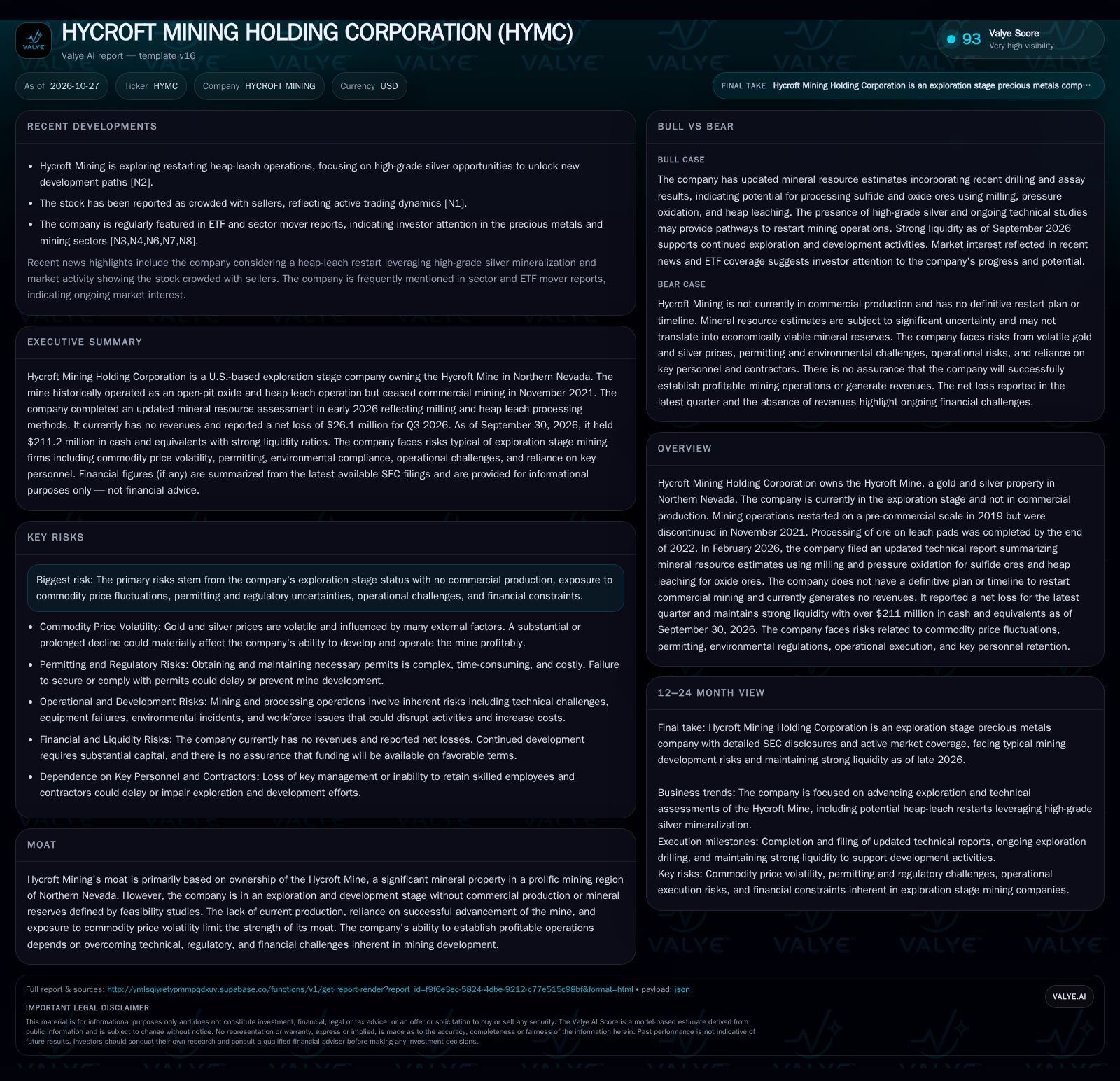
Hycroft Mining holds significant gold and silver resources in Nevada and maintains over $211 million in cash, but with operations halted since 2021 and no defined restart plan, the company’s value remains speculative and levered to technical progress, permitting, and commodity prices. The updated 2026 technical report refines its resource picture, yet a lack of feasibility study or commercial clarity keeps the investment case binary and high risk.
Hycroft Mining Holding Corporation sits at a pivotal but precarious juncture: flush with cash and controlling a large, well-located gold and silver property in Nevada, but without commercial operations or a clear timeline to unlock value. The company’s recently updated technical report refines its mineral resource estimates and explores new processing possibilities, including renewed interest in high-grade silver via heap leaching.
Where Hycroft Stands: High Liquidity, No Revenue, and a New Technical Report
As of September 30, 2026, Hycroft Mining reported $211.2 million in cash and equivalents against current liabilities of $16.0 million, resulting in a current ratio of over 13 [S2]. The company reported cash and liquidity metrics for the period; these figures do not by themselves establish operating runway, investment capacity, financial flexibility, or financing capacity. However, Hycroft is not generating any revenue from gold or silver sales and remains in the exploration stage, having halted mining operations in November 2021 and completed leach pad processing by the end of 2022 [S1] [S2]. For Q3 2026, the company posted a net loss of $26.1 million [S2].
A key recent milestone is the filing of the 2026 Initial Assessment and Technical Report Summary (TRS), which updates mineral resource estimates and considers both milling/pressure oxidation for sulfide ores and heap leaching for oxide ores [S1]. This new TRS replaces the prior 2023 assessment and incorporates additional drilling and assay data through early 2025. However, there is still no feasibility study or definitive plan and timeline for restarting commercial mining, leaving the company’s future course unresolved [S1].
Recent news coverage highlights both investor interest and skepticism: the company is reportedly exploring a heap-leach restart focused on high-grade silver, but the stock is described as 'crowded with sellers,' reflecting uncertainty about near-term catalysts [N1] [N2].
How Hycroft Could Make Money—and the Economic Hurdles Ahead
Hycroft’s business model, if commercialized, would center on extracting gold and silver from its Nevada property using a mix of processing techniques: heap leaching for oxide and some transitional ores, and milling with pressure oxidation (POX) for sulfide and remaining transitional ores [S1]. In principle, heap leaching is capital-light and scalable but often yields lower recoveries, while POX can unlock value from refractory ore at higher upfront cost and technical complexity.
At present, Hycroft’s economics are theoretical. There is no revenue, and all spending is directed toward exploration, technical assessment, regulatory compliance, and overhead. If and when commercial operations resume, the economics will depend on ore grades, recovery rates, throughput, commodity prices, and operating costs—including energy, labor, and reagents. The capital intensity for restarting or expanding operations could be significant, especially if the company pursues POX or large-scale milling.
Fixed costs in care-and-maintenance mode are relatively low, but any move towards development or construction would sharply increase both fixed and variable expenses. Without a feasibility study, the ultimate capital requirements, breakeven gold/silver prices, and project returns are speculative. The absence of revenue also means ongoing net losses and cash burn, making Hycroft’s long-term economics highly sensitive to both technical progress and external market conditions.
Asset Quality, Location, and the Realities of the Junior Mining Landscape
Hycroft’s principal competitive asset is its ownership of a large, historically productive gold and silver property in a mining-friendly region of Northern Nevada [S1]. This location confers advantages in terms of infrastructure, permitting familiarity, and access to skilled labor compared to more remote or geopolitically risky jurisdictions.
However, Hycroft faces several structural disadvantages typical of junior and development-stage miners. Without defined reserves or a feasibility study, its resources remain unproven from an economic standpoint. The market for gold and silver mining projects is crowded, with numerous exploration and development companies competing for capital, technical talent, and investor attention. Larger, better-capitalized producers can often acquire distressed or stranded assets if juniors fail to advance projects independently.
Potential substitutes for investor capital include royalty/streaming vehicles, established gold producers, and diversified miners with producing assets and proven cash flow. Hycroft’s ability to attract partners or buyers will depend on the quality and scale of its resource base, technical progress, and the perceived likelihood of successful, profitable development. Absent tangible progress toward de-risking, its competitive position remains asset-based rather than operational or cost-driven.
What Success Could Look Like: Technical De-Risking and a High-Grade Silver Play
A favorable scenario for Hycroft would unfold if the company leverages its cash reserves to advance technical studies and exploration, culminating in a positive feasibility study that demonstrates robust project economics at prevailing or higher gold and silver prices. The recent focus on heap-leach processing of high-grade silver zones could provide a lower-capital, faster-to-market opportunity compared to full-scale POX development [N2]. If metallurgical test work confirms high recoveries and low costs for select zones, and permitting hurdles are manageable, Hycroft could define a phased restart targeting early cash flow.
Such progress would likely be accompanied by clear disclosure of resource-to-reserve conversion, a detailed development plan, and potentially the securing of financing or strategic partnerships. Evidence confirming this scenario would include: the announcement of a positive feasibility study, published reserve estimates, permitting milestones, and concrete restart timelines. Early offtake agreements or joint ventures with established mining companies would further validate the project’s commercial viability.
Most Plausible Trajectory: Extended Technical Work, Slow-Drip Progress, and Ongoing Cash Burn
While the updated 2026 TRS refines the company’s understanding of its resource base, the absence of a feasibility study or commercial restart plan suggests that significant de-risking remains.
This scenario likely features continued net losses and gradual cash burn, with periodic news flow tied to technical milestones or exploration results. The stock may remain highly volatile and sensitive to commodity prices and speculative sentiment, reflecting its binary asset-optional nature. Confirmation of this base case would be the absence of announced development financing, feasibility results, or concrete restart plans over the next 12–24 months.
What Could Go Wrong: Cash Erosion, Technical Disappointments, and Resource Downgrades
In a negative outcome, Hycroft’s technical and economic studies could reveal that large portions of its resource base are uneconomic at reasonable gold and silver prices, or that permitting and regulatory obstacles are more formidable than anticipated. Metallurgical testing might show poor recoveries or high processing costs, undermining the case for a profitable restart.
Meanwhile, ongoing cash burn without tangible progress could eventually erode the current liquidity cushion, forcing the company to seek dilutive capital raises or strategic asset sales at unfavorable terms. If commodity prices weaken or investor appetite for junior miners diminishes, Hycroft’s ability to finance future development could be severely constrained. Evidence confirming this scenario would include negative technical disclosures, resource downgrades, failed permitting attempts, or a sharply declining cash balance without offsetting progress.
Milestones That Will Determine Whether Hycroft’s Optionality Becomes Real Value
The release of a full feasibility study, including detailed capital and operating cost estimates, recovery rates, and projected returns, would be a critical inflection point.
Updates on resource-to-reserve conversion rates, if disclosed, would provide tangible evidence of economic de-risking.
Progress with permitting and regulatory approvals—such as receipt of major environmental permits—would signal the transition from technical assessment to project development.
Quarterly cash burn and liquidity trends should be monitored to gauge how much runway remains before external funding might be required.
Announcements of offtake agreements, joint ventures, or strategic partnerships with established mining companies would help validate the project’s commercial appeal.
Results from ongoing drilling and metallurgical testing, particularly regarding the viability of high-grade silver heap leaching, would clarify near-term restart options.
Any changes in key personnel or contractor relationships could impact execution and should be tracked for potential disruption.
Disclosure of a definitive restart timeline, mine plan, or board-approved development decision would mark a shift from optionality to execution risk.
Disclaimer: This is research-only, informational analysis and not investment advice. It may include AI-generated interpretation and general industry context. Always verify important details using primary sources.

Comments