
Ares Capital Corp: Scale, Transaction Uncertainty, and the Dynamics of Middle-Market Lending
The company's ability to maintain earnings and manage regulatory, market, and integration challenges will define its next phase.
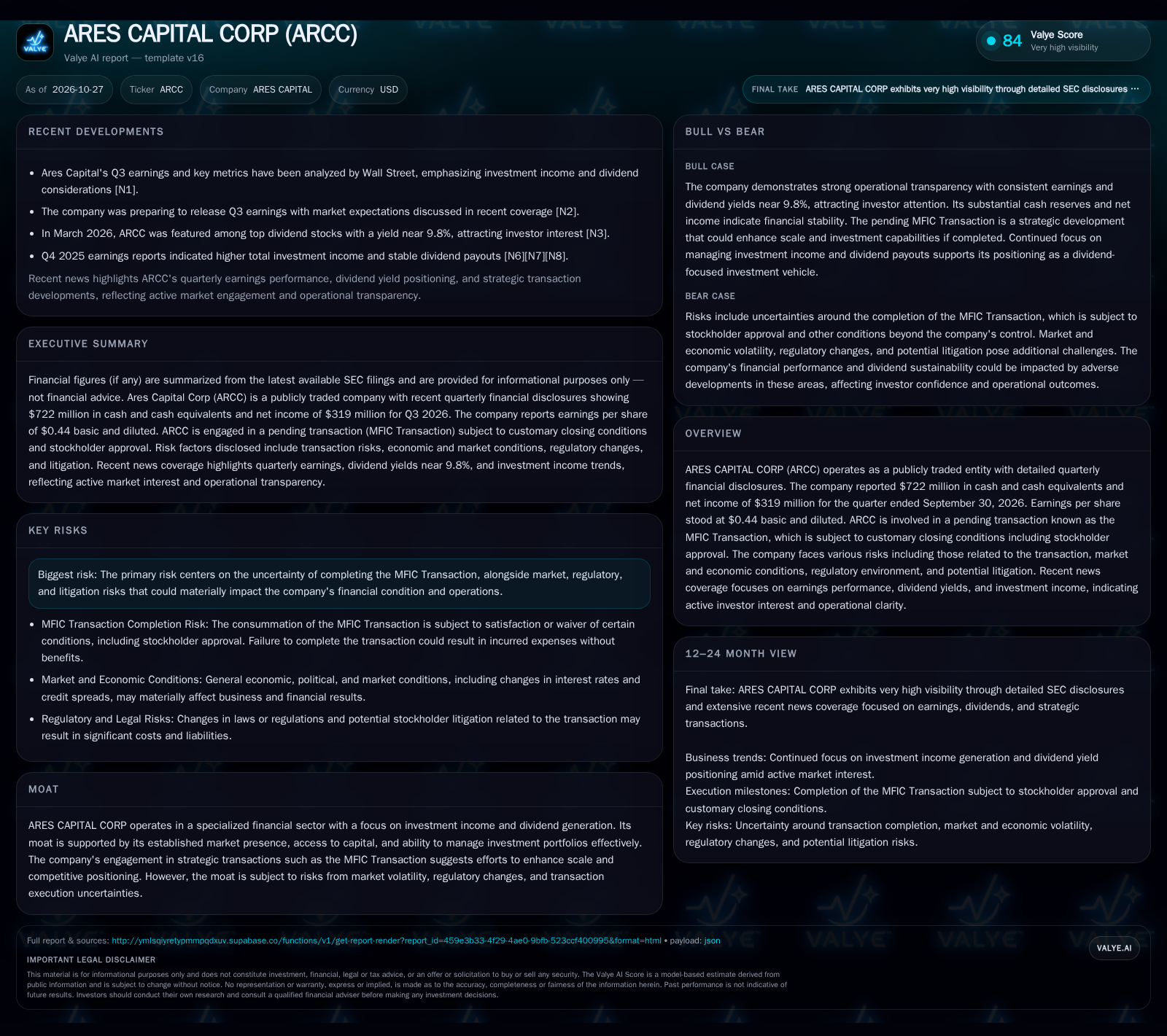
Ares Capital Corp reported $319 million in net income and $722 million in cash for Q3 2026, reflecting ongoing profitability and liquidity. The company’s pending MFIC Transaction could enhance scale but is subject to stockholder approval and closing risks. Ongoing exposure to market volatility, interest rate shifts, and regulatory changes remains material. The key question is whether ARCC can successfully complete the transaction and leverage its scale amid these evolving risks. [S2]
Ares Capital Corp (ARCC) continues to demonstrate strong financial performance, with $319 million in net income and $722 million in cash on hand for Q3 2026. However, the company stands at a strategic crossroads, with the outcome of the pending MFIC Transaction likely to reshape its scale, investment reach, and risk profile. As ARCC navigates regulatory, market, and execution risks, its capacity to sustain earnings and adapt to industry shifts will be critical in determining whether it can cement its leadership in the competitive business development company (BDC) landscape. [S2]
Recent Results and Strategic Transaction Define the Near-Term Landscape
Ares Capital Corp reported net income of $319 million and basic/diluted EPS of $0.44 for the quarter ending September 30, 2026, underscoring ongoing profitability. The company reported cash and liquidity metrics for the period; these figures do not by themselves establish operating runway, investment capacity, financial flexibility, or financing capacity. [S2] However, the most significant near-term event is the pending MFIC Transaction, which is subject to customary closing conditions, including stockholder approval. The outcome of this transaction is likely to determine ARCC’s future scale, investment capacity, and cost structure. Disclosed risks tied to the transaction, as well as broader market, regulatory, and litigation exposures, highlight the degree of uncertainty facing the business in the coming quarters [S2].
How Ares Capital Makes Money: Middle-Market Lending, Spread Management, and Scale
Ares Capital’s core business is providing debt and equity capital to middle-market companies, generating revenue primarily through interest income, origination fees, and equity investment returns. The company's economics are driven by the spread between its cost of capital and the yields on its investment portfolio. Fixed costs—such as management fees, regulatory compliance, and public company expenses—are relatively high, but the platform benefits from significant operating leverage as assets under management (AUM) grow.
Scale is critical in the BDC sector: larger portfolios enable better diversification, more competitive debt financing, and improved access to deal flow. The MFIC Transaction, if completed, could further enhance ARCC’s scale, potentially lowering marginal costs and increasing investment flexibility. However, funding needs are ongoing, as BDCs must distribute a large portion of earnings to maintain tax-advantaged status, necessitating recurring access to capital markets for growth and refinancing. Profitability is sensitive to credit quality, non-accrual rates, and interest rate environments, as well as the ability to source attractive deals without overextending on risk.
The interplay between interest rate environments and credit spreads is particularly critical for ARCC’s profitability. In rising rate scenarios, the company’s floating-rate loans can benefit from higher yields, but this advantage may be offset if funding costs increase disproportionately or if borrower credit quality deteriorates under tighter financial conditions. Conversely, in declining rate environments, spread compression can pressure net interest margins, making fee income and equity returns more important components of total revenue. Effective risk management requires continuous calibration of portfolio composition, balancing higher-yielding but riskier credits against safer assets to maintain stable earnings across cycles.
Another dimension influencing ARCC’s economics is the regulatory framework governing BDCs, which imposes distribution requirements and leverage limits that constrain capital structure flexibility. The necessity to distribute most earnings to maintain tax-advantaged status restricts retained earnings growth, compelling frequent capital raises. This dynamic can increase vulnerability to capital market conditions, especially during periods of volatility or investor risk aversion. Therefore, the company’s ability to access diverse funding sources and maintain investor confidence is integral to sustaining growth and managing refinancing risks. The pending transaction’s impact on capital structure and regulatory compliance will be a key factor in determining future operational agility.
Competitive Pressures and Moat Dynamics in the BDC Ecosystem
ARCC operates in a crowded field of business development companies and private credit managers, competing against both large diversified BDCs and smaller niche lenders. Its primary sources of advantage are scale, brand credibility, and origination network reach. Larger BDCs like ARCC often secure better deal terms, lower funding costs, and can offer more comprehensive solutions to borrowers.
However, these advantages are not absolute. Private credit funds, direct lending platforms, and even non-bank lenders have increased competition, compressing spreads and raising the bar for underwriting discipline. Regulatory changes or shifts in investor risk appetite could erode competitive advantages by altering funding costs or investment flexibility. The MFIC Transaction, if executed smoothly, could temporarily strengthen ARCC’s moat by increasing scale and portfolio diversity, but integration risks and market cyclicality remain persistent counterforces.
The competitive landscape also evolves with technological advancements and data analytics adoption in underwriting and portfolio monitoring. Firms that effectively leverage technology can enhance credit selection, reduce operational costs, and respond more rapidly to market changes. ARCC’s scale may provide resources to invest in such capabilities, potentially creating a competitive edge if integrated well. However, smaller, more nimble competitors might exploit specialized data or innovative structures to capture niche segments, challenging larger BDCs’ dominance. Hence, sustained investment in technology and talent is necessary for ARCC to preserve its moat amid intensifying competition and shifting borrower preferences.
Moreover, the increasing presence of non-traditional lenders, including private equity-backed direct lending platforms and specialty finance companies, introduces complexity in borrower relationships. These competitors may offer more flexible terms or tailored solutions that appeal to middle-market companies seeking speed and customization. ARCC’s ability to differentiate through comprehensive service offerings, credit expertise, and capital availability will be tested as borrowers weigh cost against convenience and strategic partnership value. The MFIC Transaction’s potential to broaden product capabilities and geographic reach could help ARCC counteract these pressures, but integration execution will be critical to realizing these competitive benefits.
If the MFIC Transaction Closes Smoothly, ARCC Could Accelerate Scale Benefits
The most favorable outcome involves the successful and timely closure of the MFIC Transaction, bringing incremental assets and potential synergies. This could drive down per-unit operating costs, expand the investment pipeline, and improve portfolio diversification. If credit quality remains stable and the company leverages its larger scale to negotiate better funding rates, ARCC could see enhanced earnings power and greater resilience to market shocks.
Evidence confirming this scenario would include swift stockholder approval, timely transaction closing, minimal integration disruptions, and early signs of accretive portfolio performance.
Most Likely Path: Steady Earnings with Transaction-Related Volatility
The most plausible outcome is that ARCC maintains its core profitability and liquidity profile while navigating the uncertainties of the MFIC Transaction. The deal may close, but possibly with delays or integration challenges that temporarily weigh on margins or distract management attention. Meanwhile, market volatility, interest rate movements, and competitive pressures could lead to modest spread compression or higher credit costs, but not severe enough to materially disrupt overall earnings.
Delays or incremental costs related to the MFIC Transaction—without jeopardizing the deal itself—would also be consistent with this base case.
Deal Failure or Credit Deterioration Could Reset Expectations
In a negative scenario, the MFIC Transaction fails to close due to stockholder opposition, regulatory intervention, or other closing hurdles. This would not only result in sunk costs and lost strategic opportunity but could also trigger negative investor sentiment and pressure on ARCC’s stock price. Simultaneously, if market conditions deteriorate—such as a spike in borrower defaults or a sharp rise in funding costs—ARCC’s earnings and dividend could come under stress.
Evidence supporting this scenario would include public disclosures of failed transaction negotiations, a spike in non-accruals, declining net investment income, or dividend cuts. Regulatory or legal setbacks, or a marked deterioration in credit spreads, would further validate downside risks.
What Will Shape Ares Capital’s Strategic Trajectory in the Coming Year?
Progress toward stockholder approval and closing of the MFIC Transaction—timelines, vote outcomes, and any regulatory hurdles.
Integration milestones and synergy realization, if the transaction closes—updates on cost savings, portfolio harmonization, and realized returns.
Quarterly net investment income and earnings per share trends, especially in relation to dividend coverage and payout sustainability.
Trends in portfolio credit quality—non-accrual rates, realized/unrealized losses, and sector concentrations (if disclosed).
Changes in funding costs and access to debt/equity capital markets, given interest rate volatility and investor sentiment.
Regulatory or legal developments tied to the transaction or broader BDC industry oversight.
Competitive landscape shifts: evidence of increased competition from private credit, direct lending platforms, or non-bank lenders.
Management commentary on market conditions, deal pipeline, and portfolio risk appetite in earnings calls or filings (if disclosed).
Disclaimer: This is research-only, informational analysis and not investment advice. It may include AI-generated interpretation and general industry context. Always verify important details using primary sources.

Comments