
JAKKS Pacific: Licensing Leverage, Retail Concentration, and the Complexities of Toy Industry Scale
JAKKS Pacific’s recent earnings beat and dividend declaration underscore profitability and operational stability, but the company’s heavy licensing dependence and retailer concentration pose structural risks. As international sales expand and evergreen IP remains central, the company’s ability to manage supply chain exposure and navigate evolving consumer preferences will determine whether it can sustain growth and margin resilience.
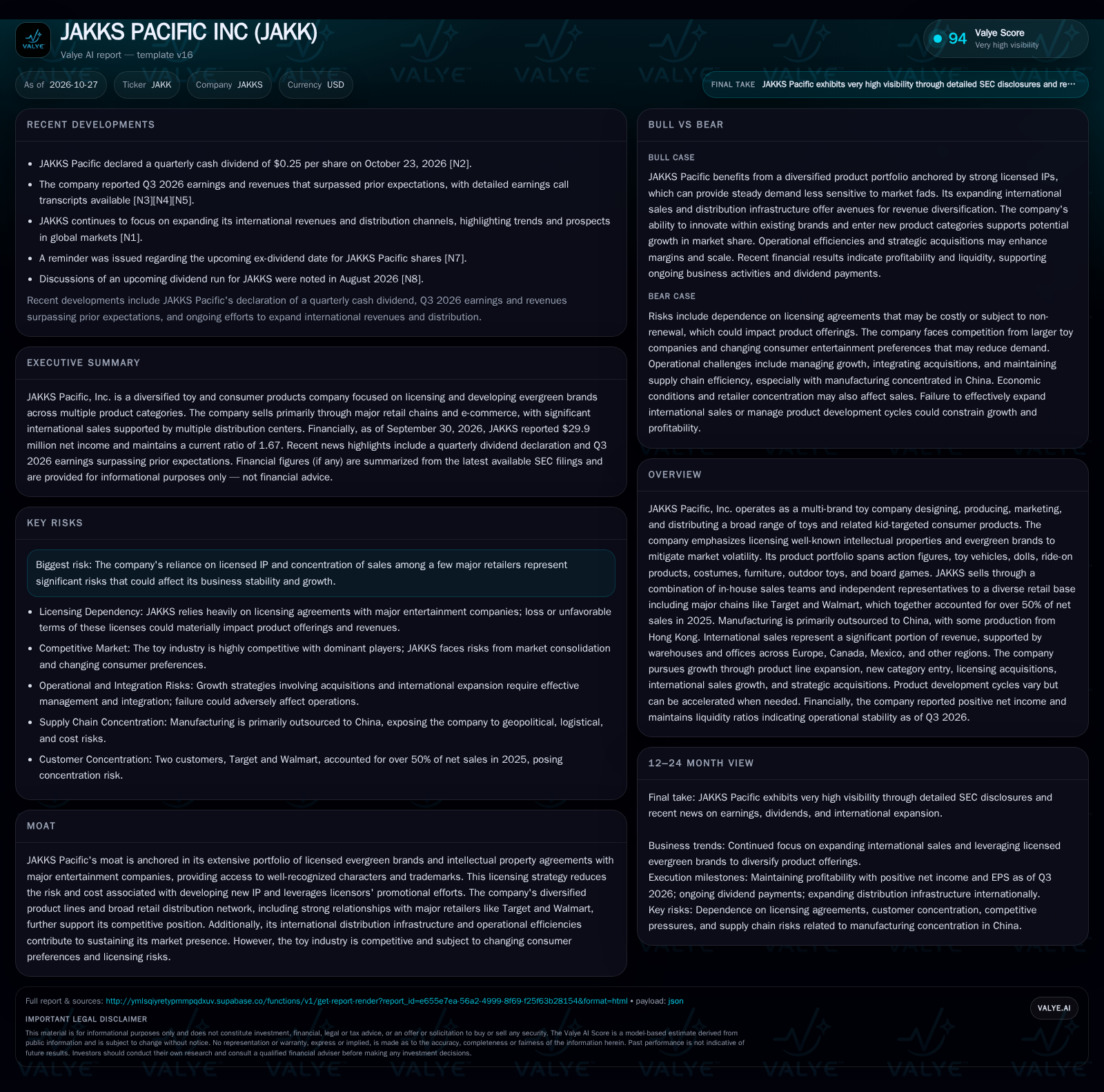
JAKKS Pacific posted Q3 2026 earnings and revenues above expectations, declared a $0.25 quarterly dividend, and remains profitable with a current ratio of 1.67. The company’s model relies on licensing major entertainment IPs and selling through large retailers—Target and Walmart made up over 50% of 2025 net sales. While international sales and distribution have grown, risks around licensing, customer concentration, and supply chain dependence remain central to the investment thesis. [S1] [S2] [N2] [N3] [N4] [N5] [N1]
The cited source reports dividend-related activity; that disclosure alone does not establish dividend-policy continuity, management confidence, or a material constraint on capital flexibility. Yet beneath these headline positives, the company’s business model remains heavily exposed to risks around licensing dependence, customer concentration, and supply chain geography. As JAKKS seeks to grow international sales and deepen its reliance on evergreen brands, its ability to adapt to evolving consumer trends and manage operational exposures will define its next phase of value creation.
Recent Earnings, Dividend Action, and Evolving International Footprint
JAKKS Pacific reported net income of $29.9 million for the period ending September 30, 2026, with basic and diluted EPS of $2.61 and $2.48, respectively [S2]. Liquidity metrics as of Q3 2026 included $43.999 million in cash and equivalents, a current ratio of 1.67, and a cash ratio of 0.2 [S2]. The company declared a $0.25 per share quarterly dividend on October 23, 2026 [N2]. Importantly, Q3 2026 earnings and revenues surpassed earlier expectations, suggesting operational momentum [N3] [N4] [N5]. International sales reached $154.1 million in 2025—27% of net sales—underpinned by a growing network of overseas warehouses and distribution points [S1] [N1]. While these developments highlight profitability and expanding global reach, they also raise questions about sustainability given the company’s structural dependencies.
How Licensing and Retail Dynamics Shape JAKKS’ Economic Engine
JAKKS Pacific’s business model centers on acquiring and licensing well-known intellectual property, then designing and marketing a broad array of toys and kids’ consumer products under those brands [S1]. This approach allows for rapid product launches tied to major entertainment releases and reduces the risk and capital outlay associated with creating new IP. However, licensing fees are typically significant, and terms can be volatile—royalty rates and minimum guarantees often compress margins, especially if a licensed property underperforms at retail.
Revenue is largely driven by volume sales through major retail partners—Target and Walmart alone contributed over 50% of 2025 net sales [S1]. This concentration amplifies both opportunity and risk: large orders and shelf presence can drive scale, but bargaining power tilts toward the retailers, potentially pressuring pricing and terms. Product development cycles range from 3 to 18 months, allowing JAKKS to respond to market trends, but also exposing it to inventory and forecasting risk if consumer tastes shift unexpectedly [S1].
Manufacturing is outsourced, primarily to China, which provides cost flexibility but introduces logistics, currency, and geopolitical risk [S1]. Gross margins are heavily influenced by licensing mix (proprietary vs. licensed), product category, and FX swings on international sales. Fixed costs are relatively modest compared to larger vertically integrated peers, but the model requires working capital to support seasonal inventory builds and global distribution. Operating leverage can be positive in strong sales years but will magnify downside in periods of weak demand or supply chain disruption.
Where JAKKS Stands in a Crowded Toy Industry Landscape
JAKKS competes with larger branded toy companies (such as Hasbro and Mattel), private-label and value players, and a growing number of digital-native entertainment brands. Its primary advantage lies in its ability to secure licenses for evergreen, globally recognized IP, giving it access to established fan bases and the promotional muscle of major entertainment conglomerates [S1]. This reduces the risk of product flops tied to short-lived fads and can support more predictable demand.
However, access to top-tier IP is not exclusive—licensors often partner with multiple manufacturers, and bidding for new licenses can be costly. JAKKS faces counterforces from retailer private labels, digital entertainment substituting for physical play, and the ability of larger peers to outspend on marketing and shelf space. The company’s broad product portfolio and flexible development cycles allow for opportunistic category entry, but scale disadvantages could limit its ability to absorb licensing cost increases or withstand periods of weak sell-through.
Internationally, JAKKS’ growing distribution footprint is a positive differentiator, but it also faces entrenched local competitors and variable regulatory regimes. The company’s ability to build durable retailer and licensor relationships, while managing cost structure and inventory risk, will determine whether it can maintain or grow share in a consolidating market.
Margin Expansion and Global Diversification Drive Durable Growth
The favorable scenario for JAKKS centers on continued expansion of its international business and deeper penetration of evergreen licensed brands across new product categories. If JAKKS can consistently secure attractive IP licenses at reasonable terms, leverage its overseas distribution infrastructure, and maintain strong relationships with mass retailers, it could grow revenue while expanding gross and operating margins.
Confirmation of this scenario would require evidence of growing international sales as a percentage of total revenue, continued EPS growth, and signs that new product launches (both proprietary and licensed) are gaining shelf space and consumer traction. Additional signals would include renewal or expansion of major licensing agreements, successful entry into adjacent product categories, and stable or improving gross margin despite cost pressures.
Sustained Profitability Amid Licensing and Retailer Dependency
The most plausible path for JAKKS is one of steady, but not runaway, growth—anchored by a stable base of evergreen licensed products and continued reliance on large retail partners. International sales likely continue to rise as a share of the mix, but the overall business remains exposed to the renewal terms of key licenses and the purchasing decisions of Target and Walmart.
Evidence of solid inventory management and successful product refreshes would further support the base case. The company may experience periodic margin pressure due to licensing fee renegotiations or supply chain cost increases, but avoids major disruptions. The thesis would be challenged by a significant loss of a major license, a retailer reducing shelf space, or a marked deterioration in supply chain reliability.
Licensing Shock or Retailer Retrenchment Triggers Earnings Volatility
The adverse scenario for JAKKS involves one or more structural shocks: non-renewal or unfavorable renegotiation of a major licensing agreement, or a key retailer like Target or Walmart materially reducing orders or shelf space. Either event would likely force rapid product portfolio adjustments, margin compression, and potential inventory write-downs.
Other plausible downside triggers include significant supply chain disruption (e.g., tariffs, logistics bottlenecks, or political instability in China), or a sharp shift in consumer preferences away from licensed toys. Confirmation of the downside would be seen in sudden revenue declines, negative EPS, cuts to or suspension of the dividend, and inventory build-ups. Early warning signs would include public disclosure of lost licenses, retailer shelf space reductions, or a spike in cost of goods sold tied to supply chain issues.
What Will Determine JAKKS Pacific’s Next Phase of Value Creation?
The proportion of international sales to total revenue—continued growth here would support the global diversification thesis; stagnation would signal limits to overseas expansion.
Renewal and expansion of key licensing agreements, especially with top entertainment IP owners—any non-renewal or adverse terms would directly threaten product pipeline and margins.
Changes in shelf space or order volume from Target and Walmart—a reduction would materially impact revenue and bargaining power.
Gross margin direction and drivers—improving margins would suggest better product mix or cost control; compression could indicate licensing or supply chain stress.
Inventory turnover and working capital trends—deterioration may foreshadow demand missteps or retailer destocking.
Dividend continuity and payout ratio—suspension or reduction could be an early signal of cash flow stress.
Supply chain resilience, particularly regarding manufacturing in China—any shift to alternative geographies or major disruption would test operational flexibility.
If disclosed, the share of proprietary versus licensed product sales—growing proprietary mix could reduce licensing risk, while increasing licensed mix could signal higher dependency.
Disclaimer: This is research-only, informational analysis and not investment advice. It may include AI-generated interpretation and general industry context. Always verify important details using primary sources.

Comments