
Rexford Industrial Realty: Infill Focus, Repositioning Leverage, and the Dynamics of Southern California Industrial Real Estate
Rexford Industrial Realty commands a dominant presence in Southern California’s supply-constrained infill industrial market, leveraging a vertically integrated platform and value-add strategy. The company’s capital recycling, tenant diversity, and asset management expertise are counterbalanced by geographic concentration, execution risk, and reliance on external funding for continued growth.
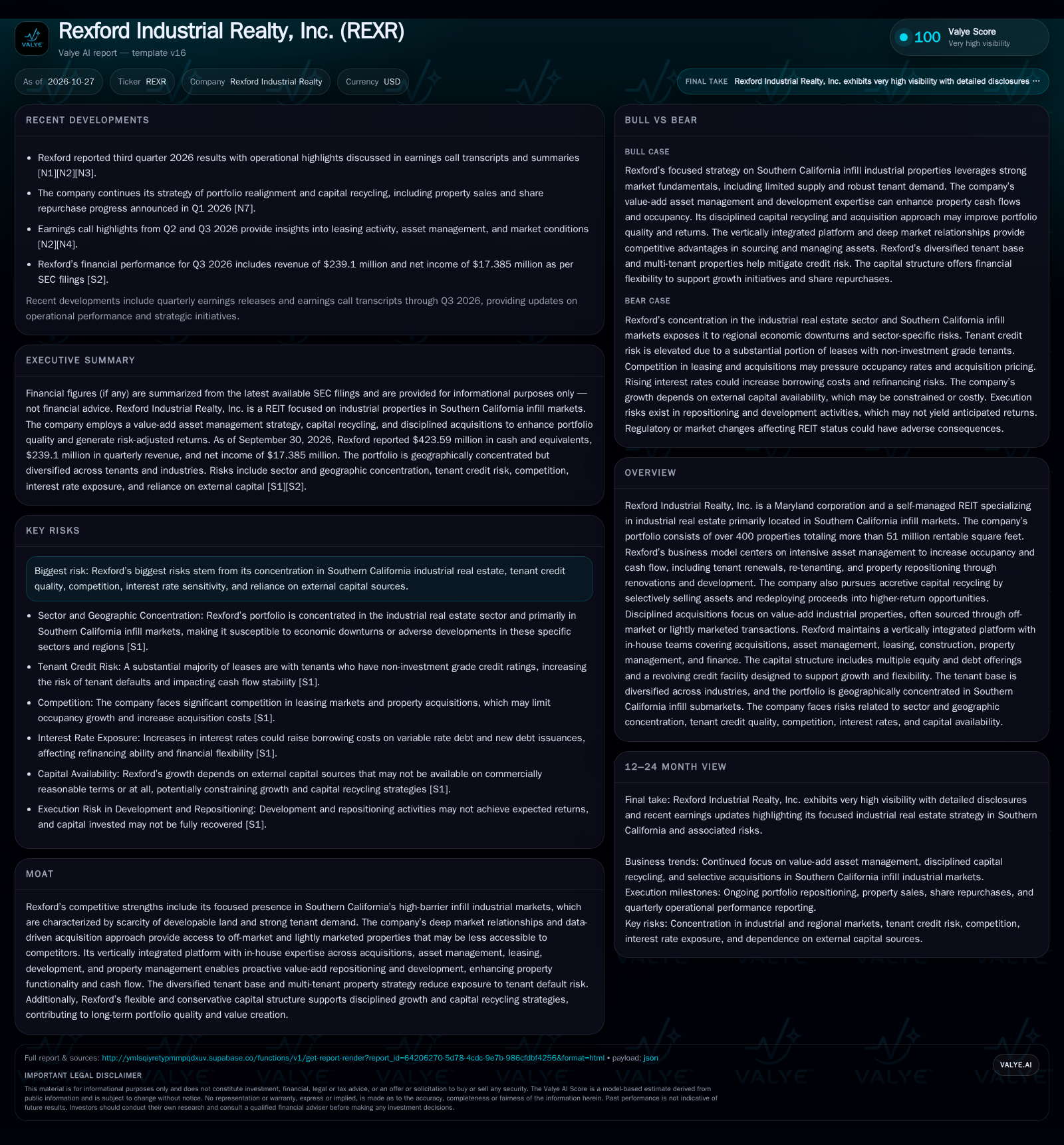
Rexford Industrial Realty’s distinct strategy in Southern California infill industrial markets centers on value-add repositioning, disciplined acquisitions, and capital recycling. While the company’s Q3 2026 financials reflect continued revenue growth and a flexible balance sheet, the business remains exposed to regional and sector concentration, tenant credit risk, and the need for sustained access to external capital. The key question is whether Rexford can maintain outperformance as competition for infill assets intensifies and interest rates remain elevated.
Rexford Industrial Realty stands out among industrial REITs for its laser focus on Southern California’s infill submarkets—arguably some of the most supply-constrained and strategically valuable industrial real estate in the U.S. The company’s vertically integrated model, with in-house expertise spanning acquisitions, asset management, leasing, and development, supports a value-add approach that seeks to unlock latent property value through repositioning and selective redeployment of capital. Recent financial results underscore continued portfolio expansion and operational execution, but the investment thesis hinges on Rexford’s ability to sustain superior returns amid intensifying competition, elevated interest rates, and the inherent risks of geographic and sector concentration.
Recent Operational and Financial Highlights Set the Stage
Rexford’s Q3 2026 financials reflect a company operating at scale in a coveted market niche: the firm reported $239.1 million in revenue and $17.385 million in net income for the quarter, with cash and equivalents standing at $423.59 million as of September 30, 2026 [S2]. The portfolio has grown to encompass 419 properties and 51.2 million rentable square feet, nearly all located within Southern California’s infill industrial corridors [S1]. This regional focus is significant, as it anchors Rexford’s value proposition in a market with limited new supply and robust tenant demand. The company’s tenant base remains highly diversified, with no single tenant accounting for more than 2.4% of annualized base rent as of year-end 2025 [S1]. These facts highlight Rexford’s ability to execute its growth and asset management strategy, but also frame the key risks: concentrated exposure to a single region and asset class, ongoing dependence on robust tenant demand, and the necessity of maintaining access to external capital to support acquisitions and development.
How Rexford Generates Value: Asset Management, Capital Recycling, and the Economics of Infill Industrial
Rexford’s business model is predicated on extracting incremental value from industrial properties in high-barrier, supply-constrained infill markets. Core revenue is driven by rental income, with value creation through intensive property management, strategic tenant renewals, re-tenanting at higher rents, and repositioning of assets via redevelopment or subdivision. The company’s focus on properties with value-add potential—such as under-managed assets or those requiring modernization—enables it to pursue above-market rent growth when repositioning is successful.
Capital recycling is central: Rexford selectively sells fully valued or underperforming assets, redeploying proceeds into acquisitions or share repurchases. This approach aims to enhance portfolio quality and return on capital, but it also means that ongoing growth requires a continuous pipeline of attractive acquisition targets and access to capital. The company’s vertically integrated platform allows for operational efficiencies and potentially lower operating costs, but the fixed cost base of in-house teams means that significant scale is necessary to achieve optimal operating leverage.
On the capital side, Rexford maintains flexibility through a mix of public equity and debt offerings and a $1.25 billion unsecured revolver with accordion capacity [S1]. This structure supports both opportunistic acquisitions and development, but exposes the company to interest rate risk—particularly as the cost of external funding rises. The net operating income (NOI) margin for value-add industrial assets in Southern California is typically robust, but can be pressured by tenant churn, redevelopment costs, and market rent volatility. Ultimately, Rexford’s ability to drive same-store NOI growth and realize outsized returns depends on disciplined underwriting, execution of repositioning projects, and sustained tenant demand.
Competitive Dynamics: Barriers, Substitutes, and the Battle for Infill Assets
Rexford’s moat derives from its deep specialization in Southern California infill markets, where developable land is scarce and regulatory hurdles for new construction are high. The company leverages longstanding relationships and local market knowledge to source off-market or lightly marketed deals, often ahead of national and institutional competitors [S1]. Its vertically integrated platform—covering acquisitions, leasing, development, and management—enables speed and flexibility in executing value-add strategies.
However, the competitive landscape is intensifying. Institutional investors, private equity, and global REITs increasingly target infill industrial assets, attracted by e-commerce-driven demand and the pricing power these locations confer. This has driven up acquisition prices and compressed cap rates, making it more difficult to find accretive deals. Substitutes exist in the form of newer industrial developments in exurban markets, but these often lack the last-mile logistics advantage critical to many tenants. Rexford’s diversified, multi-tenant property portfolio helps manage tenant credit concentration, but also means higher management complexity and potential exposure to smaller, less creditworthy tenants.
The key competitive risks are twofold: first, the potential for overpaying in highly competitive acquisition environments; second, the risk that new supply or tenant migration to lower-cost submarkets erodes the premium commanded by infill locations. Rexford’s continued outperformance will depend on its ability to maintain sourcing advantages and operational excellence as capital floods into the sector.
Unlocking Embedded Value: How Rexford Could Outperform
The most constructive scenario for Rexford is that Southern California infill industrial demand remains robust, outpacing new supply, and allowing the company to drive above-average rent growth and occupancy. In this scenario, Rexford continues to source attractive value-add acquisitions—leveraging its market relationships and vertically integrated platform—while successfully repositioning assets for higher rents and improved tenant quality. Capital recycling enhances portfolio returns, and disciplined execution mitigates redevelopment risk.
Confirmation of this scenario would come from continued same-store NOI growth, strong tenant retention rates, and evidence of successful rent roll-ups on re-leased or repositioned space. Sustained cap rate compression in Rexford’s target markets, as well as the ability to close off-market deals at discounts to market pricing, would also support the bull case.
Sustaining Advantage in a Competitive, Capital-Intensive Market
The most plausible outcome is that Rexford continues to grow, but at a more measured pace as competition for infill assets intensifies and the cost of capital rises. The company’s value-add strategy and capital recycling generate incremental improvements in portfolio quality and cash flow, but acquisition yields compress, and repositioning projects require more selective underwriting. Tenant demand remains solid, supporting high occupancy, but rent growth moderates from recent peaks.
Evidence supporting this scenario would include steady, but not accelerating, same-store NOI growth; ongoing, but smaller, accretive acquisitions; and maintenance of high occupancy rates with modest increases in rental rates. Rising interest expense and tighter acquisition spreads would be visible in financial disclosures and earnings commentary. The company’s continued ability to access capital markets at reasonable terms—without excessive dilution or leverage—would also confirm the base case. Signs of operational discipline and a stable dividend would reinforce a thesis of steady, if unspectacular, compounding.
When Concentration Becomes a Liability: Downside Mechanisms for Rexford
The bear case unfolds if Southern California experiences a regional economic downturn, industrial demand weakens, or new supply unexpectedly enters core infill markets. Tenant defaults could rise, especially among non-investment grade tenants, resulting in declining occupancy and cash flow. If capital markets tighten or interest rates continue to climb, Rexford’s ability to finance acquisitions or refinance maturing debt at reasonable costs could be impaired, limiting growth and increasing risk.
Execution missteps—such as failed repositioning projects or overpayment for assets—would exacerbate downside risk. Evidence for this scenario would include a decline in occupancy rates, negative same-store NOI growth, increased tenant concessions, or asset impairments. Deteriorating potential financial flexibility, such as reduced access to the unsecured revolver or dilutive equity issuance, would also be a warning sign. Any indication that infill industrial rent growth is stalling or that tenants are migrating to alternative locations would call into question the sustainability of Rexford’s strategy.
Testing the Rexford Thesis: What Should Investors Track Next?
Same-store net operating income (NOI) growth: This metric will reveal whether Rexford continues to extract incremental value from its existing portfolio or faces operational headwinds.
Occupancy rates across submarkets: Persistence of high occupancy, especially in Los Angeles and Inland Empire, would confirm robust demand for infill assets.
Acquisition volume and pricing: Tracking the pace, size, and cap rates of new acquisitions will indicate whether Rexford can maintain discipline and source accretive deals in a competitive environment.
Cost of capital and interest expense: Rising funding costs could erode the economics of new investments and pressure AFFO. Monitoring debt maturity schedules and refinancing activity is essential.
Tenant retention and re-leasing spreads: Evidence of strong rent roll-ups and low turnover would validate the value-add strategy; a useful metric would be average cash rent spreads on renewals, if disclosed.
Execution on value-add and development projects: Monitoring project timelines, budget adherence, and post-repositioning rent growth will test management’s operational claims.
Access to external capital: Continued ability to raise debt and equity on favorable terms is vital to fund acquisitions and recycling strategies.
Geographic and sectoral economic trends: Macro indicators such as Southern California industrial vacancy rates, rental growth, and regional economic health will provide context for Rexford’s performance.
Disclaimer: This is research-only, informational analysis and not investment advice. It may include AI-generated interpretation and general industry context. Always verify important details using primary sources.

Comments