
Herc Holdings After H&E Acquisition: Scale, Cyclicality, and What the Next CEO Inherits
Herc Holdings’ acquisition of H&E Equipment Services and recent CEO succession mark a transformative period. Integration execution, economic cyclicality, and supply chain resilience will determine whether scale delivers lasting competitive and financial benefits.
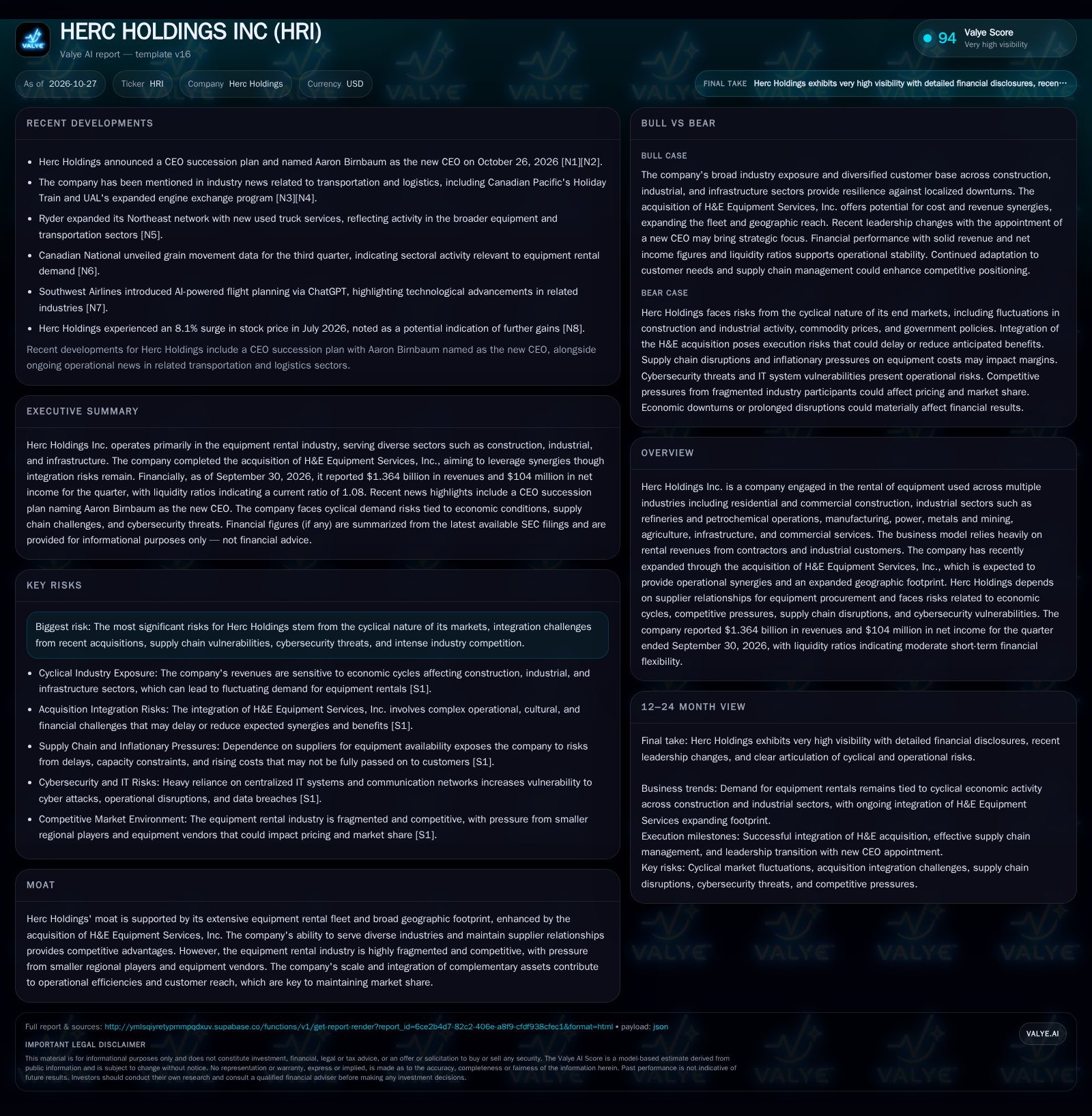
Herc Holdings has completed the integration of H&E Equipment Services, expanding its North American fleet and geographic footprint. The appointment of Aaron Birnbaum as CEO signals a new strategic phase. Key variables for the thesis are the realization of acquisition synergies, management of cyclical demand, and mitigation of supply chain and IT risks. Competitive intensity and macro headwinds remain persistent challenges. [S1] [S2] [N1] [N2]
Herc Holdings stands at a pivotal juncture following the completed integration of H&E Equipment Services and the announcement of a new CEO. With a broader fleet and expanded North American presence, Herc seeks to leverage scale for operational efficiency and market share gains. However, the company’s fortunes remain tethered to cyclical end-markets, ongoing supply chain risks, and execution on acquisition synergies. The next phase under new leadership will test whether Herc can convert recent investments into durable value amid persistent industry competition.
Integration, Leadership Change, and Financial Performance Shape the Near-Term Outlook
Herc Holdings has completed the integration of H&E Equipment Services, enhancing its scale and operational footprint across North America. This integration is intended to deliver operational synergies and expand geographic reach, though the realization of these benefits will depend on ongoing execution. [S1] [S2]
The company reported cash and liquidity metrics for the period; these figures do not by themselves establish operating runway, investment capacity, financial flexibility, or financing capacity. [S2]
On October 26, 2026, Herc announced that Aaron Birnbaum would become the new CEO, marking a significant leadership transition at a time when integration and strategic focus are critical. [N1] [N2]
How Herc Holdings Turns Scale into Profit—and Where the Leverage Lies
Herc’s core business model is built on renting equipment to construction, industrial, and infrastructure clients. Revenue is primarily driven by equipment utilization, rental rates, and fleet mix. Ancillary streams include used equipment sales, consumables, maintenance, and value-added services such as equipment management and on-site support. [S1] [S2]
The economics are capital-intensive: significant upfront investment in fleet is required, with profitability hinging on high utilization and disciplined asset turnover. Operating leverage is substantial, as incremental revenue from higher fleet utilization or improved pricing can drive outsized EBITDA gains once fixed costs are covered. Conversely, underutilization during economic slowdowns can quickly pressure margins.
Pricing power is limited in a fragmented, competitive market, but scale can enable better supplier terms and fleet management efficiencies. The integration with H&E is expected to yield cost synergies, though these will only be realized if operational and cultural integration is successful.
The company reported a current ratio of 1.08 for the period. [S2]
Scale Versus Fragmentation: Herc’s Relative Strengths and Industry Threats
Herc’s competitive position is strengthened by its expanded fleet, broad geographic footprint, and ability to serve large, multi-site customers post-H&E acquisition. Scale can drive procurement efficiencies, broader service offerings, and more resilient supply chains. [S1]
However, the equipment rental industry remains highly fragmented, with regional and local players often competing aggressively on price and service. Direct equipment sales by manufacturers and the emergence of digital rental platforms represent additional substitution threats. Pricing discipline can be difficult to maintain, and switching costs for customers are generally low, making customer retention a constant challenge unless supported by superior service or integrated digital tools.
Herc’s digital platform (ProControl by Herc Rentals™), which offers e-commerce and fleet management tools, may provide modest switching friction for customers seeking operational transparency and analytics, but this advantage remains at risk if competitors deploy similar technology or if customers prioritize price over platform features.
If Integration Delivers: How Synergies and Digital Tools Could Boost Returns
The most favorable outcome arises if Herc successfully realizes the anticipated cost and revenue synergies from the H&E acquisition. This would be evidenced by sustained improvement in margins, lower per-unit operating costs, and increased cross-selling to a broader customer base.
A further upside would come from effective deployment and adoption of Herc’s digital fleet management tools, which could drive customer retention, premium pricing for value-added services, and higher equipment utilization rates.
Indicators confirming this scenario would include expanding EBITDA margins, rising utilization rates, clear cost reductions attributable to integration, and evidence of increased customer stickiness (such as rising average customer tenure or multi-site contract wins, if disclosed).
This scenario could be invalidated if margin improvement stalls, integration costs persist, or customer churn accelerates despite the expanded platform.
What Steady-State Looks Like: Cyclical Resilience, Modest Synergy, and Ongoing Competition
The most plausible path is for Herc to achieve moderate integration benefits, with incremental cost savings and some revenue synergies from the expanded footprint, but with gains partially offset by competitive pricing pressure and cyclical demand variability.
Under this scenario, financial results would mirror broader construction and industrial cycles. Operating leverage would provide upside in periods of strong demand, but downside risk remains if utilization or rental rates soften.
Evidence supporting this scenario would be stable or gradually improving margins, relatively steady utilization rates, and limited disruption from supply chain or IT incidents. Signs of aggressive pricing or market share losses to regional competitors would challenge this view.
Where the Risks Stack Up: Cyclical Downturn, Integration Stumbles, and Margin Compression
The adverse scenario is characterized by weaker-than-expected demand in core construction and industrial end-markets, leading to underutilization of the expanded fleet. This could be triggered by recession, delayed infrastructure projects, or a sharp pullback in commodity-linked sectors.
If integration of H&E is poorly executed—manifested in cultural clashes, operational inefficiencies, or customer attrition—the expected synergies may fail to materialize, and costs could rise.
Supply chain disruptions or inflation in equipment costs may further squeeze margins if Herc is unable to pass through higher expenses to customers. Cybersecurity breaches or IT outages could exacerbate operational instability.
Confirmation of the downside scenario would include declining utilization and margins, persistent integration costs, missed synergy targets, and negative revisions to earnings guidance.
Milestones That Will Determine Whether Herc’s Scale Thesis Holds Up
Progress on realized cost and revenue synergies from the H&E acquisition—disclosure of specific synergy amounts or margin improvement attributable to integration would help test this thesis.
Utilization rates and rental yield trends across the expanded fleet—if disclosed—would clarify whether scale is translating into better asset productivity.
Customer retention, expansion of multi-site contracts, or evidence of increased customer stickiness from digital tools—a useful metric would be renewal rates or customer tenure if available.
Direct and indirect cost inflation (equipment, labor, transport) and the company’s ability to pass these costs through to customers, as reflected in margin trends.
Any signs of supply chain constraints impacting equipment availability, lead times, or capex efficiency.
Incidence and impact of cybersecurity events or major IT disruptions, as these could rapidly escalate operational risks.
Leadership messaging and execution under new CEO Aaron Birnbaum—watch for changes in strategic priorities, capital allocation, or integration approach.
Disclaimer: This is research-only, informational analysis and not investment advice. It may include AI-generated interpretation and general industry context. Always verify important details using primary sources.

Comments