
Armstrong World Industries: Expanding Architectural Specialties, Managing Cyclicality, and the Realities of Construction Supply Chains
Armstrong World Industries (AWI) continues to grow through targeted acquisitions in architectural specialties while balancing the cyclicality of construction markets, customer concentration, and raw material cost pressures. Recent profit growth and a dividend increase highlight operational strength, but future performance will depend on integration success and resilience against industry headwinds.
AWI has delivered higher quarterly profits and raised its dividend, reflecting operational momentum. The company is actively expanding its Architectural Specialties segment through acquisitions, aiming to diversify its offering and reduce cyclicality. However, exposure to construction cycles, reliance on major distributors, and raw material volatility remain central risks. The next phase hinges on successful integration of acquisitions, sustaining customer relationships, and managing input costs.
Armstrong World Industries (AWI) has built on its legacy in building materials by aggressively expanding into architectural specialties, aiming to capture higher-value niches and reduce dependency on the cyclical mineral fiber ceiling market. The cited source reports dividend-related activity; that disclosure alone does not establish dividend-policy continuity, management confidence, or a material constraint on capital flexibility. Success in these areas could support further margin expansion and resilience, while failure may expose AWI to intensified competitive and cyclical pressures.
Recent Profit Growth, Dividend Hike, and Strategic Expansion Define 2026 Backdrop
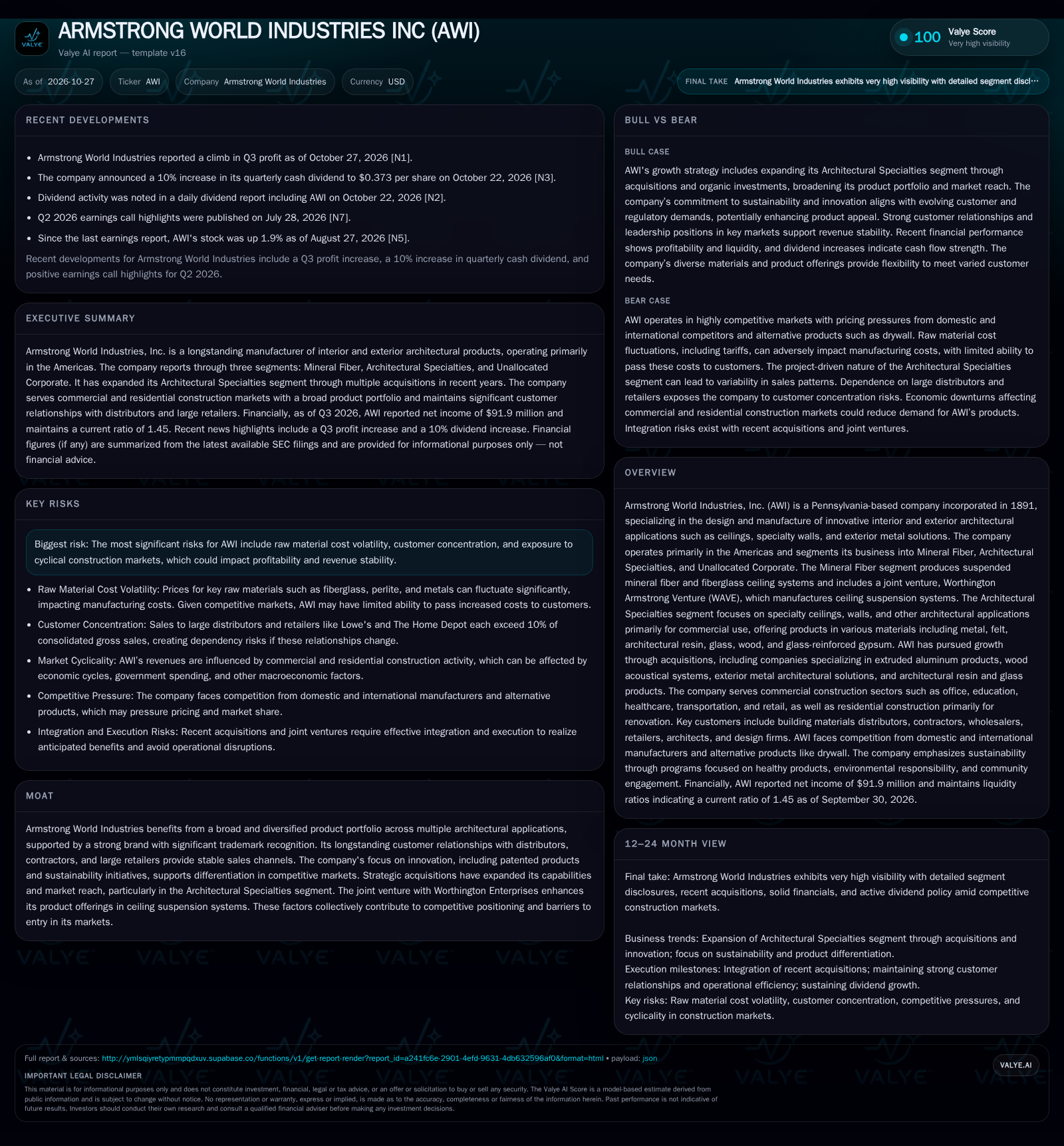
Armstrong World Industries reported a climb in Q3 profit as of October 27, 2026, and announced a 10% increase in its quarterly cash dividend to $0.373 per share [N1] [N3]. These developments signal a period of financial strength and confidence in cash flow. The company’s cash and equivalents stood at $71.4 million with a current ratio of 1.45 at the end of Q3 2026 [S2].
AWI has continued its acquisition-driven expansion, most recently acquiring FGM-Parallel LLC (extruded aluminum) in December 2025 and Geometrik Manufacturing, Inc. (wood acoustical systems) in September 2025, following earlier deals in exterior metal and resin/glass solutions [S2]. These moves reflect a deliberate strategy to scale and diversify the Architectural Specialties segment, which is positioned as a growth driver beyond the mature mineral fiber ceiling core.
The company’s sales remain highly concentrated through building materials distributors, with Lowe's and The Home Depot each accounting for over 10% of gross sales in 2025 [S1]. While these relationships provide scale and access, they also introduce customer concentration risk.
How AWI’s Multi-Segment Model Translates to Cash Generation and Margin Dynamics
AWI’s business model is anchored in manufacturing and distributing building materials, with two principal operating segments: Mineral Fiber (suspended ceiling tiles and systems) and Architectural Specialties (custom and high-performance ceilings, walls, and exterior solutions). The Mineral Fiber segment is characterized by higher fixed costs, scale manufacturing, and a relatively mature market, leading to stable—if cyclical—cash flows. Architectural Specialties, in contrast, carries a more project-driven, lower-volume, higher-mix profile, with potential for higher gross margins but also greater variability due to the timing and size of commercial construction projects.
Recent acquisitions have shifted the product mix toward specialty and exterior solutions, which could enhance average selling prices and margin potential if integration is successful. However, the project-driven nature of Architectural Specialties introduces lumpiness into revenue recognition, and the company’s ability to manage backlog, pricing, and project execution will influence volatility. Operating leverage is most pronounced in the Mineral Fiber segment, where incremental volume can drive profit expansion due to fixed plant overhead. Conversely, the Architectural Specialties segment may require ongoing investments in design, customer support, and project management, limiting immediate margin scalability.
AWI’s capital needs are moderate relative to heavy industrials but not trivial: investments in manufacturing upgrades, acquisitions, and sustainability initiatives require ongoing cash deployment. The cited source reports dividend-related activity; that disclosure alone does not establish dividend-policy continuity, management confidence, or a material constraint on capital flexibility.
Competitive Landscape: Brand, Product Breadth, and Sustainability as Differentiators
AWI operates in a competitive market for ceiling and specialty wall systems, facing both legacy mineral fiber and fiberglass tile producers and a wide array of specialty providers in metal, resin, wood, and exterior architectural solutions. The company’s competitive advantages stem from its broad product portfolio, strong brand recognition (notably Armstrong® and 3form®), and established distribution relationships with major retailers and contractors [S1].
However, barriers to entry are not insurmountable. Alternative materials such as drywall and imported specialty products continue to pressure pricing and market share. The Architectural Specialties segment, while less commoditized, is exposed to design trends and requires continuous innovation. AWI’s emphasis on sustainability—including recycling programs for mineral fiber ceilings and a focus on healthy, circular products—aligns with evolving regulatory and customer preferences and may offer modest differentiation, particularly for institutional and commercial clients.
Customer concentration remains a double-edged sword: while partnerships with Lowe’s and The Home Depot deliver scale, they also give these retailers negotiating leverage and expose AWI to abrupt volume or pricing shifts if relationships sour or if market share is lost to competitors.
Margin Expansion and Revenue Growth If Specialty Integration and Innovation Succeed
A favorable scenario for AWI would see the Architectural Specialties segment successfully integrated, driving higher-margin growth through project wins in commercial, education, healthcare, and transportation verticals. If acquisitions deliver anticipated synergies—such as cross-selling, supply chain optimization, and expanded design capabilities—the segment could outpace the more cyclical mineral fiber business in both growth and profitability.
AWI could further benefit if sustainability programs and product innovation resonate with architects and contractors seeking green building credentials, supporting premium pricing and customer loyalty. Evidence confirming this scenario would include sustained growth in Architectural Specialties revenue, improvement in consolidated gross margins, and reduced earnings volatility. Additional signals would be new customer wins outside the traditional distributor channel and successful integration milestones for acquired businesses (if disclosed).
Incremental Gains Amid Cyclicality and Integration Demands
The most plausible trajectory for AWI is one of incremental improvement: modest revenue growth driven by a diversified product mix, with profitability supported by cost management and selective pricing power in specialty niches. The Mineral Fiber segment continues to provide a stable foundation, while Architectural Specialties delivers episodic growth tied to commercial project cycles.
Integration of recent acquisitions likely proceeds with some friction, but not enough to derail overall performance. Customer concentration remains, but major distributor relationships are maintained. Margin expansion is possible but limited by ongoing input cost pressures and competitive pricing.
Project Delays, Input Cost Surges, and Customer Concentration Risks Erode Results
A negative scenario could emerge if commercial construction activity weakens significantly, leading to project delays or cancellations in the Architectural Specialties segment. If integration of recent acquisitions falters, expected synergies may not materialize and margins could be compressed by redundant costs and operational inefficiency.
Simultaneously, a spike in raw material costs—particularly for fiberglass, aluminum, and steel—could squeeze gross margins if AWI is unable to pass these increases to customers. Customer concentration risk may crystallize if a major distributor reduces orders or shifts to alternative suppliers, amplifying revenue pressure. Evidence for this scenario would include declining Architectural Specialties revenue, margin contraction, missed integration milestones, and/or a loss of major customer volume.
Milestones and Metrics That Will Shape AWI’s Specialty Growth Narrative
Progress and revenue contribution from newly acquired businesses in Architectural Specialties—if disclosed—would clarify integration success and growth potential.
Segment-level gross margin trends, particularly in Architectural Specialties, would help assess mix shift and pricing power.
Customer concentration metrics: Any material change in sales to Lowe’s, The Home Depot, or other major distributors would test the stability of core relationships.
Raw material cost trends and AWI’s ability to offset or pass through these costs will be critical, especially for fiberglass, aluminum, and steel.
Capital allocation between dividends, acquisitions, and organic investment: Shifts here would reveal management’s confidence and strategic priorities.
Sustainability initiative adoption rates and their impact on customer wins, especially in institutional/commercial channels, if disclosed.
Commercial construction market indicators (e.g., non-residential starts, project backlogs) as leading signals for demand in AWI’s core segments.
Disclaimer: This is research-only, informational analysis and not investment advice. It may include AI-generated interpretation and general industry context. Always verify important details using primary sources.

Comments