
Zura Bio: Clinical Readouts, Cash Burn, and the Long Road to Immunology Value Creation
The company’s path to value hinges on near-term trial outcomes and its ability to sustain momentum without commercialized products.
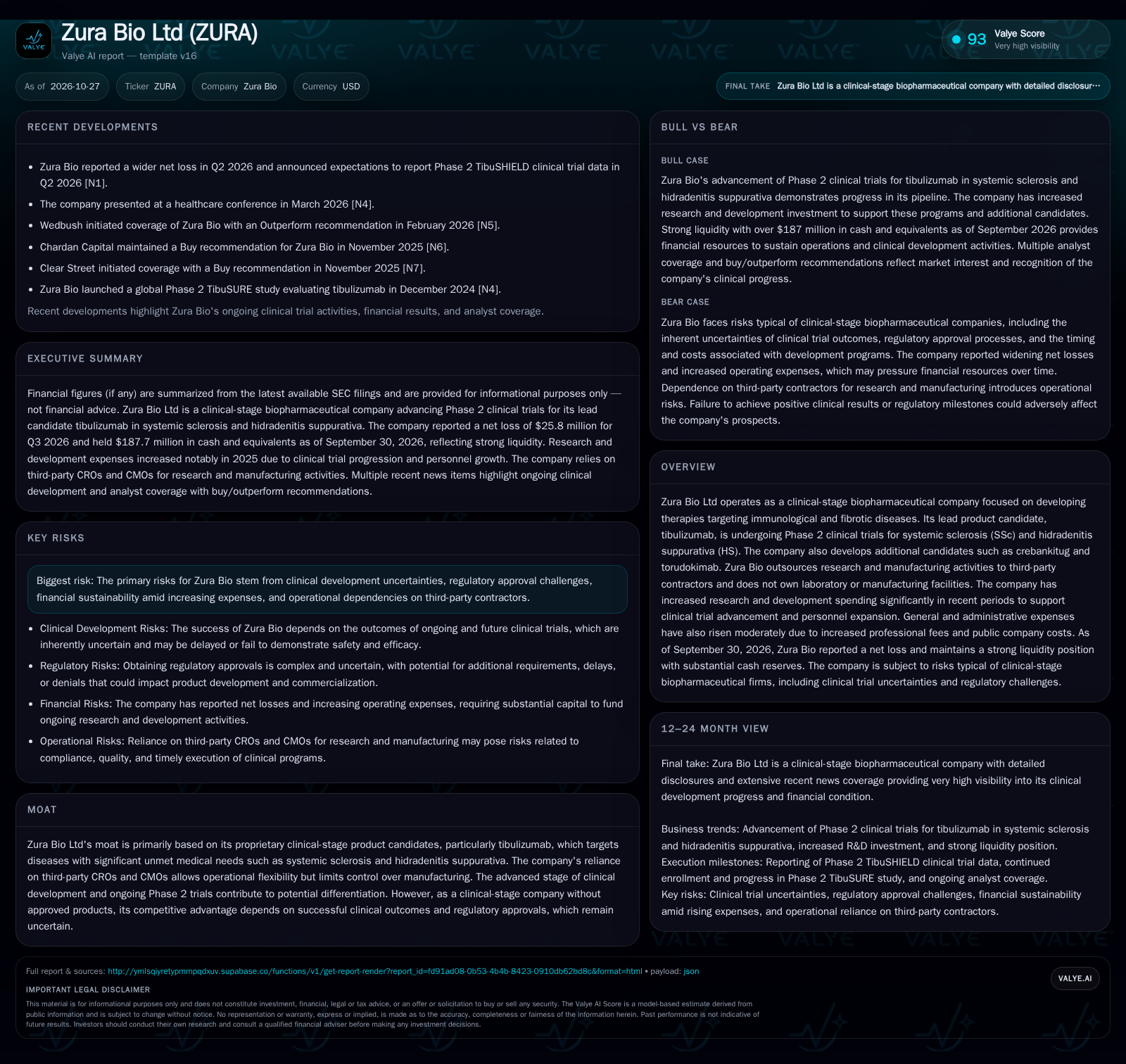
Zura Bio remains a high-visibility clinical-stage biopharma with $187.7 million in cash and a deepening net loss as of Q3 2026. The company’s upcoming Phase 2 TibuSHIELD data will be a major inflection point, but ongoing reliance on external CROs/CMOs and escalating operating expenses highlight the challenges of translating pipeline progress into durable value. Success now depends on clinical readouts, regulatory navigation, and disciplined capital deployment. [S2] [N1]
Zura Bio sits at a critical juncture familiar to many clinical-stage biotechs: well-funded with $187.7 million in cash, but facing widening net losses as it pushes multiple immunology and fibrosis candidates through the clinic. The anticipated Phase 2 results for tibulizumab could dramatically alter the company’s trajectory, yet Zura’s reliance on third-party contractors and lack of commercial revenue highlight enduring operational and financial risks. The company’s ability to convert scientific progress into sustainable value will be tested by upcoming clinical readouts, regulatory scrutiny, and its capacity to manage costs and capital.
Liquidity, Losses, and the Coming Clinical Catalyst
Zura Bio reported a net loss of $25.8 million for the quarter ended September 30, 2026, with basic and diluted EPS of -$0.20 per share. This marks an ongoing trend of rising operating expenses as the company advances its clinical programs. Despite these losses, Zura maintains a substantial cash position of $187.7 million and a current ratio of 11.29, indicating significant liquidity as of the end of Q3 2026. A key near-term milestone is the expected readout of Phase 2 TibuSHIELD trial data, anticipated in Q2 2026, which could serve as a major catalyst for the company’s lead immunology asset. [S2] [N1]
How Zura Bio’s Model Amplifies Both Flexibility and Burn
Zura Bio’s economics are emblematic of clinical-stage biopharma: the company incurs substantial research and development costs without offsetting revenue, leading to persistent operating losses. The absence of commercialized products means no recurring revenue streams, placing the focus squarely on capital deployment and cost efficiency. Outsourcing research and manufacturing to CROs and CMOs provides operational flexibility and avoids the capital intensity of owned facilities, but creates a variable cost base highly sensitive to project volume and timeline slippage.
R&D expenses are primarily personnel-related, with additional spend tied directly to clinical activities rather than fixed infrastructure. This structure may allow the company to scale resources up or down as programs progress or stall, but it also means that any delays or negative trial outcomes can quickly erode financial runway. As operating expenses rise with advancing clinical programs, Zura’s cash burn will likely accelerate unless offset by external funding, partnerships, or a shift into later-stage, revenue-generating activities.
The reliance on external CROs and CMOs also introduces strategic trade-offs beyond cost and flexibility. While outsourcing reduces fixed capital commitments, it can limit Zura Bio's control over timelines and quality, potentially amplifying risks if third-party providers face capacity constraints or regulatory compliance issues. Moreover, variability in contract terms and pricing can complicate long-term financial forecasting, making it harder to predict cash burn with precision. The company’s ability to negotiate favorable agreements and maintain robust oversight of outsourced activities will be critical to balancing operational agility with cost containment.
In addition, the lack of commercial revenue streams places a premium on capital efficiency and prioritization of development programs. Zura Bio must carefully allocate resources to projects with the highest probability of clinical and regulatory success, as well as potential market differentiation. This prioritization process becomes increasingly important if clinical readouts do not meet expectations, requiring strategic decisions on whether to halt, pivot, or seek partnerships for certain assets. The capacity to dynamically adjust the portfolio in response to emerging data will influence the company’s financial sustainability and investor confidence.
Pipeline Promise Versus Industry Giants and Fast Followers
Zura Bio’s competitive position is defined by its portfolio of proprietary clinical-stage assets targeting immunological and fibrotic diseases, with tibulizumab as the lead candidate. The company operates in a crowded and high-stakes therapeutic area, where large pharmaceutical incumbents, other clinical-stage biotechs, and emerging platform companies all vie for share. Zura’s approach—focusing on diseases with significant unmet medical need—could enable it to carve out a niche if clinical data prove differentiated.
However, the absence of commercial infrastructure, combined with reliance on third-party contractors, limits Zura’s ability to rapidly scale or pivot in response to competition. Larger peers typically possess deeper pipelines, more robust funding, and established regulatory and commercialization capabilities. For Zura, sustainable competitive advantage will depend on demonstrating clinical superiority or unique safety/tolerability, securing intellectual property, and navigating regulatory hurdles faster than rivals. The company’s flexibility could allow it to partner or out-license successful assets, but also leaves it vulnerable to being outmaneuvered by more integrated or capitalized players.
What Clinical Validation and Capital Discipline Could Unlock
If Zura Bio’s Phase 2 TibuSHIELD data demonstrate robust efficacy and safety, the company could see a step-change in valuation and negotiating leverage. Positive clinical results would likely attract increased attention from both investors and potential strategic partners, opening doors to non-dilutive funding, co-development deals, or even acquisition interest from larger biopharma players seeking to bolster their immunology portfolios.
The upside scenario would be further supported if Zura can maintain disciplined capital deployment, keeping operating expenses in line with pipeline progress and preserving cash runway. Evidence confirming this scenario would include statistically significant and clinically meaningful Phase 2 outcomes, a spike in partnership or licensing announcements, and management guidance signaling extended cash runway without immediate need for new equity financing. Falsification would come from negative or inconclusive data, a lack of partnering activity, or rapid escalation in cash burn absent clear value inflection.
Beyond direct clinical validation, the company’s ability to leverage its data package for regulatory incentives such as fast-track or breakthrough therapy designations could materially enhance the value proposition. These designations often facilitate accelerated development timelines and increased dialogue with regulatory agencies, potentially reducing time to market and associated costs. If Zura Bio can secure such regulatory advantages, it would strengthen its negotiating position with partners and investors, while mitigating some of the inherent risks of lengthy clinical development in immunology.
Furthermore, demonstrating operational discipline by maintaining or improving cost efficiency amid clinical advancement would signal strong management execution. Investors tend to reward companies that show they can scale their operations prudently, especially in capital-intensive sectors like biopharma. Evidence of disciplined spending, combined with clinical success, could create a virtuous cycle attracting non-dilutive capital and enabling selective investment in pipeline expansion or commercialization preparedness, thereby enhancing long-term shareholder value.
Most Likely: Incremental Progress, Persistent Cash Burn
The most plausible outcome is that Zura Bio continues to advance its clinical programs with incremental progress but without immediate breakthrough. In this scenario, Zura’s valuation and partnership potential would hinge on a series of smaller clinical and regulatory milestones rather than a single transformative event.
Confirmation would come from timely delivery of planned clinical readouts (even if results are mixed), continued analyst and investor interest, and stable or moderately increasing operating expenses. Falsifying evidence would include repeated trial delays, unexpected safety signals, or a sudden need for dilutive capital raises to fund ongoing operations.
Trial Failure, Delays, and the Risk of Capital Exhaustion
The adverse scenario centers on clinical setbacks—such as negative or inconclusive Phase 2 TibuSHIELD data—combined with continued cash burn and operational risks from heavy reliance on external CROs/CMOs. If Zura fails to deliver positive clinical outcomes, it would likely face a sharp drop in investor confidence, making additional fundraising more challenging and potentially forcing program discontinuations or restructuring.
This pathway could be confirmed by a lack of meaningful clinical progress, escalating net losses, and management commentary signaling the need to seek new funding or cut costs aggressively. Falsification would require either positive trial data or evidence of successful cost containment and strategic partnering that extends financial runway despite setbacks.
Milestones and Metrics That Will Shape Zura Bio’s Trajectory
Actual Phase 2 TibuSHIELD trial results: The magnitude and direction of these data will be the most consequential near-term catalyst for Zura’s pipeline and valuation. [N1]
Quarterly cash burn and runway projections: Monitoring how quickly the company’s $187.7 million in cash is consumed, and whether guidance on runway changes, will test capital discipline. [S2]
Updates on clinical trial enrollment and timelines for tibulizumab, crebankitug, and torudokimab: Delays or acceleration would impact both costs and investor sentiment. If disclosed, program-specific enrollment rates would be highly informative.
Announcements of new partnerships, licensing deals, or strategic collaborations: These would signal external validation and potential for non-dilutive funding.
Changes in R&D and general administrative expense trends: A useful metric would be the ratio of R&D spend to overall operating expenses, to assess focus and scalability.
Regulatory filings or approvals: Any progress toward IND filings, fast-track designations, or regulatory milestones would serve as tangible de-risking events.
Management commentary on future funding plans: Explicit statements regarding the need (or lack thereof) for additional capital raises would clarify financial sustainability.
Disclaimer: This is research-only, informational analysis and not investment advice. It may include AI-generated interpretation and general industry context. Always verify important details using primary sources.

Comments