
Rallybio’s Strategic Pivot: Clinical-Stage Wind-Down, Asset Monetization, and the Uncertain Road to Value Realization
Rallybio’s transition from clinical-stage biotech to a shell for merger-driven value hinges on the fate of its lead candidate RLYB116, asset sales, and the successful execution of its latest merger with Avenzo Therapeutics. The company’s future now depends less on operational R&D and more on capturing contingent value for shareholders while navigating dilution and execution risk.
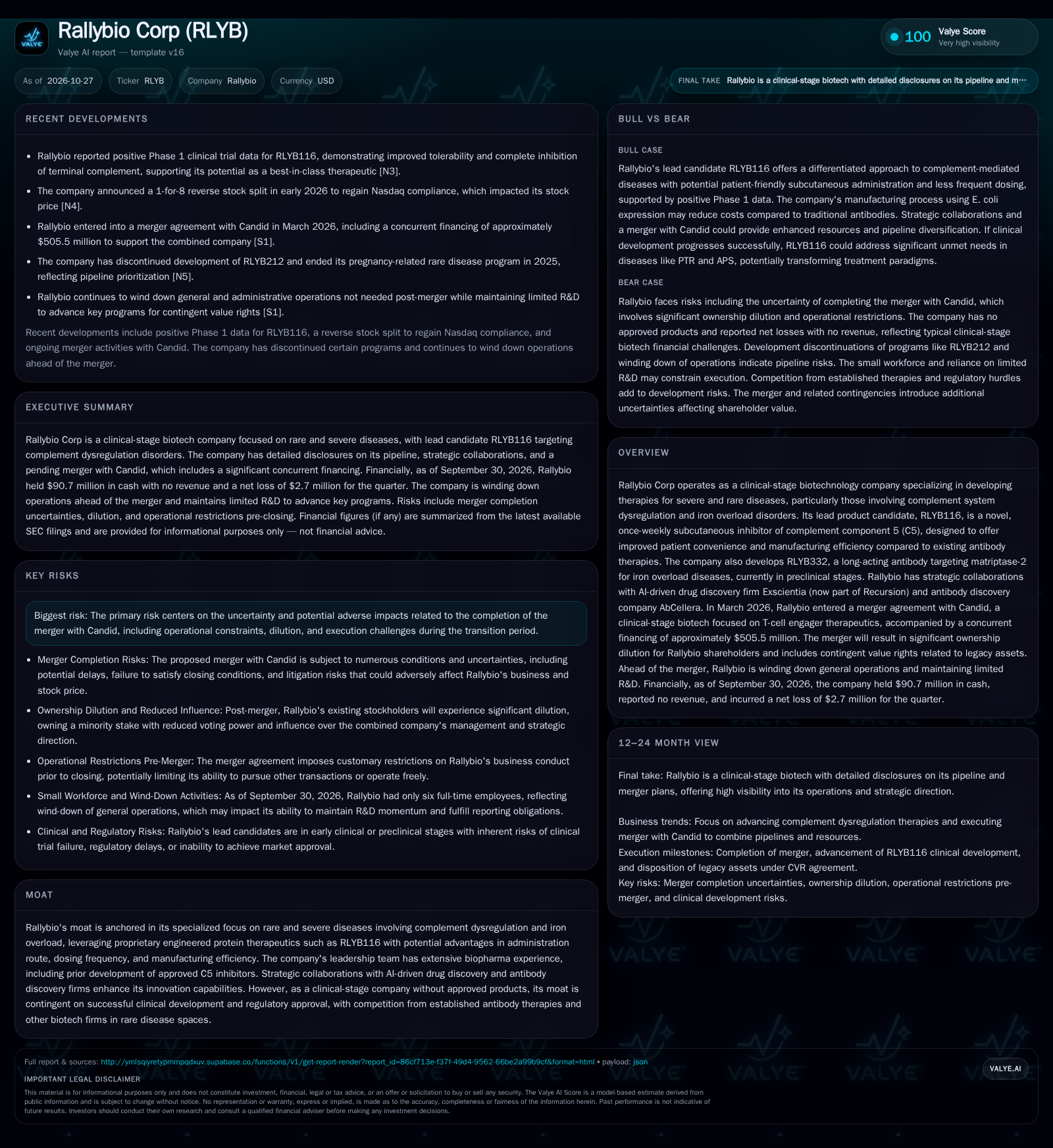
Rallybio, once focused on rare disease therapeutics, is now winding down operations following the termination of a key merger and the initiation of a new merger with Avenzo Therapeutics. The company’s value is tied to the monetization of its remaining clinical assets, particularly RLYB116, and the realization of contingent value rights for its legacy shareholders. With a small workforce, no revenue, and significant dilution ahead, the business case now centers on strategic execution rather than therapeutic breakthrough. [S2]
Rallybio Corp’s transformation from a clinical-stage biotech innovator to a shell for merger and asset monetization is emblematic of the challenges facing early-stage biotechs in 2026. Following the termination of its high-profile merger with Candid, and the subsequent pivot to a new deal with Avenzo Therapeutics, Rallybio’s operational footprint has shrunk to a skeleton crew and a handful of legacy assets. The future for Rallybio equity holders is now a question of extracting contingent value from the company’s remaining programs—particularly RLYB116—and navigating the risks and dilution inherent in the merger process. This analysis examines the economics, strategic levers, and scenario logic now driving the company’s investment case.
Pivoting from Clinical-Stage Operations to Asset Monetization
Three material changes define Rallybio’s current state: First, the termination of the Candid merger in May 2026 generated a $50 million cash inflow via a termination fee and forced a reset of strategic direction. Second, Rallybio immediately entered a new merger agreement with Avenzo Therapeutics, shifting the company’s identity to a shell for business combination and asset monetization. Third, operational wind-down has left Rallybio with only six full-time employees, minimal R&D, and a focus on extracting value from legacy assets via contingent value rights (CVRs). Shareholders now face substantial dilution, as the merged entity will operate under the Avenzo banner with Rallybio equityholders retaining only a minority stake. [S2]
Rallybio’s lead clinical asset, RLYB116, continues to anchor the company’s value proposition, having demonstrated improved tolerability and sustained terminal complement inhibition in Phase 1 data. However, with the company’s shift to merger-driven strategy and the discontinuation of other programs, RLYB116’s path to value realization now depends on asset sales, licensing, or successful clinical out-licensing rather than internal development. [N3] [S2]
How Rallybio’s Economics Have Shifted: From Pipeline Build to Strategic Exit
Historically, Rallybio’s economics were those of a typical early-stage biotech: high cash burn, zero revenue, and heavy investment in a pipeline targeting rare disease markets using differentiated biologics such as RLYB116. The company’s cash balance of $90.7 million as of September 30, 2026, is largely a function of recent asset sales and the Candid termination fee, not product or milestone revenue. [S2]
With the wind-down of operations and the impending merger, Rallybio’s cost structure has shifted dramatically. Fixed costs have been slashed through workforce reduction and the elimination of most R&D spend, with only minimal resources allocated to programs that may yield CVR value for legacy shareholders. The company’s financial model is now driven by the timing and magnitude of asset monetization events and the structure of merger consideration, rather than product launch or operating leverage.
Going forward, Rallybio’s ability to generate value for equity holders depends on successfully selling or out-licensing RLYB116 or other legacy assets and on the terms and outcomes of the Avenzo merger. The economics of RLYB116, if successfully partnered, could include upfront payments, milestones, or royalty streams—but none are guaranteed, and execution risk is high. Without internally generated revenue, Rallybio is reliant on external strategic events to realize value.
Competitive Dynamics: Asset Quality, Not Operating Scale, Now Matters Most
Rallybio’s competitive position has fundamentally changed: It is no longer an operating biotech competing for clinical development milestones or commercial launches, but rather a strategic seller of early-stage assets. RLYB116’s technical differentiators—subcutaneous administration, potential for improved patient adherence, and E. coli-based manufacturing—could make it attractive to established players in complement-mediated diseases, provided later-stage data confirm its early promise. [N3]
However, the competitive landscape for C5 inhibitors is crowded, with entrenched incumbents and multiple next-generation candidates in development. The value Rallybio can capture from RLYB116 will depend on the asset’s ability to address meaningful unmet needs, demonstrate competitive efficacy and safety, and attract partners or acquirers willing to take on late-stage development risk. For discontinued or deprioritized programs, the probability of out-licensing or salvage value is low. In the broader context, Rallybio’s competitive advantage now comes down to the technical quality of its remaining pipeline and the company’s ability to negotiate favorable exit terms.
Unlocking Value Through Asset Sales and a Smooth Merger Execution
The most favorable outcome for Rallybio equity holders is a scenario in which RLYB116 is successfully partnered or sold at a meaningful upfront and milestone value, and the Avenzo merger proceeds without major delays or additional dilution. In this case, CVR holders could realize substantial value from the monetization of legacy assets, while also retaining minority exposure to the combined company’s oncology pipeline.
Key evidence that would confirm this scenario includes announcements of asset sales or licensing agreements for RLYB116 with reputable partners, clear communication of CVR payout mechanics, and a rapid, uncontested close of the Avenzo merger. Additional upside could come from the unexpected monetization of other legacy programs, or a premium re-rating of the merged company’s equity if Avenzo’s pipeline gains traction post-transaction.
Most Likely Outcome: Slow Asset Monetization and Shareholder Dilution
The most plausible near-term path is a gradual wind-down in which Rallybio completes the Avenzo merger, sells or licenses RLYB116 at modest terms, and returns limited CVR value to legacy shareholders. Ongoing administrative costs and the complexity of the merger process could erode residual value, and the combined company’s equity may underperform if Avenzo’s assets do not quickly show clinical progress.
Confirmation of this scenario would come from incremental disclosures of asset monetization at modest valuations, slow or partial CVR payouts, and limited market enthusiasm for the new Avenzo entity. Evidence to the contrary would include either a total failure to monetize RLYB116 or significant delays and litigation in the merger process.
Value Erosion from Failed Asset Sales and Merger Delays
The adverse scenario involves Rallybio failing to secure meaningful value for RLYB116 or other assets, either due to lack of partner interest, regulatory setbacks, or clinical failure. If the Avenzo merger is delayed, renegotiated, or challenged, the cost of maintaining a shell company could quickly erode the remaining cash balance, leaving little for CVR holders.
This scenario would be confirmed by a lack of asset sale announcements, regulatory or clinical setbacks for RLYB116, legal or shareholder challenges to the merger, or repeated delays in closing. In this case, Rallybio equity holders could be left with illiquid CVRs and minimal exposure to future upside.
Milestones That Will Determine Whether Rallybio’s Legacy Value Can Be Realized
Announcement of asset sales, out-licensing, or partnership deals for RLYB116, including upfront and milestone economics.
Completion timeline and closing terms for the Avenzo merger, including any required shareholder or regulatory approvals.
Updates on the structure, timing, and payout mechanics of contingent value rights (CVRs) to Rallybio legacy shareholders.
Disclosures regarding ongoing administrative costs and cash burn during the wind-down and merger execution period.
Evidence of continued or resumed development activity around RLYB116, including regulatory feedback or investigator interest, if disclosed.
Any litigation, shareholder activism, or regulatory interventions that could delay or interrupt the merger process.
Clarity on the status and potential value of other discontinued or deprioritized pipeline programs.
Disclaimer: This is research-only, informational analysis and not investment advice. It may include AI-generated interpretation and general industry context. Always verify important details using primary sources.

Comments