
Smithfield Foods: Portfolio Diversification, Margin Pressures, and the Next Phase of Meat Industry Modernization
Smithfield Foods stands at a crossroads of operational transformation and industry headwinds, balancing a broad product portfolio, major capital investments, and the risks of commodity volatility and global trade friction. The company’s recent acquisition and facility plans signal ambitions for scale, but execution and cost management will be decisive.
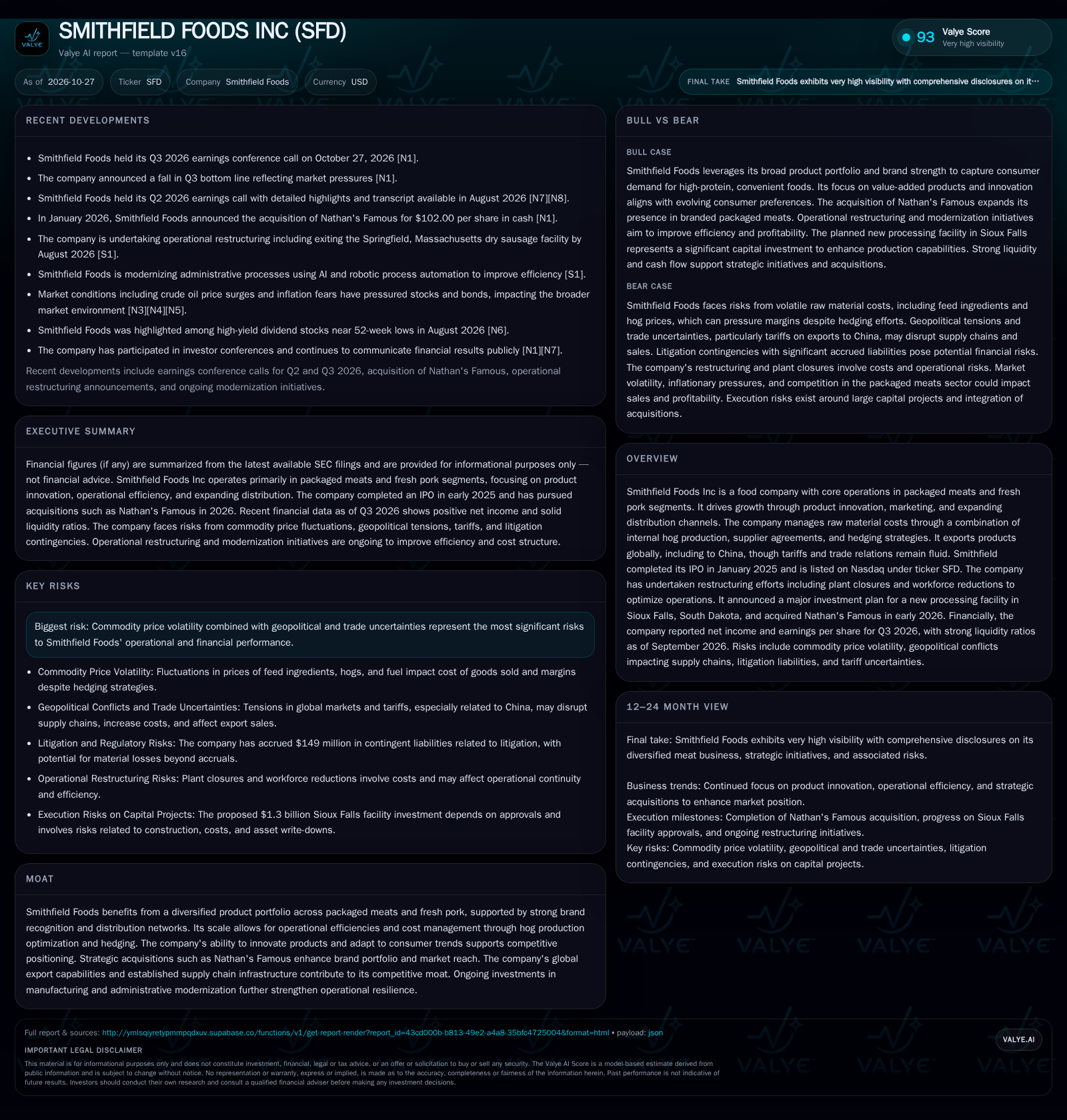
Smithfield Foods is pursuing margin-accretive growth through product innovation, operational restructuring, and strategic acquisitions, most notably Nathan’s Famous. Success will depend on the realization of efficiency gains, integration of new assets, and the ability to navigate global supply chain volatility. [S2] [N1]
Smithfield Foods, a leading integrated meat producer, is navigating a pivotal period marked by strategic expansion and operational overhaul. With a diversified business spanning packaged meats and fresh pork, the company has recently executed a large acquisition, announced a major facility investment, and undertaken restructuring to sharpen efficiency. Yet, persistent headwinds from commodity markets, litigation risks, and global trade volatility temper the upside. The coming quarters will test Smithfield’s ability to translate scale and modernization into sustainable margin gains.
Recent Moves Define Smithfield’s Strategic Trajectory
The company reported cash and liquidity metrics for the period; these figures do not by themselves establish operating runway, investment capacity, financial flexibility, or financing capacity. This financial snapshot follows a series of significant moves: the January 2026 agreement to acquire Nathan’s Famous for $102 per share in cash, funded by existing resources, and the announcement of a proposed $1.3 billion investment in a new integrated processing facility in Sioux Falls. Meanwhile, Smithfield is executing operational restructuring, including plant closures and workforce reductions, and deploying AI and robotic process automation for administrative modernization. These facts highlight a company in active transition—deploying capital to scale up, streamline operations, and expand its branded product lineup—while facing persistent risks from commodity volatility, litigation liabilities ($149 million accrued as of December 28, 2025), and global trade friction, particularly with China. [S2] [S1] [N1]
How Smithfield’s Revenue Engines and Cost Structures Shape Profit Potential
Smithfield’s business model spans two primary segments: Packaged Meats and Fresh Pork. The Packaged Meats division focuses on value-added, branded products that generally command higher margins due to brand equity, product innovation, and the ability to influence retail shelf space. Sales drivers here include household penetration, product mix, and the successful introduction of new offerings—factors that can support price realization if consumer preferences align. The Fresh Pork segment is more exposed to commodity price swings, with profitability influenced by global demand, whole-hog utilization, and the ability to extract value across retail, foodservice, export, and industrial channels.
Raw material costs—mainly feed and hogs—constitute the largest share of Smithfield’s cost of goods sold. The company attempts to mitigate margin volatility through vertical integration, hedging, and strategic sourcing, but the effectiveness of these measures can be limited during extreme commodity cycles. Fixed costs, particularly in processing and distribution, create operating leverage: incremental volume or successful mix-shift toward premium products can disproportionately boost margins, but underutilization or demand shocks have the opposite effect. Large capital projects, like the proposed Sioux Falls facility, require careful management to avoid asset write-downs and cost overruns, while the integration of acquisitions (such as Nathan’s Famous) will test Smithfield’s ability to extract synergies without disrupting core operations. [S2]
Competitive Landscape: Scale, Brands, and the Battle for Shelf Space
Smithfield operates in a highly competitive industry that includes multinational meat processors, regional producers, private label offerings, and alternative protein providers. Its advantage lies in portfolio breadth, established brands, and a robust distribution network—attributes that help secure shelf space and maintain pricing power in packaged meats, especially for value-added and convenience-focused products.
However, the industry is not static. Large peers also pursue efficiency and innovation, and private label products can pressure branded margins, particularly during periods of consumer trade-down. Export markets, while providing diversification, expose Smithfield to geopolitical risks, tariffs, and fluctuating demand—China accounted for approximately 2% of sales in fiscal 2025, a non-trivial but not dominant share. The company’s investments in modernization, AI-driven administrative processes, and scale-oriented capital projects may provide cost and efficiency advantages, but these are not insurmountable barriers. Ultimately, the ability to continuously innovate, manage commodity risk, and execute on integration will determine whether Smithfield’s scale translates into durable competitive advantage. [S2] [S1]
Efficiency Gains and Brand Expansion Drive Sustained Margin Growth
The most favorable outcome for Smithfield would stem from a successful mix-shift toward higher-margin packaged meats, effective integration of Nathan’s Famous, and the realization of cost savings from both operational restructuring and administrative modernization. The new Sioux Falls facility, if approved and executed on time and on budget, could further enhance supply chain flexibility and production efficiency, helping Smithfield respond to evolving consumer preferences and capture greater market share.
Confirmation of this scenario would include: sequential margin expansion in the Packaged Meats segment, evidence of cost reductions (especially in SG&A and plant operations), new product launches driving incremental revenue, and strong post-acquisition performance from Nathan’s Famous. Additional signals would be improved export performance without material tariff shocks, and continued positive net income despite commodity price volatility. If disclosed, details on realized synergies from the Nathan’s integration and clear progress milestones on the Sioux Falls project would further support the upside case. [S2] [S1]
Navigating Commodity Cycles and Integration Complexities
The most plausible trajectory for Smithfield is a mixed environment: ongoing, though uneven, progress in operational efficiency and innovation, offset by periodic margin pressure from commodity price volatility and global trade disruptions. The integration of Nathan’s Famous may proceed without major issues, but synergies could take longer than expected to materialize, and the benefits of administrative modernization may be gradual rather than immediate.
In this scenario, Smithfield’s reported net income remains positive but exhibits quarter-to-quarter variability tied to feed and hog price fluctuations. The company continues to invest in new products and markets, but volume gains are partly offset by competitive pricing and occasional underperformance in exports due to tariffs or shifting geopolitical conditions. Plant closures and restructuring yield some cost savings, but not enough to fully counteract external headwinds. Confirmation would come from steady, if modest, improvement in gross margin and SG&A ratios over several quarters, moderate growth in branded packaged meats sales, and manageable litigation and capital project costs. [S2] [N1]
Margin Compression from Commodity Shocks and Execution Stumbles
A downside scenario would see Smithfield’s cost-control and innovation initiatives overwhelmed by external shocks. Severe, sustained increases in feed and hog prices, or a spike in fuel costs, could compress margins faster than hedging or vertical integration can offset. Simultaneously, delays or overruns in the Sioux Falls project, or significant integration issues with Nathan’s Famous, could erode anticipated returns and tie up capital.
Additional risks include escalation of litigation liabilities or adverse outcomes beyond the current $149 million accrual, and a deterioration in export demand due to new tariffs or geopolitical conflict, particularly with China. If quarterly net income turns negative and the current ratio narrows sharply due to operational cash burn or unexpected costs, it would confirm this adverse scenario. A spike in restructuring charges, underutilization of production assets, or loss of branded shelf space to private label competitors would be further warning signs. [S2] [S1]
Testing Smithfield’s Thesis: What Will Separate Strategic Progress from Setbacks?
Gross margin trends in the Packaged Meats segment—sequential improvement would suggest successful mix-shift and cost management; deterioration would indicate margin pressure.
Reported SG&A as a percentage of sales—declining ratios would confirm administrative efficiency gains from AI and process automation.
Integration milestones and performance metrics for Nathan’s Famous, if disclosed—look for revenue growth, cost synergies, and retention of distribution partners.
Capex and progress updates on the Sioux Falls facility—monitor for timeline adherence, cost overruns, or delays in regulatory approval.
Quarterly net income and EPS volatility—persistent swings tied to commodity prices would indicate ongoing vulnerability.
Export sales trends, especially to China and other tariff-sensitive markets—growth or contraction will reflect the impact of global trade dynamics.
Litigation expense disclosures and changes in accrued liabilities—material increases could signal emerging legal or regulatory headwinds.
If disclosed, realized cost savings from plant closures and restructuring—actual versus projected savings will test the effectiveness of these initiatives.
Disclaimer: This is research-only, informational analysis and not investment advice. It may include AI-generated interpretation and general industry context. Always verify important details using primary sources.

Comments