
Dorman Products: Aftermarket Breadth, Customer Concentration, and the Realities of Parts Innovation
Dorman Products’ operational breadth and relentless product development underpin its leadership in the North American vehicle aftermarket, yet the company’s fortunes remain tightly bound to a handful of major customers and the evolving economics of vehicle repair.
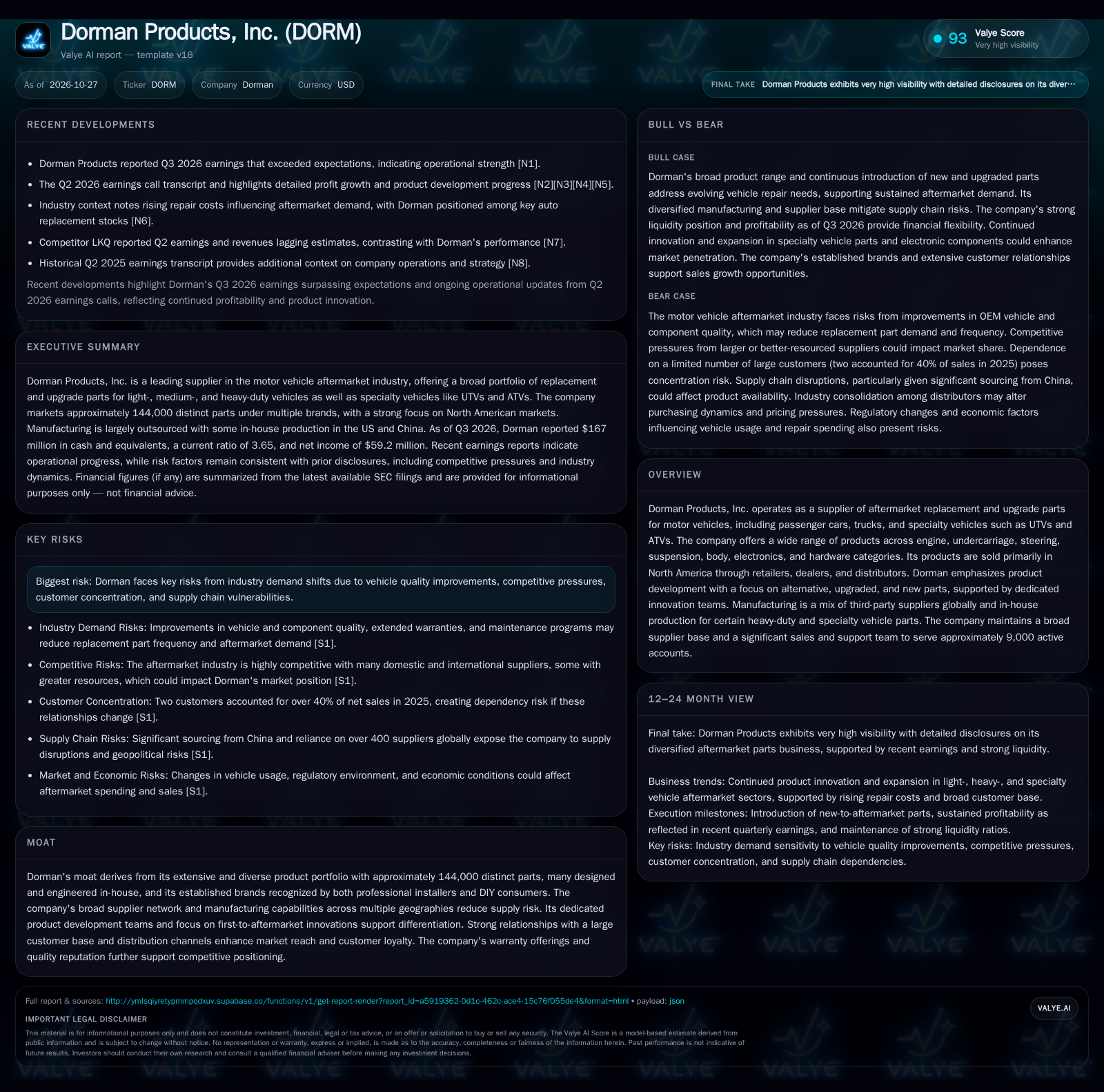
Dorman Products continues to expand its aftermarket portfolio, introducing thousands of new and upgraded parts annually. Its Q3 2026 results outperformed expectations, but with two customers accounting for 40% of sales, the company’s growth and margin trajectory are exposed to both competitive and structural risks in the parts distribution ecosystem. Supply chain diversity and in-house innovation help buffer shocks, but long-term demand will hinge on repair trends and OEM component durability. [S1] [S2] [N1]
Dorman Products, Inc. stands as a dominant supplier in North America’s vehicle aftermarket, leveraging a vast catalog of replacement and upgrade parts and a disciplined approach to product innovation. The company’s business is built on breadth—both in its product lines and its diversified supplier base. However, the realities of modern distribution mean that Dorman’s growth and risk are closely linked to a small set of powerful customers. As the industry contends with evolving vehicle technology, supply chain complexity, and changing repair economics, Dorman’s ability to sustain its innovation engine and manage channel dependencies will define its next phase of value creation.
Recent Performance Highlights Channel Strengths—and Exposures
Dorman’s Q3 2026 earnings topped analyst estimates, signaling robust operational execution even as the broader aftermarket faces cost and competition pressures. The company ended the quarter with $167 million in cash, a current ratio of 3.65, and net income of $59.2 million. Its product catalog reached approximately 144,000 distinct parts, with major annual innovation efforts: in 2025 alone, Dorman introduced 1,608 new-to-aftermarket parts and nearly 4,000 line extensions. However, two customers represented about 40% of net sales in 2025, underscoring a significant channel concentration risk. The supplier network remains broad, with over 400 suppliers globally, though 38% of purchases were sourced from China. These dynamics set the stage for both resilience and exposure as Dorman navigates industry shifts. [S1] [S2] [N1]
How Product Breadth and Channel Mix Shape Aftermarket Economics
Dorman’s economics hinge on high product breadth, rapid new-part introduction, and volume-driven efficiency across a multi-channel aftermarket. Most products serve light-duty vehicles, sold through retailers and professional installers, with heavy-duty and specialty vehicle parts providing additional diversification. Margins are shaped by a mix of proprietary (Dorman-branded) and private-label sales, with roughly three-quarters of revenue tied to the company’s own brands. This likely supports blended gross margins above typical commodity distributors, though pricing power is tempered by large, consolidated customers and the need to maintain price competitiveness across thousands of SKUs.
Manufacturing is primarily outsourced, which keeps fixed costs lower and allows for flexible scaling, but introduces variable margin exposure to supply chain disruptions and input cost volatility—particularly given the company’s reliance on Chinese suppliers for a substantial portion of purchases. In-house manufacturing for specialty and some heavy-duty parts may offer margin enhancement or customization advantages, but is unlikely to shift the overall fixed/variable balance dramatically. Operating leverage is achieved through scale in distribution, product development, and shared overhead, but the need for continual new product investment and warranty support (notably, limited lifetime warranties on most light- and medium-duty parts) means that cost discipline is critical to sustaining margins as the product base expands.
Brand, Innovation, and Channel Relationships: Durable Strengths, Persistent Threats
Dorman’s competitive position is anchored by its vast portfolio—spanning 144,000 parts and multiple brands—along with a reputation for aftermarket innovation. The company’s OE FIX line and focus on parts not available from OEMs differentiate its offering, especially for older or high-mileage vehicles where OEM support is limited. Extensive customer relationships, including approximately 9,000 active accounts, and broad distribution through major North American retailers and distributors, create both reach and embeddedness in the aftermarket ecosystem.
However, the aftermarket is intensely competitive, with both diversified suppliers and vertically integrated OEMs vying for share. Larger or better-resourced competitors can put pressure on pricing and shelf space, particularly with major retail and wholesale customers. Dorman’s high customer concentration amplifies this risk: if purchasing dynamics or relationships shift—due to industry consolidation, strategic realignment, or direct sourcing by retailers—the impact on revenue and negotiating leverage could be substantial. Additionally, improvements in OEM part longevity and electronic integration threaten the frequency and complexity of aftermarket replacement, posing a long-term substitution risk.
If Dorman’s Innovation Engine Accelerates Aftermarket Adoption
The most favorable scenario hinges on Dorman’s ability to consistently outpace competitors in introducing new, high-need aftermarket parts—especially in categories where OEMs are slow to serve or where repair complexity is rising. If the company can maintain or grow its share of proprietary branded products, while leveraging its engineering teams to address emerging vehicle technologies (such as electronics, sensors, and specialty vehicle upgrades), it could capture premium pricing and margin expansion.
Confirmation of this scenario would include sustained growth in new-to-aftermarket product launches, higher share of sales from products introduced within the last three years, and evidence that Dorman-branded offerings are gaining shelf space or market share with top customers. Additional indicators would be continued outperformance in quarterly earnings, improving gross margin trends, and successful navigation of supply chain disruptions without material margin compression.
Sustained Product Refresh Meets Structural Channel Constraints
The most plausible outcome is that Dorman continues to deliver steady revenue and modest earnings growth through ongoing product innovation, disciplined cost control, and incremental expansion in specialty and heavy-duty categories. Aftermarket demand remains stable, buoyed by rising repair costs and an aging vehicle fleet, but is partially offset by continued improvements in OEM part longevity and efficiency.
In this scenario, customer concentration does not worsen, but neither does it materially improve—leaving Dorman exposed to the purchasing decisions and bargaining power of its largest accounts. Supply chain management remains a constant operational challenge, but the company’s diversified supplier base prevents major disruptions. Evidence would include ongoing, incremental growth in net income, stable or modestly expanding gross margins, and continued introduction of new parts at similar rates to recent years.
Customer Consolidation or Supply Chain Shocks Disrupt the Playbook
The adverse scenario materializes if one or both of Dorman’s top customers reduce their purchases—whether due to distributor consolidation, internalization of sourcing, or competitive displacement—resulting in a sudden drop in revenue and margin pressure from lost scale and unfavorable renegotiations. Simultaneously, a significant supply chain disruption (such as trade restrictions or logistics breakdown in China) could constrain product availability or inflate input costs, eroding profitability.
This scenario would be confirmed by a decline in sales to major customers, sharp increases in customer concentration, sequential or year-over-year revenue contractions, or sudden gross margin compression tied to supply chain or pricing pressures. Additional warning signs include missed earnings estimates, reduced pace of new part launches, or inventory build-ups suggesting demand weakness or supply mismatches.
Benchmarks for Testing Dorman’s Aftermarket Resilience and Channel Risk
Monitor the proportion of sales represented by Dorman’s top two customers each quarter—an increase would heighten channel risk, while a decrease would indicate improved customer diversification.
Track the number of new-to-aftermarket parts launched annually and the revenue contribution from products introduced in the past three years (if disclosed)—sustained or accelerating innovation would support the upside case.
Watch for sequential and year-over-year gross margin trends, which would reflect pricing power, mix shift, and supply chain efficiency.
Assess exposure to China and other key sourcing geographies—any material change in the percentage of purchases from high-risk regions would alter supply chain risk.
Evaluate the pace and scale of product recalls, warranty claims, or quality issues, as these could signal problems with rapid product introduction or supply chain complexity.
Observe inventory turnover rates—rising inventories may indicate demand softening or supply chain mismatches.
Review management commentary and disclosed contractual relationships with major customers for signs of renegotiation, shelf space changes, or distributor consolidation impacts.
Monitor external trends in vehicle repair frequency, average vehicle age, and OEM part durability, as these will influence long-term aftermarket demand.
Disclaimer: This is research-only, informational analysis and not investment advice. It may include AI-generated interpretation and general industry context. Always verify important details using primary sources.

Comments