
Hilton Worldwide: Growth Fueled by Fees, Pipeline Development, and Hospitality Market Dynamics
Hilton’s asset-light expansion strategy is driving unit and earnings growth, but exposure to macro shocks, working capital structure, and regional volatility remain pivotal to the long-term economics of its hospitality model.
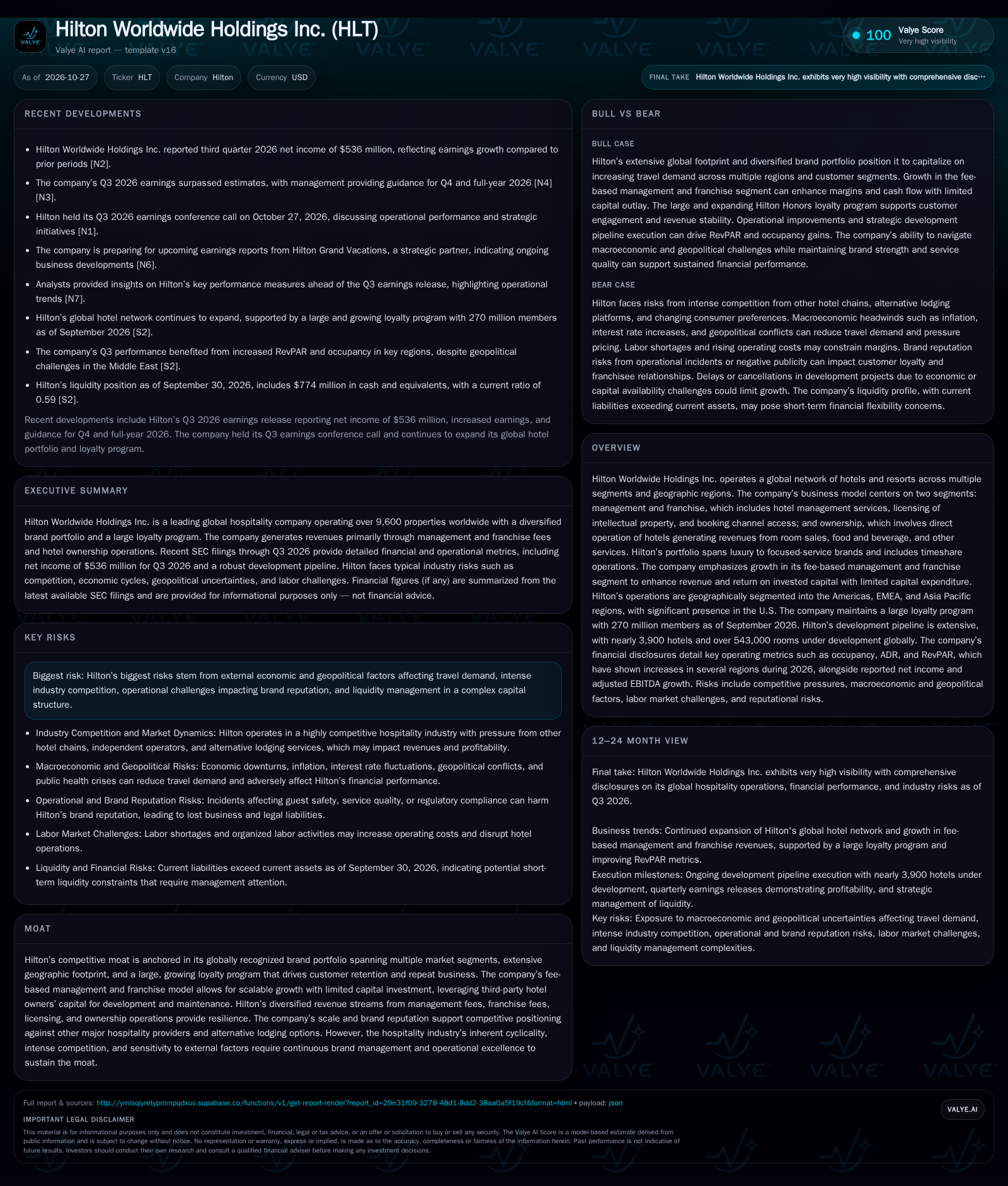
Hilton Worldwide Holdings is expanding its global hotel footprint while increasing its focus on fee-based management and franchise revenues. Key recent facts include strong net unit growth, record Hilton Honors membership, and a large development pipeline, but the company’s working capital structure reflects current liabilities exceeding current assets. The business model’s scalability and margin potential hinge on continued RevPAR gains, loyalty program engagement, and successful navigation of macroeconomic and geopolitical risks.
Hilton Worldwide’s 2026 trajectory underscores the power—and the vulnerabilities—of the modern asset-light hospitality model. With over 9,600 hotels spanning 144 countries and net unit growth outpacing industry averages, Hilton is leveraging its brand, scale, and loyalty network to drive fee-based revenue and global expansion. The balance Hilton must strike between relentless expansion and risk management will define its next phase.
Hilton's Recent Growth Drivers and Financial Trends Entering 2026
Hilton added 450 hotels and 55,500 rooms to its system in the first nine months of 2026, representing 6% net unit growth year-over-year—a pace that signals robust underlying development activity and continuing appetite for Hilton’s brands among owners and operators [S2]. This expansion is supported by a record-high 270 million Hilton Honors loyalty members, up 15% year-over-year, which reflects both organic guest acquisition and increased engagement [S2]. The company’s development pipeline remains formidable, with 3,869 hotels and 543,100 rooms under development, more than half located outside the U.S. and nearly half already under construction [S2].
Financially, Hilton delivered Q3 2026 net income of $536 million and adjusted EBITDA of $3.013 billion for the first nine months, up from the prior year [S2] [N2]. Key hotel operating metrics—occupancy at 75.8%, ADR at $164.57, and RevPAR at $124.70—showed year-over-year gains, though regional results were mixed as the Middle East and Asia Pacific faced declines due to geopolitical and regulatory disruptions [S2].
The company reported cash and liquidity metrics for the period; these figures do not by themselves establish operating runway, investment capacity, financial flexibility, or financing capacity. [S2] While this structure is common in asset-light hospitality models that rely on recurring fee streams, it also heightens sensitivity to operational shocks or unexpected downturns.
Economic Implications of Hilton’s Fee-Based Business Model
Hilton’s business model is increasingly anchored in management and franchise fees, which generated $815 million in franchise/licensing fees and $167 million in combined management fees in Q3 2026 [S2]. This asset-light approach minimizes direct capital requirements and allows Hilton to scale globally without the heavy balance sheet burden of property ownership. The management and franchise segment now encompasses the vast majority of Hilton’s properties, while the ownership segment accounts for just 45 hotels and 14,881 rooms [S2].
The economics of this model are fundamentally driven by system-wide occupancy, average daily rate (ADR), and revenue per available room (RevPAR). Because franchise and management fees are typically structured as a percentage of gross room revenues (with some incentive components tied to profitability), Hilton’s top-line growth is highly levered to increases in RevPAR and overall network size. This creates strong operating leverage during periods of rising travel demand.
However, the model also introduces variability: should occupancy or ADR decline—due to macro shocks, regional instability, or competitive pricing pressure—fee streams can fall rapidly with little buffer. The capital-light model reduces fixed costs relative to owned-asset peers, but exposes Hilton to working capital swings, particularly when current liabilities (e.g., deferred revenues, accrued expenses) outstrip current asset coverage, as seen in the latest figures [S2].
Capital needs for new development are largely borne by third-party owners, but Hilton’s ongoing investment in technology, brand standards, and loyalty infrastructure is essential to maintain competitive differentiation and pricing power. The company’s ability to expand its pipeline without stretching its own balance sheet remains a core strategic advantage, but also means that macro or owner-specific capital constraints could slow future growth.
Leveraging Brand Scale and Loyalty to Capture Owner and Guest Preference
Hilton’s primary competitive advantages are its globally recognized brand portfolio, scale, and the size of its Hilton Honors loyalty program. With 9,620 properties across 144 countries and 270 million loyalty members, Hilton can offer owners broad distribution, marketing reach, and access to a large, recurring guest base [S2]. This scale allows for negotiation leverage with suppliers, more efficient marketing spend, and network effects that reinforce brand loyalty.
However, the hospitality sector remains intensely competitive. Hilton faces direct competition from other global hotel chains with similar franchise-driven models, as well as from alternative accommodation platforms that continue to disrupt traditional travel patterns. The value proposition to both guests (consistency, rewards, service) and owners (revenue performance, cost efficiency, reservation system strength) is constantly tested by evolving consumer preferences, technology shifts, and new entrants.
Switching costs for owners are moderate—franchise agreements often run for several years and include brand-specific standards, but competitive offers from rival operators and the possibility of rebranding create ongoing retention risks. For guests, the loyalty program provides a meaningful retention lever, but the proliferation of travel platforms and alternative lodging options means that price, convenience, and experience can drive churn if Hilton’s offerings lose differentiation.
Geopolitical events, regional regulation, and labor dynamics add further complexity, impacting not only operating metrics but also the pace and feasibility of new development. Hilton’s large international pipeline creates growth optionality but also exposes the company to diverse, sometimes volatile, local market conditions.
Potential for Margin Gains Through Hilton’s Asset-Light Strategy
The most favorable scenario for Hilton is one in which global travel demand continues to recover and expand, driving sustained RevPAR and occupancy growth across major regions. In this environment, Hilton’s fee-based management and franchise revenues compound as the company adds new hotels and rooms, while incremental costs remain modest due to the capital-light structure.
If Hilton successfully leverages its loyalty program to increase direct bookings and repeat stays, it could see improvements in both pricing power and franchisee satisfaction. Strong execution on the development pipeline, particularly outside the U.S., would diversify revenue streams and reduce reliance on any single region’s economic health. Advances in technology and guest experience could further differentiate Hilton’s brands and reduce cost per acquisition.
Evidence that would confirm this scenario includes continued above-industry net unit growth, rising system-wide RevPAR and ADR, sustained growth in Hilton Honors membership, and margin expansion (e.g., EBITDA margin improvement) without a material increase in capital expenditure or working capital stress. Announcements of major new franchise agreements or successful entry into underserved markets would further support the case.
Conversely, a meaningful slowdown in unit additions, erosion in RevPAR, or flattening loyalty program metrics would falsify this scenario.
Regional Market Cycles and Their Influence on Hilton’s Growth Trajectory
The most plausible forward path for Hilton is continued, though potentially uneven, growth in hotel units and fee-based revenues, moderated by regional macroeconomic and geopolitical uncertainties. While the company’s pipeline supports system expansion, actual net additions may fluctuate as local markets experience varying demand trends, regulatory changes, or owner financing constraints.
Hilton is likely to maintain high levels of occupancy and RevPAR in core U.S. and European markets, with periodic setbacks in regions impacted by conflict or government restrictions. The loyalty program should continue to grow, but at a potentially slower rate as the base becomes larger and competitive offers proliferate.
Margins may expand modestly as scale increases, but cost inflation (labor, insurance, technology) and owner incentives could offset some gains. The working capital structure—current liabilities exceeding current assets—remains manageable as long as fee streams are stable, but could become a focus if collection cycles lengthen or deferred revenue grows faster than cash inflows.
Evidence confirming this scenario would include mid-single-digit annual net unit growth, steady system-wide ADR and RevPAR, and stable or gradually improving EBITDA. Evidence against it would be a sharp reversal in development activity, pronounced declines in regional operating metrics, or any signs of material liquidity stress.
Consequences of Economic or Geopolitical Disruptions on Hilton’s Performance
The primary risk to Hilton is a sharp, prolonged downturn in global travel demand—potentially triggered by recession, inflation, geopolitical conflict, or a new public health crisis. In such a scenario, occupancy and ADR would decline across multiple regions, directly reducing franchise and management fee streams and putting pressure on EBITDA and cash generation.
With current liabilities already exceeding current assets, a sudden contraction in cash inflows could force Hilton to draw on credit lines, renegotiate working capital terms, or slow investment in technology and brand support. Franchisees and owners facing their own cash flow pressures might delay or default on payments, increasing bad debt expense and threatening the pace of new hotel openings.
Brand reputation could also come under pressure if operational cuts or service lapses affect guest experience. Labor shortages and cost spikes may exacerbate margin compression. The development pipeline could stall if capital becomes scarce or risk aversion rises among third-party owners.
Evidence of this scenario would include sequential declines in occupancy, ADR, and RevPAR, a slowdown or reversal in net unit growth, deteriorating liquidity metrics, and negative revisions to earnings guidance. Widespread owner distress or negative headlines impacting the Hilton brand would further validate the downside.
Key Developments Influencing Hilton’s Fee-Centric Growth Strategy
Quarterly net unit additions (hotels and rooms), especially relative to pipeline projections and industry peers, to gauge Hilton’s ability to expand its system in a competitive and volatile environment.
System-wide RevPAR and ADR trends—both globally and by region—as direct indicators of pricing power, demand resilience, and owner profitability.
Growth in Hilton Honors membership and engagement metrics (if disclosed), which would reveal the loyalty program’s ongoing effectiveness in driving direct bookings and guest retention.
Franchise and management fee revenue as a percentage of total revenue, to monitor the ongoing shift to asset-light, high-margin business lines.
Working capital trends, particularly the evolution of current liabilities versus current assets and any changes in Hilton’s approach to liquidity management.
Regional performance volatility, especially in EMEA and Asia Pacific, as a signal of geopolitical or regulatory headwinds that could impact expansion plans or operating metrics.
Development pipeline conversion rates—how many hotels under development actually open on schedule—to assess execution risk and owner demand.
Any changes in cost structure, such as labor expense or technology investment, that could affect the operating leverage of the fee-based model.
Disclaimer: This is research-only, informational analysis and not investment advice. It may include AI-generated interpretation and general industry context. Always verify important details using primary sources.

Comments