
WHIRLPOOL: Margin Pressures, Geographic Refocus, and the Challenge of Restoring Profitability
Whirlpool’s recent swing to a quarterly loss and lowered full-year outlook underscore the operational and strategic headwinds it faces after major geographic deconsolidations. As the business refocuses on core markets and implements cost actions amid margin compression and tariff exposure, the central question is whether scale, brand, and operational improvements can offset declining volumes and protect long-term earnings.
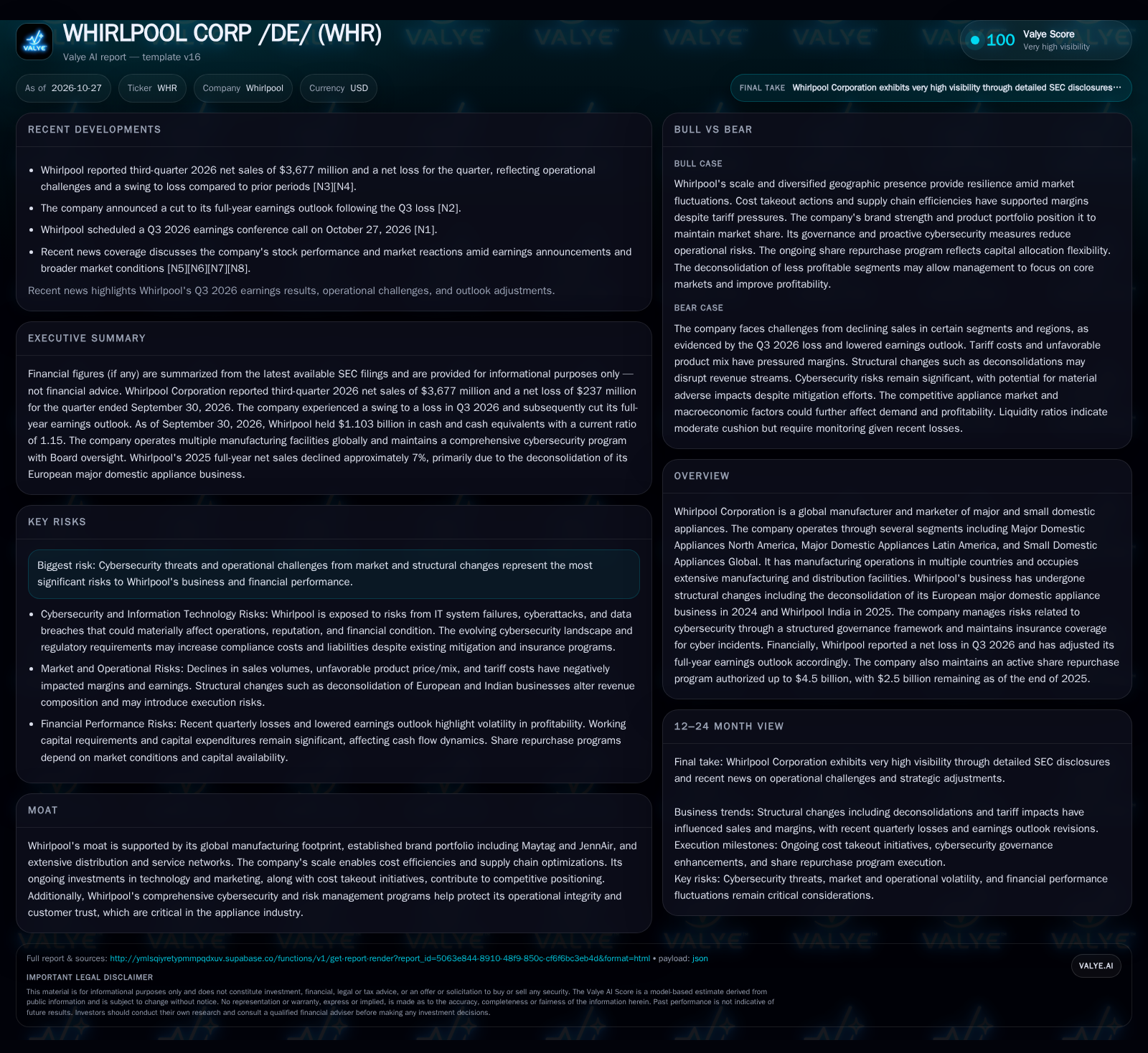
Whirlpool reported a net loss of $237 million in Q3 2026 and cut its full-year earnings outlook, with 2025 net sales down 7% primarily due to the deconsolidation of its European business. North American sales and margins declined, pressured by lower volumes, unfavorable mix, and tariffs. The company’s strategic challenge is to stabilize core markets and restore profitability amid competitive and macroeconomic headwinds, leveraging its scale and brand while managing structural and cybersecurity risks. [S2] [N2] [N3]
Whirlpool’s Q3 2026 loss, coupled with a downward revision to its annual earnings outlook, marks a decisive inflection point for the appliance giant. Following years of structural change—including the exit from its European and Indian major appliance businesses—the company now faces the challenge of restoring profitability in its remaining core markets. With North American sales under pressure and margins eroding amid tariff headwinds and unfavorable product mix, Whirlpool’s ability to leverage its scale, brand equity, and operational initiatives will be tested against an intensely competitive and mature industry landscape. The next phase hinges on whether cost takeout and strategic focus can offset volume declines and margin compression. [S2] [N2] [N3]
Recent Losses and Strategic Realignment Define the Current State
Whirlpool reported a net loss of $237 million for Q3 2026, with basic and diluted EPS of -$3.80, reflecting a swing to loss and prompting a cut to its full-year earnings outlook. Net sales for the quarter were $3,677 million. [S2] [N2] [N3]
Full-year 2025 net sales declined by approximately 7%, primarily due to the deconsolidation of the European major domestic appliance business as of April 2024, followed by the deconsolidation of Whirlpool India at the end of 2025. [S2]
North America, Whirlpool’s largest segment, saw a 0.8% decrease in net sales and a margin contraction (EBIT margin fell from 6.5% in 2024 to 4.9% in 2025), driven by lower volumes, unfavorable price/mix, and tariff costs. [S2]
The company reported a current ratio of 1.15 for the period. [S2]
Revenue Levers, Margin Compression, and Fixed-Cost Sensitivity in Appliance Manufacturing
Whirlpool’s business model is rooted in high-volume manufacturing and distribution of major domestic appliances, where scale and operational efficiency are critical for margin preservation. Gross margins in this sector are typically thin due to commoditization, price competition, and high fixed costs in manufacturing and logistics.
Volume remains the primary driver of revenue, but shifts in product mix (e.g., toward higher-margin premium appliances) and pricing power can have outsized effects on profitability. In recent periods, unfavorable mix and lower volumes have combined with tariff costs to squeeze margins, as evidenced by North America’s EBIT margin drop. [S2]
Fixed costs—plant operations, R&D, supply chain infrastructure—mean that volume declines rapidly erode profitability. Cost takeout initiatives can help, but these are often offset by inflation, tariffs, or the need for ongoing investment in technology and cybersecurity.
The deconsolidation of underperforming geographies (Europe, India) may reduce top-line scale but could, in theory, improve group margins if management tightens focus on higher-return operations. However, this also increases dependence on North America and Latin America, concentrating risk and amplifying the impact of demand fluctuations in those regions.
Brand Power and Scale Versus an Evolving Competitive and Substitution Landscape
Whirlpool’s enduring advantage lies in brand equity (Maytag, JennAir, KitchenAid), broad distribution, and a global manufacturing footprint. These factors enable some pricing power and supply chain leverage, particularly in mature markets.
However, the company faces intense competition from other global manufacturers as well as regional challengers and private-label offerings, especially as price sensitivity increases in challenging macro environments. Substitution risk from lower-cost or imported brands remains high, limiting the ability to pass through cost increases.
Recent deconsolidations remove exposure to structurally weaker regions but also cede ground to competitors in Europe and India. The question is whether a leaner footprint translates to greater focus and profitability or merely shrinks the company’s long-term addressable market.
Technological differentiation in appliances is limited, with most innovation centering on incremental efficiency, connectivity, or design improvements. While smart appliances and IoT integration offer some potential for differentiation, these features have not yet created durable switching costs or network effects. As a result, customer loyalty is largely driven by reliability, service, and promotional activity rather than lock-in mechanisms.
If Cost Takeout and Mix Improvements Gain Traction, Margins Could Recover
A plausible upside scenario is that Whirlpool’s restructuring and cost takeout actions, combined with a refocus on core geographies, allow for stabilization of volumes and a shift toward higher-margin products. If North American and Latin American demand holds steady or recovers, and if cost controls are effective in offsetting tariff and input cost pressures, EBIT margins could rebound toward historical levels.
Improved product mix—driven by premiumization, new product introductions, or successful marketing—would support gross margin expansion. Evidence for this scenario would include sequential improvements in EBIT margin (particularly in North America), stabilization or growth in unit volumes, and positive commentary on mix and pricing during earnings updates.
Successful execution would also be reflected in resumed share repurchases or increased capital returns to shareholders, signaling management confidence in sustainable free cash flow. [S2]
Falsification would come from continued margin erosion, further volume declines, or new cost headwinds that overwhelm cost savings, as well as signs of market share loss in core regions.
Realistic Outlook: Margin Stabilization Remains Elusive Amid Macro and Competitive Pressure
The most plausible scenario is that Whirlpool experiences ongoing margin pressure as it adjusts to a smaller geographic footprint and faces persistent challenges in offsetting tariffs, unfavorable mix, and competitive pricing. Modest cost savings may be achieved, but these are likely to be absorbed by inflation, ongoing supply chain volatility, and the need for continued investment in technology and cybersecurity.
Sales volumes may stabilize in North America and Latin America, but meaningful growth is unlikely without a significant market or product innovation. EBIT margins could remain below pre-deconsolidation levels, with periodic volatility tied to macroeconomic cycles and consumer demand.
Confirmation of this scenario would be visible in flat or slightly declining sales, EBIT margins stabilizing at a lower level, and cautious management commentary. Falsification would require either a sustained improvement in margins and volumes or a marked deterioration leading to further restructuring or capital raises.
Prolonged Volume Declines and Margin Squeeze Could Force Further Retrenchment
A negative scenario unfolds if North American and Latin American markets weaken further, either due to macroeconomic slowdown, aggressive competitive pricing, or ongoing cost inflation that cannot be offset. In this case, fixed-cost leverage would drive deeper losses, erode cash reserves, and potentially force Whirlpool to consider additional asset sales, plant closures, or even further geographic retrenchment.
Margin compression could accelerate if tariffs increase, supply chain disruptions persist, or if the company is forced to discount heavily to defend share. Evidence would include consecutive quarters of widening losses, rapid cash burn, and management guidance pointing to further restructuring or capital conservation measures.
Falsification would require signs of stabilization—such as an unexpected rebound in volumes, successful new product launches, or evidence that cost actions are finally outpacing headwinds.
Factors That Will Determine Whether Whirlpool Can Restore Earnings Power
Sequential changes in EBIT margin by segment, especially in North America, as a direct measure of cost control and mix improvement.
Quarterly unit sales or shipment volumes in core product categories, which would signal whether demand is stabilizing or declining further.
Commentary and disclosures on premium product mix, price realization, and promotional activity—indicators of success in margin management.
Updates on tariff exposure, supply chain costs, and the effectiveness of ongoing cost takeout initiatives.
Capital expenditure trends and working capital swings, both of which affect cash flow resilience.
Progress or changes in the $2.5 billion remaining share repurchase authorization, which could signal management’s confidence in free cash flow.
Incidents or escalations in cybersecurity events, along with insurance claim disclosures, as a gauge of operational risk management.
Management guidance on further restructuring, asset sales, or geographic rationalization—any moves that would alter the company’s long-term scale and scope.
Disclaimer: This is research-only, informational analysis and not investment advice. It may include AI-generated interpretation and general industry context. Always verify important details using primary sources.

Comments