
INNIO N.V.: Distributed Energy Engines, Data Center Demand, and the Lifecycle Service Opportunity
INNIO N.V. delivers modular gas-powered energy solutions for mission-critical infrastructure, with a growing installed base and a clear pivot toward data centers. While recent financials confirm robust revenue and net income, the company’s long-term value creation will hinge on lifecycle services, competitive differentiation in a crowded market, and its ability to capitalize on accelerating data center energy needs.
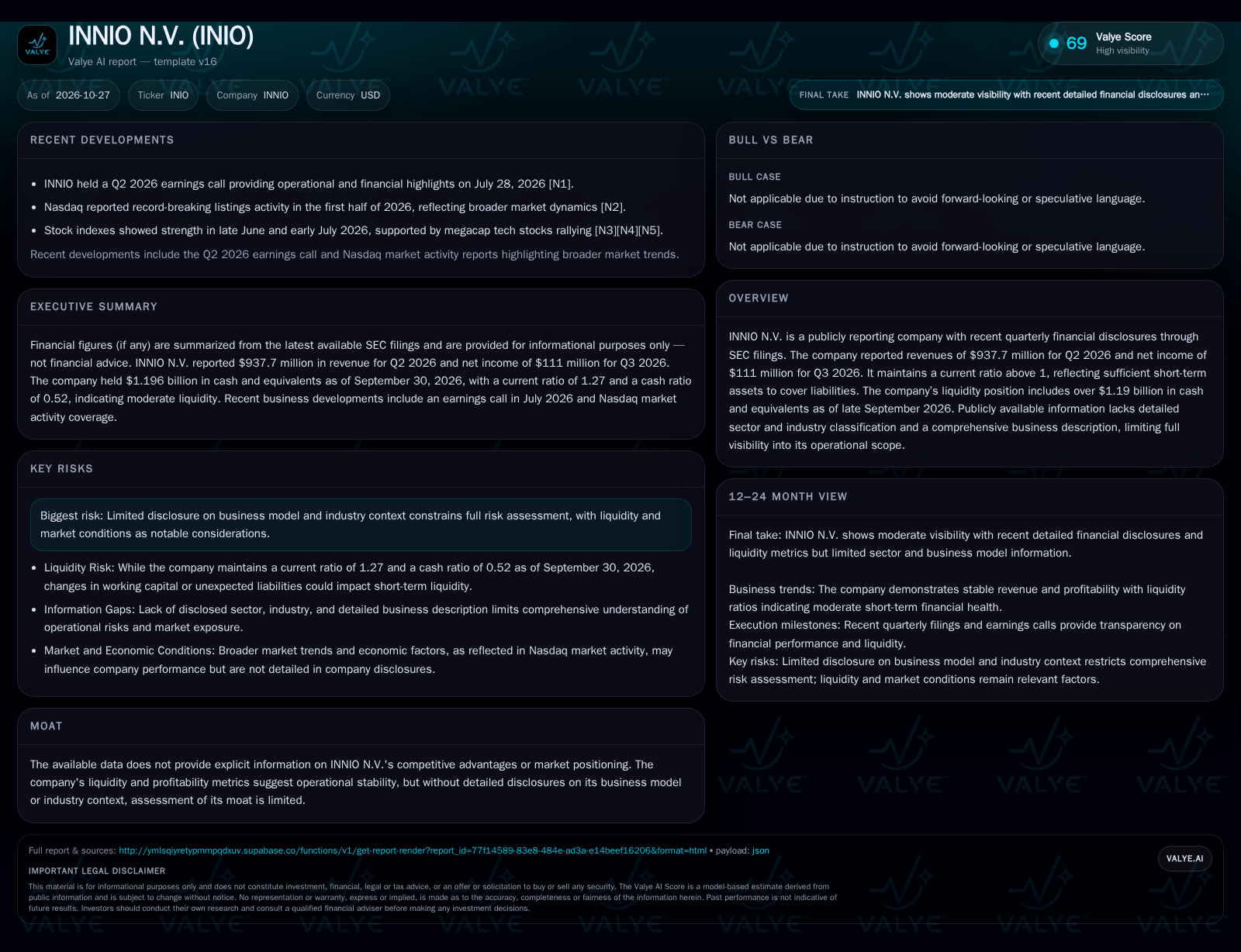
INNIO N.V. reported $937.7M in Q2 2026 revenue and $111M in Q3 2026 net income, anchored by a $1.2B cash balance and a current ratio of 1.27. The company’s modular gas engine platforms target grid, industrial, and increasingly data center customers, with a large installed base driving services revenue. The core questions now are whether INNIO can sustain growth as energy solutions markets shift and if its service moat is defensible.
INNIO N.V. stands at a crossroads of the global energy transition, leveraging decades of gas engine technology to serve mission-critical applications from grids to data centers. Recent financials show strong profitability and liquidity, but the company’s future will be shaped by how well it navigates the evolving needs of infrastructure operators—especially as data centers demand rapid, reliable, and scalable power. With a large installed base feeding its services business, INNIO’s ability to maintain a lifecycle moat and adapt to shifting market requirements will determine its competitive durability.
Recent Financial Performance and Operational Focus
INNIO N.V. reported revenue of $937.7 million for Q2 2026 and net income of $111 million for Q3 2026, signaling continued operational scale and profitability. As of September 30, 2026, the company held $1.196 billion in cash and equivalents, with current assets of $2.923 billion and current liabilities of $2.297 billion, yielding a current ratio of 1.27. [S1]
Strategically, INNIO operates two core segments: Equipment (modular gas engines for power, compression, and data centers) and Services (maintenance and parts for its installed base). The installed base reached approximately 44 GW by year-end 2025, up from 42 GW the prior year, reinforcing a recurring service revenue opportunity as these systems require regular upkeep [S1].
How INNIO’s Modular Engines and Services Generate Value
INNIO’s business model hinges on the sale of modular reciprocating gas engines and the ongoing servicing of a large, mission-critical installed base. The initial sale of equipment—targeting data centers, grid operators, and industrial customers—provides up-front revenue, but the longer-term economics are shaped by lifecycle services. These include scheduled maintenance, proprietary replacement parts, and technical support, which can carry higher margins and more predictable cash flow than equipment sales alone.
The company’s proprietary component design supports a ‘razor-and-blade’ dynamic: once installed, customers rely on INNIO for essential service and parts. This can create recurring revenue streams and potential pricing power, especially if switching to third-party service providers is technically challenging or risks voiding warranties. However, the actual degree of pricing power and retention depends on contract structures, customer bargaining power, and the technical complexity of the equipment.
Capital needs for the equipment segment are likely substantial—covering R&D, manufacturing, and working capital—while the services segment may offer higher operating leverage as the installed base grows. The mix between new equipment and services revenue will influence margins, cash generation, and resilience to cyclical swings in capital spending by customers.
Lifecycle Moat or Commodity Trap? Assessing INNIO’s Defensibility
INNIO’s competitive position is rooted in its portfolio of modular, high-efficiency gas engines and a growing installed base that anchors its services business. The company’s focus on gaseous fuels (natural, renewable, specialty gases) rather than diesel aligns with decarbonization trends and regulatory pressures in many markets.
Key potential advantages include: proven technology in demanding applications, a captive installed base, and proprietary components that may raise switching costs for lifecycle services. However, the market for distributed energy solutions is highly competitive, with global engine OEMs, alternative power providers, and emerging battery or hydrogen technologies all vying for share. Data centers—a priority growth area—are particularly sensitive to power reliability, scalability, and total cost of ownership, making them discerning buyers.
A central question is whether INNIO’s proprietary designs and field track record are sufficient to defend service margins against both traditional rivals and new technology entrants. If customers can credibly dual-source service or if new power architectures (e.g., grid-scale batteries or fuel cells) undercut the value of gas engines, the lifecycle moat could erode.
Capturing the Data Center Power Boom and Deepening Service Attach Rates
A favorable trajectory for INNIO would see accelerating adoption of its modular gas engines as data centers proliferate and demand high-reliability, scalable backup and prime power. If INNIO’s systems prove materially faster to deploy, more capital efficient, or operationally superior for data center workloads—especially those driven by AI and high-density compute—the company could gain share in this fast-growing vertical.
Upside would be confirmed if INNIO reports a rising proportion of equipment sales to data center customers, increasing service contract penetration rates, and expanding aftermarket revenues as a share of total sales. Additional signs would include new multi-year service agreements, lower churn in the installed base, and evidence that proprietary components continue to lock in customers over the lifecycle. Strategic wins in emerging markets or with hyperscale operators would further support the bull case.
Sustaining Installed Base Services Amid Evolving Market Dynamics
The most plausible outlook is that INNIO maintains steady equipment sales into core infrastructure and industrial markets, with services revenue tracking the gradual expansion and aging of its installed base. The company continues to benefit from recurring maintenance and parts revenue, but faces ongoing pricing pressure and the need to invest in R&D to keep pace with evolving customer requirements.
Evidence supporting this scenario would include stable or incrementally growing installed base figures, consistent gross margins on services, and continued renewal of service contracts. Market share in core segments remains broadly stable, but breakthrough wins in new verticals (like data centers) are incremental rather than transformative. Headwinds could arise if alternative energy solutions gain traction faster than anticipated or if customers push back on service pricing.
Margin Compression and Substitution Risk in a Shifting Energy Landscape
A negative outcome could materialize if energy technology shifts or regulatory changes accelerate the adoption of alternatives to gas engines—such as battery storage, hydrogen solutions, or grid enhancements—dampening demand for INNIO’s core equipment. In this scenario, new equipment sales could slow, and the installed base might shrink as older systems are retired or replaced by substitutes.
Service margin erosion could also occur if customers become more price-sensitive, if third-party providers succeed in servicing INNIO equipment, or if proprietary component advantages are undermined by regulatory mandates or technical standardization. This would be evidenced by declining aftermarket revenue, eroding service margins, or increased customer attrition.
Milestones and Metrics That Will Define INNIO’s Long-Term Value
Quarterly trends in installed base growth—especially new deployments in data center and grid applications—will clarify demand momentum.
Breakdown of revenue mix between equipment and services, if disclosed, would illuminate the durability of recurring cash flows.
Gross margin trends by segment (equipment vs. services) would help assess pricing power and cost discipline.
Service contract renewal and attachment rates are critical for testing lifecycle moat strength; disclosure would be valuable.
Customer concentration metrics (e.g., share of revenue from top customers or regions) would reveal risk exposure.
Evidence of technology adoption or substitution (e.g., customer wins for battery or hydrogen systems) could challenge the core thesis.
Any material changes in working capital, unexpected liabilities, or guidance on capital allocation would affect liquidity and resilience.
Disclosures on regulatory or policy shifts affecting gaseous fuel solutions versus alternatives would help frame long-term demand.
Disclaimer: This is research-only, informational analysis and not investment advice. It may include AI-generated interpretation and general industry context. Always verify important details using primary sources.

Comments