
Itron’s Multi-Segment IIoT Strategy: Recurring Revenue Growth, Integration Risks, and the Battle for Smart Infrastructure Leadership
Itron’s expanding portfolio across hardware, software, and AI-driven services is yielding material growth in recurring revenue and operational profitability, but the company’s ability to sustain momentum hinges on integration execution, competitive innovation, and the evolving needs of utility and municipal customers.
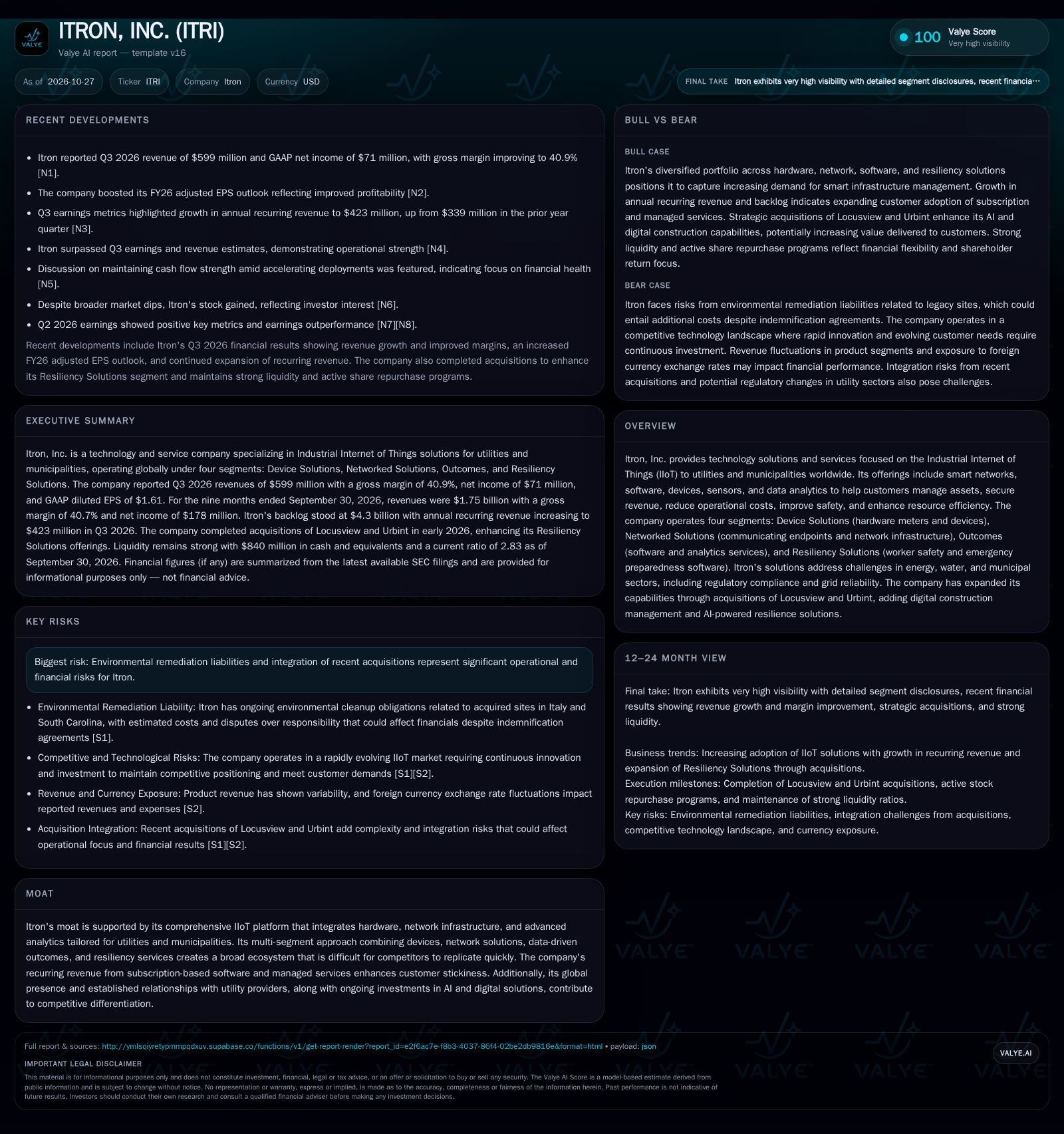
Itron reported Q3 2026 revenues of $599.3 million (up 3% YoY), gross margins near 41%, and annual recurring revenue of $423 million, reflecting growing traction in its software and services offerings. [S2] [N1] [N2]
Itron, Inc. is sharpening its focus on the intersection of hardware, network infrastructure, and advanced analytics for utilities and municipalities as the Industrial Internet of Things (IIoT) revolution accelerates. Recent financial results highlight not only stable core operations but also a pronounced shift toward software-driven, recurring revenue streams. The company’s $4.3 billion backlog and expanding Resiliency Solutions segment—strengthened by the acquisitions of Locusview and Urbint—signal ambition to capture a greater share of smart infrastructure investments. However, the challenge remains to integrate new capabilities, defend against agile competitors, and navigate sector-specific risks ranging from regulatory disruption to legacy environmental liabilities.
Recent Results Signal Software Traction and Strategic Expansion
Itron reported Q3 2026 revenues of $599.3 million, a 3% year-over-year increase, with gross margin expanding to 40.9% [S2] [N1]. Net income for the quarter was $71.4 million, and annual recurring revenue (ARR) rose to $423 million, up from $339 million in the prior year [S2]. The company’s $4.3 billion backlog, with $1.7 billion expected to convert within twelve months, offers near-term revenue visibility [S2]. Early 2026 acquisitions of Locusview and Urbint introduced new AI-powered and digital construction management capabilities under the newly formed Resiliency Solutions segment [S1] [S2]. The company reported cash and liquidity metrics for the period; these figures do not by themselves establish operating runway, investment capacity, financial flexibility, or financing capacity. [S2]
Recurring Revenue, Margin Structure, and the Economics of IIoT Expansion
Itron’s business model blends device sales, network infrastructure, and subscription software/services. Device Solutions (meters, sensors) and Networked Solutions (endpoints, connectivity) drive upfront hardware revenue, while the Outcomes and Resiliency Solutions segments increasingly anchor recurring, higher-margin revenue through software subscriptions, analytics, and managed services [S1] [S2]. The company’s 40.7-40.9% gross margin reflects this mix, with software/services likely diluting the volatility and lower margins of hardware shipments.
Annual recurring revenue (ARR) growth to $423 million points to a successful pivot toward more predictable, subscription-based economics—a crucial defense in cyclical or project-driven utility markets [S2]. Fixed costs in R&D, software development, and network infrastructure may create operating leverage as recurring revenue scales; however, capital requirements remain significant for ongoing platform investment, AI capability expansion, and integration of acquired technologies.
The economics of IIoT deployment are sensitive to customer adoption cycles and regulatory-driven upgrade mandates. Hardware refreshes tend to be lumpy, but software and analytics layers—if successfully embedded—could increase customer lifetime value and reduce churn. The question is whether Itron’s bundled approach can drive higher wallet share without eroding margins through heavy customization or integration costs.
Defending the Utility Edge: Ecosystem Breadth Meets Specialized Rivals
Itron’s competitive positioning relies on its ability to offer an end-to-end IIoT solution for utilities and municipalities, spanning hardware, connectivity, analytics, and operational resilience. This breadth creates switching frictions for customers already invested in Itron’s ecosystem, particularly as regulatory compliance and long asset lifecycles make utilities risk-averse to wholesale platform changes.
However, the competitive landscape is dynamic. Specialized software vendors, vertically integrated infrastructure giants, and emerging AI startups all target slices of the smart grid, grid edge device, and smart city value chains. Competitors may offer best-of-breed analytics, lower-cost sensors, or more flexible cloud-native solutions. Itron’s challenge is to maintain differentiation through integration, reliability, and domain expertise—while ensuring its legacy hardware does not become commoditized.
The integration of Locusview and Urbint may strengthen Itron’s hand in digital construction and AI-powered resilience, but also invites execution risk. Customer procurement cycles, regulatory standards (such as cybersecurity requirements), and rapid innovation in AI-driven grid management could all reshape the field. Ultimately, Itron’s moat will depend on continued investment in software, proven interoperability, and the ability to demonstrate ROI to conservative utility buyers.
If Integration Delivers and Utilities Accelerate Digital Modernization
The most favorable scenario sees Itron capitalizing on the industry’s shift to digital, networked, and resilient infrastructure. Successful integration of Locusview and Urbint could enable Itron to offer a differentiated platform—combining meter data, grid intelligence, digital construction, and operational resilience—tailored for utility and municipal buyers seeking end-to-end solutions.
If ARR continues its current growth trajectory, and the Resiliency Solutions segment gains traction, Itron could see a rising proportion of high-margin, recurring software and analytics revenue, improving both profitability and revenue visibility. Confirmation would come from sustained ARR growth, margin expansion, and increasing share of revenue from Outcomes and Resiliency Solutions.
Additional upside could be realized if regulatory mandates or infrastructure stimulus drive accelerated utility adoption of advanced metering, grid management, and safety solutions. Evidence would include new multi-year contracts, expansion of the customer base into new regions, and increased backlog conversion rates.
Steady Progress Anchored by Backlog, Mixed by Hardware Cyclicality
The most plausible path is one of stable, moderate growth as Itron executes on its backlog, gradually increases ARR, and integrates its recent acquisitions. Hardware and network project revenues may remain subject to cyclical utility spending and regulatory timelines, while the software/services mix continues to rise but does not yet dominate total revenues.
Confirmation would come from consistently meeting or modestly exceeding revenue and margin guidance, stable or slightly improving ARR, and incremental progress in Outcomes and Resiliency Solutions adoption. Falsification would be visible in stalled ARR growth, margin compression from integration costs, or significant delays in new segment adoption.
This scenario assumes no dramatic competitive displacement, but also no step-change in utility spending or regulatory drivers. Environmental remediation liabilities and integration-related expenses may create periodic headwinds, but are not thesis-breaking unless they materially escalate.
Execution Stumbles, Integration Drag, and Competitive Pressure Erode Momentum
In a more adverse scenario, Itron faces substantial integration challenges with Locusview and Urbint, resulting in higher-than-expected costs, operational distractions, or customer dissatisfaction. If new software and resiliency offerings fail to gain traction, ARR growth could stall, and the company may revert to lower-margin, project-based hardware sales.
Competitive threats from more agile or lower-cost rivals could accelerate margin pressure, especially if utilities opt for modular, cloud-native solutions over Itron’s integrated platform. Environmental remediation liabilities could unexpectedly escalate, impacting cash flows or necessitating reserve increases.
Evidence supporting this scenario would include declining ARR, gross margin erosion, missed earnings or backlog conversion targets, and customer losses or delayed project deployments. Watchpoints would be any signs of deteriorating customer satisfaction, elevated churn, or adverse regulatory/regional developments.
Milestones That Will Define Itron’s Ability to Compound Value in IIoT
Sustained ARR growth and its share of total revenue, especially from the Outcomes and Resiliency Solutions segments.
Gross margin trajectory, particularly as software/services adoption scales and integration costs are absorbed.
Backlog conversion rates—tracking how much of the $4.3 billion backlog turns into recognized revenue within expected periods.
Integration progress for Locusview and Urbint, with qualitative updates on customer uptake and product roadmap synergies.
Environmental remediation expense trends and any updates to estimated liabilities or indemnification recovery.
Customer retention rates, win/loss data, and expansion within existing accounts (if disclosed).
New contract announcements or expansions in geographies/verticals outside Itron’s traditional core, signaling successful cross-selling or platform expansion.
Operating cash flow generation relative to net income, as an indicator of underlying business quality and ability to self-fund growth.
Disclaimer: This is research-only, informational analysis and not investment advice. It may include AI-generated interpretation and general industry context. Always verify important details using primary sources.

Comments