
TechCom, Inc.: Shell Status, Structural Hurdles, and Reverse Merger Potential
With no operations, assets, or liquidity, TechCom, Inc. is a shell company seeking a merger to regain operational relevance. The company’s future depends entirely on its ability to attract and consummate a deal with an operating business—yet the structural headwinds are substantial, and its deficit and lack of resources raise the bar for any turnaround.
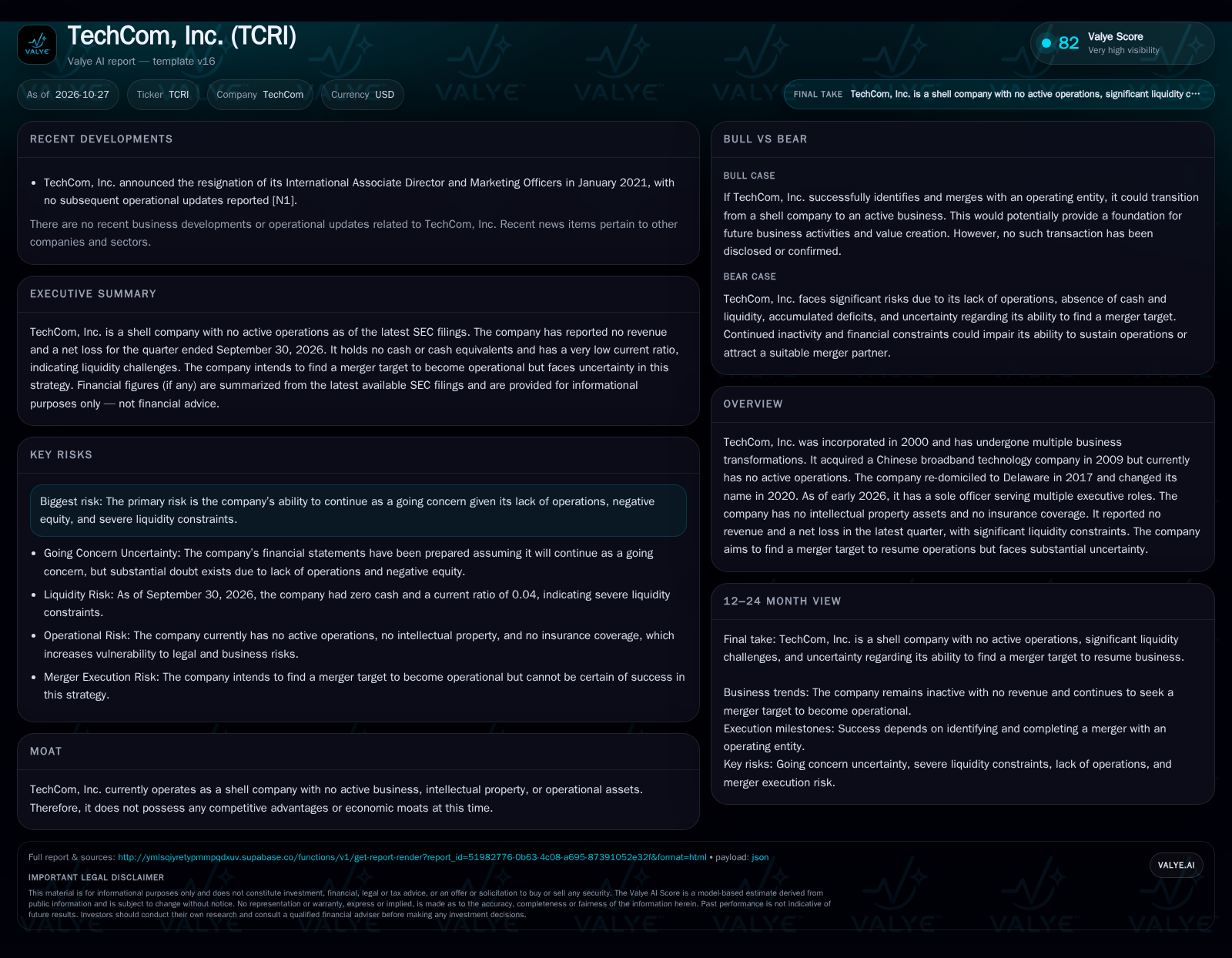
TechCom, Inc. is a shell company with no ongoing business, cash, or intellectual property, and a significant stockholders’ deficit. The thesis now hinges entirely on the likelihood and quality of a reverse merger, with little margin for error or delay. [S2]
TechCom, Inc. stands at a business dead end: the company has no ongoing operations, no assets or cash, and no intellectual property, and is run by a single executive. Its stockholders’ deficit and lack of liquidity mean there is little room for maneuver. The sole strategic lever is to secure a reverse merger with an operating company—a path that, while possible in principle, is fraught with execution risk and highly contingent outcomes. Investors and stakeholders face a binary scenario: either TechCom, Inc. successfully attracts a viable partner and reboots as a going concern, or it continues to languish as a shell with mounting deficits and limited prospects. [S2]
Operations Halted, Negative Equity, and a Singular Strategic Route
As of September 30, 2026, TechCom, Inc. reported no operating activity, zero revenue, and a net loss of $11,324 for the quarter. The company’s balance sheet showed zero cash and cash equivalents, a current ratio of 0.04, and a stockholders’ deficit of $307,913. It holds no intellectual property, assets, or insurance, and is managed solely by Mr. Aziz Ali, who occupies all executive and board roles. The company’s only stated strategy is to seek a merger target to regain operational status, but there is no assurance of success or timeline for such a transaction. [S2]
Value Creation and Destruction Within a Shell Company Framework
TechCom, Inc. currently generates no revenue and incurs minimal expenses associated with maintaining its listing and corporate existence. With no assets or operations, its business model is, in effect, dormant. The only plausible route to value creation is through a reverse merger—where a private operating company merges into the public shell to obtain a stock market listing without the cost and scrutiny of a traditional IPO.
If a reverse merger occurs, future value would depend entirely on the economics of the operating business injected into the shell: its revenue streams, cost structure, and capital needs. The shell status may appeal to small- or mid-stage private enterprises seeking fast-track public access but also brings risks—such as legacy deficits, potential litigation exposure, and the dilution typically associated with recapitalizing a distressed entity.
The company’s lack of cash means it cannot fund due diligence or pay for regulatory, legal, or listing fees without external support. Any deal would likely require substantial new capital, either from the merger partner or external investors, and would almost certainly involve highly dilutive equity issuance. No operating leverage or fixed/variable cost dynamics are currently relevant, as TechCom has no activities beyond minimal compliance costs. [S2]
Public Listing as the Sole Asset in an Asset-Light Company
TechCom, Inc. does not possess any competitive advantages: it has no operations, intellectual property, assets, or customer relationships. Its only potential differentiator is its status as a publicly listed shell, which may be attractive to certain private companies seeking a shortcut to public markets via a reverse merger.
However, the supply of clean, operationally inactive shells is significant, and regulatory scrutiny of reverse mergers has increased in recent years, especially following high-profile abuses in the past. Competitor shells with cleaner balance sheets, lower deficits, or more proactive sponsorship may be preferred by merger candidates. Additionally, alternatives such as SPACs (special purpose acquisition companies) and direct listings provide other pathways for private companies considering public market access.
In sum, TechCom’s competitive position is weak: it faces both structural and reputational disadvantages relative to alternative shells, and the public listing alone is not a strong magnet unless paired with favorable deal terms, sponsor support, or other facilitating factors.
Unlocking Potential Through a Successful Reverse Merger
The only realistic bull case is that TechCom, Inc. attracts a high-quality operating company as a merger partner, resulting in a reverse merger that injects an active business, new management, and fresh capital into the shell. This could transform the entity into a functioning operating company, potentially unlocking value for legacy shareholders if the merged business is viable and the transaction terms are not egregiously dilutive.
Confirmation of this scenario would require a binding merger agreement, public disclosure of the operating company’s financials and business plan, evidence of committed capital to recapitalize the shell, and regulatory approval. Early indicators might include engagement of investment banks or advisors, 8-K filings announcing term sheets or letters of intent, and the appointment of credible management with relevant industry experience.
A successful merger could result in a rerating of the company’s shares as the market prices in the prospects of the new operating business. However, the actual value realized by legacy shareholders would depend on the terms of the deal—especially the post-merger ownership structure, recapitalization mechanics, and any liabilities retained or assumed.
Likely Outcomes Without a Merger: Decline and Stagnation
Absent a merger or capital infusion, the most plausible outcome is that TechCom, Inc. remains in stasis as a non-operating shell. With no revenue, assets, or cash, and ongoing compliance and minimal administrative costs, the stockholders’ deficit is likely to deepen over time, potentially triggering further going concern warnings.
This scenario would be confirmed by continued inactivity in SEC filings—no announcements of merger negotiations, no engagement of advisors, and no change in management composition. The company’s filings would continue to report zero revenue, mounting deficits, and no tangible progress toward operational status.
While such shells can persist for years, the longer TechCom remains inactive, the less attractive it becomes as a merger vehicle due to the compounding deficit, potential delisting risk, and reputational overhang.
Risks of Extended Dormancy or Delisting Consequences
If TechCom, Inc. fails to secure a merger partner or capital infusion within a reasonable time frame, deeper downside risks materialize. The company could eventually face delisting from its exchange if it fails to meet listing requirements or maintain compliance. With no assets, cash, or insurance, any unexpected legal or regulatory claim could further impair the shell or result in administrative dissolution.
Signs this scenario is playing out would include repeated going concern qualifications, warnings about imminent delisting, or the company ceasing to file timely reports with the SEC. If the shell becomes too encumbered by deficits or legal issues, it may become effectively unmarketable as a merger vehicle—erasing any residual value for shareholders.
Legacy shareholders would then be left with an illiquid, non-operating entity with little to no prospect of value realization.
Key Developments and Concerns in TechCom’s Shell Company Outlook
Any 8-K filing or press release disclosing a letter of intent, term sheet, or definitive agreement with a merger target would be a material development.
Engagement of investment banks, legal counsel, or M&A advisory firms would suggest progress toward a transaction.
Appointment of new directors or officers with relevant operating experience could signal preparatory steps for a merger.
Disclosure of a capital injection, bridge financing, or recapitalization plan would indicate near-term funding and deal prospects.
SEC notices or warnings about listing compliance or going concern status would highlight mounting risks.
A useful metric would be any disclosed merger consideration structure—specifically, the dilution impact on legacy shareholders.
Continued inactivity in filings, with no mention of deal progress or capital plans, would reinforce the status quo scenario.
If disclosed, any legal or regulatory proceedings that might encumber the shell or complicate a merger should be closely monitored.
Disclaimer: This is research-only, informational analysis and not investment advice. It may include AI-generated interpretation and general industry context. Always verify important details using primary sources.

Comments