
CMS Energy: Utility Earnings Stability, Clean Energy Goals,
Its ability to manage working capital, debt, and regulatory change will determine whether it can convert stable cash flows and sustainability positioning into durable value.
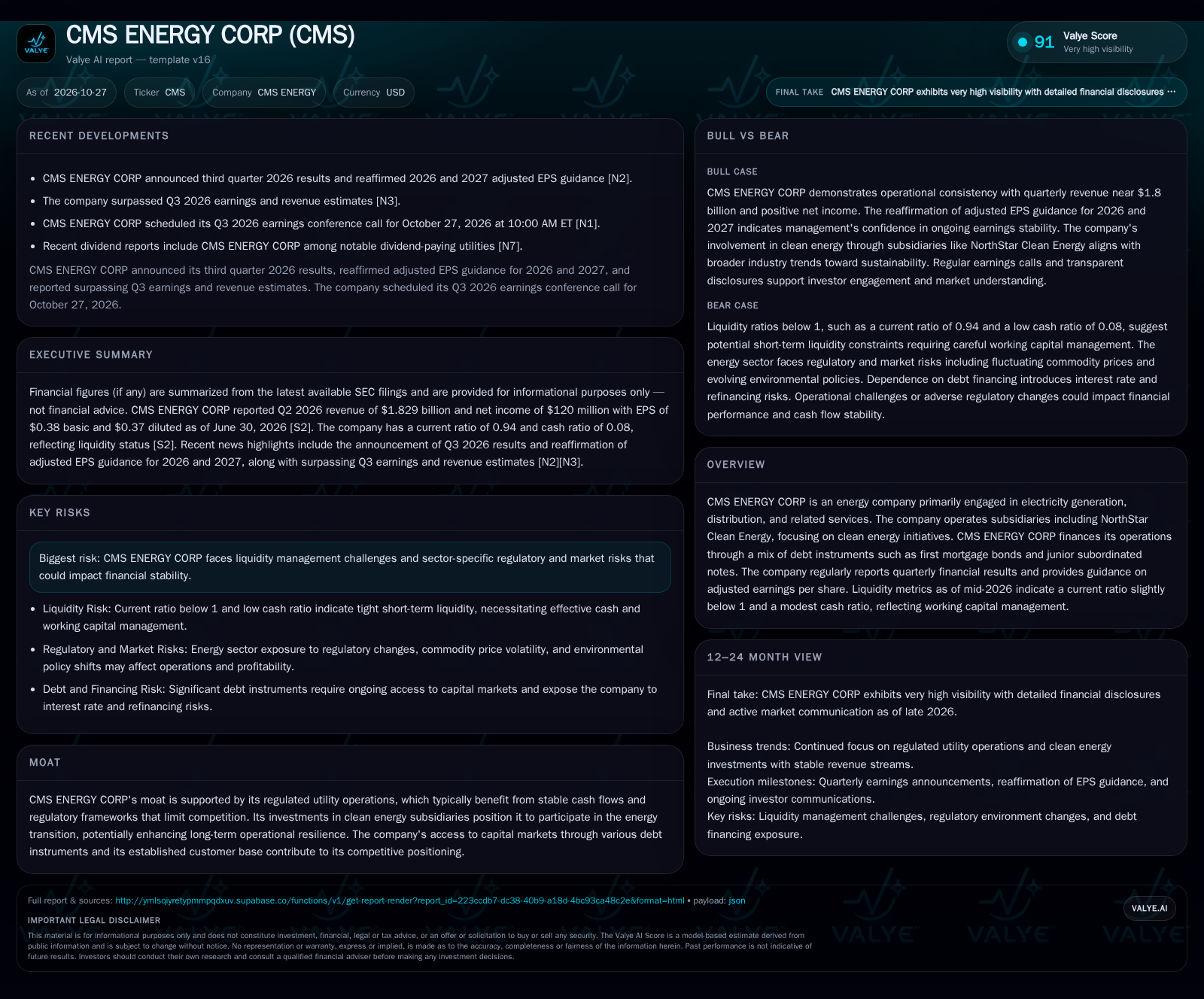
CMS Energy Corp reported Q2 2026 revenue of $1.829 billion and net income of $120 million, maintaining its track record of stable regulated utility earnings. The company is investing in clean energy through subsidiaries like NorthStar Clean Energy, positioning for the sector’s energy transition. The company’s reliance on debt and exposure to regulatory change remain central to its risk profile. Surpassing Q3 2026 estimates and reaffirming EPS guidance suggest operational momentum, but liquidity and policy headwinds are key watchpoints. [S2] [N2] [N3]
CMS Energy Corp stands at a familiar crossroads for regulated utilities: balancing the promise of stable, predictable earnings with the demands of capital-intensive infrastructure, evolving energy policy, and tight liquidity. The company’s strong Q2 2026 financials and consistent performance through Q3 highlight the resilience of its core utility operations. Yet, as CMS ramps up clean energy investments and manages a substantial debt load, its ability to navigate short-term liquidity pressures and sector headwinds will be central to its value creation prospects. The current environment demands not just operational execution, but also deft financial and regulatory management.
2026 Financial Performance and Liquidity Highlights
CMS Energy reported Q2 2026 revenue of $1.829 billion with net income of $120 million, continuing its pattern of stable, regulated utility earnings [S2]. Basic and diluted EPS for the quarter were $0.38 and $0.37, respectively [S2]. The company reported a current ratio of 0.94 for the period. [S2] The company exceeded Q3 2026 estimates and reaffirmed 2026–2027 EPS guidance, signaling operational momentum and management confidence in delivering on financial targets [N2] [N3]. These facts collectively highlight both the stability and the ongoing financial balancing act inherent in CMS’s business model.
The Impact of CMS Energy’s Regulated Framework and Capital Needs
CMS Energy primarily generates revenue through regulated electricity generation, transmission, and distribution, which typically ensures predictable cash flow due to cost recovery frameworks and allowed returns set by state regulators. This stability is foundational, but it comes with limited pricing flexibility and necessitates large, ongoing capital expenditures to maintain and modernize infrastructure.
The company’s investments in clean energy, such as those through NorthStar Clean Energy, may offer new growth avenues and regulatory goodwill but generally require substantial upfront capital and long payback periods. The economics of these projects often hinge on regulatory approval for cost recovery and incentives for renewable integration.
CMS’s funding model relies heavily on debt, including first mortgage bonds and junior subordinated notes [S2]. While this enables large-scale investment, it brings significant fixed interest costs and refinancing exposure—a risk magnified in higher rate environments. Operating leverage is moderate: cost structures are largely fixed due to asset intensity, but incremental margin expansion is possible if rate base grows faster than operating expenses.
The regulated utility framework inherently limits CMS Energy's pricing power but simultaneously reduces revenue volatility, creating a trade-off between stability and growth potential. This dynamic necessitates a strategic focus on rate base expansion and operational efficiency to drive earnings growth. The company’s capital-intensive nature means that even modest improvements in regulatory allowed returns or accelerated asset deployment can have outsized impacts on profitability. Additionally, the timing and predictability of regulatory approvals critically influence the cash flow profile, as delays can extend payback periods and increase financing costs. Understanding the interplay between regulatory cycles and capital expenditure schedules is essential to evaluating CMS’s long-term economic viability.
Strong Utility Positions Amid Shifting Policy and Technological Challenges
CMS Energy’s competitive advantage is rooted in its status as a regulated utility with geographic and infrastructure moats—entry barriers are high, and its customer base is captive. The regulatory framework provides some insulation from direct competition and disruptive pricing. However, the company faces indirect competition and substitution threats from distributed energy resources, large-scale renewables, and potential policy-driven changes favoring new entrants or accelerated decarbonization.
Peer utilities are also accelerating clean energy investments, meaning that CMS’s advantage from early or aggressive renewables adoption may be temporary unless it can leverage scale, execution, or regulatory relationships more effectively. Access to capital markets remains a differentiator; any deterioration in credit profile or liquidity could erode this edge. Additionally, as technology costs fall, customer adoption of behind-the-meter solar, storage, or demand response could gradually chip away at the traditional utility revenue base.
Value Growth Potential Through Clean Energy Initiatives and Regulatory Support
The most favorable path for CMS Energy involves sustained operational performance in its regulated utility business, successful execution of clean energy investments, and a supportive regulatory environment that allows for timely cost recovery and fair returns. If CMS can continue exceeding earnings estimates, contain operating expenses, and demonstrate progress on decarbonization goals through NorthStar Clean Energy, it could see multiple expansion and improved access to capital.
Evidence that would confirm this scenario includes regulatory approval for major capital projects, ongoing outperformance versus financial guidance, credit rating stability or improvement, and clear progress on renewable energy targets (such as new capacity additions or carbon reduction milestones). Conversely, delays in project approvals, cost overruns, or regulatory pushback would falsify the upside thesis.
Ongoing Utility Operations Coupled with Gradual Clean Energy Advancements
The most plausible near-term outcome is that CMS Energy continues to deliver stable, regulated utility earnings and incremental growth in clean energy, but faces ongoing liquidity management challenges and only modest margin expansion. Revenue and EPS are likely to track within guidance ranges, supported by cost recovery mechanisms and manageable operating costs.
In this scenario, clean energy investments progress but do not materially outpace sector peers, and the company’s balance sheet remains tight, requiring continued vigilance on working capital and refinancing. Confirmation would come from consistent quarterly results, stable or gradually improving liquidity ratios, and steady regulatory relationships. Deterioration in liquidity, missed guidance, or a spike in financing costs would challenge this scenario.
Potential Value Risks from Liquidity Pressures and Regulatory Obstacles
A more adverse outcome could emerge if CMS encounters a working capital crunch, faces unfavorable regulatory decisions, or is hit by a credit market dislocation.
This scenario would be confirmed by increasing short-term borrowings, credit rating downgrades, missed or withdrawn financial guidance, or abrupt management changes. Early warning signs include a further decline in liquidity ratios, rising interest expense, or negative regulatory developments affecting cost recovery or allowed returns.
Factors Influencing CMS Energy’s Ability to Sustain Shareholder Returns
Progress reports and regulatory approvals for major clean energy projects—especially through NorthStar Clean Energy—would help validate the growth and transition thesis.
Updates on the company’s debt maturity schedule, refinancing activity, and interest expense trajectory will signal balance sheet risk or resilience.
EPS guidance updates and the frequency with which CMS meets, exceeds, or misses internal and external forecasts will indicate operational consistency.
Any changes in regulatory environment—such as new rate cases, policy shifts, or adverse rulings—would directly impact cost recovery, margins, and capital allocation.
If disclosed, customer adoption rates of distributed energy resources (solar, storage, demand response) would test the company’s ability to defend its traditional utility revenue base.
Peer utility developments—such as clean energy project wins, regulatory outcomes, or credit events—will provide context for CMS’s relative performance and risk.
Disclaimer: This is research-only, informational analysis and not investment advice. It may include AI-generated interpretation and general industry context. Always verify important details using primary sources.

Comments