
Lincoln Electric’s Global Scale, Automation Expansion, and the Shifting Economics of Industrial Welding
Lincoln Electric’s Q3 2026 results highlight operational strength as the company leverages a diversified global footprint and invests in automated solutions. The next phase of value creation will hinge on maintaining pricing power, managing trade and regulatory risks, and capturing automation-led margin opportunities amid intensifying competition and shifting end-market cycles.
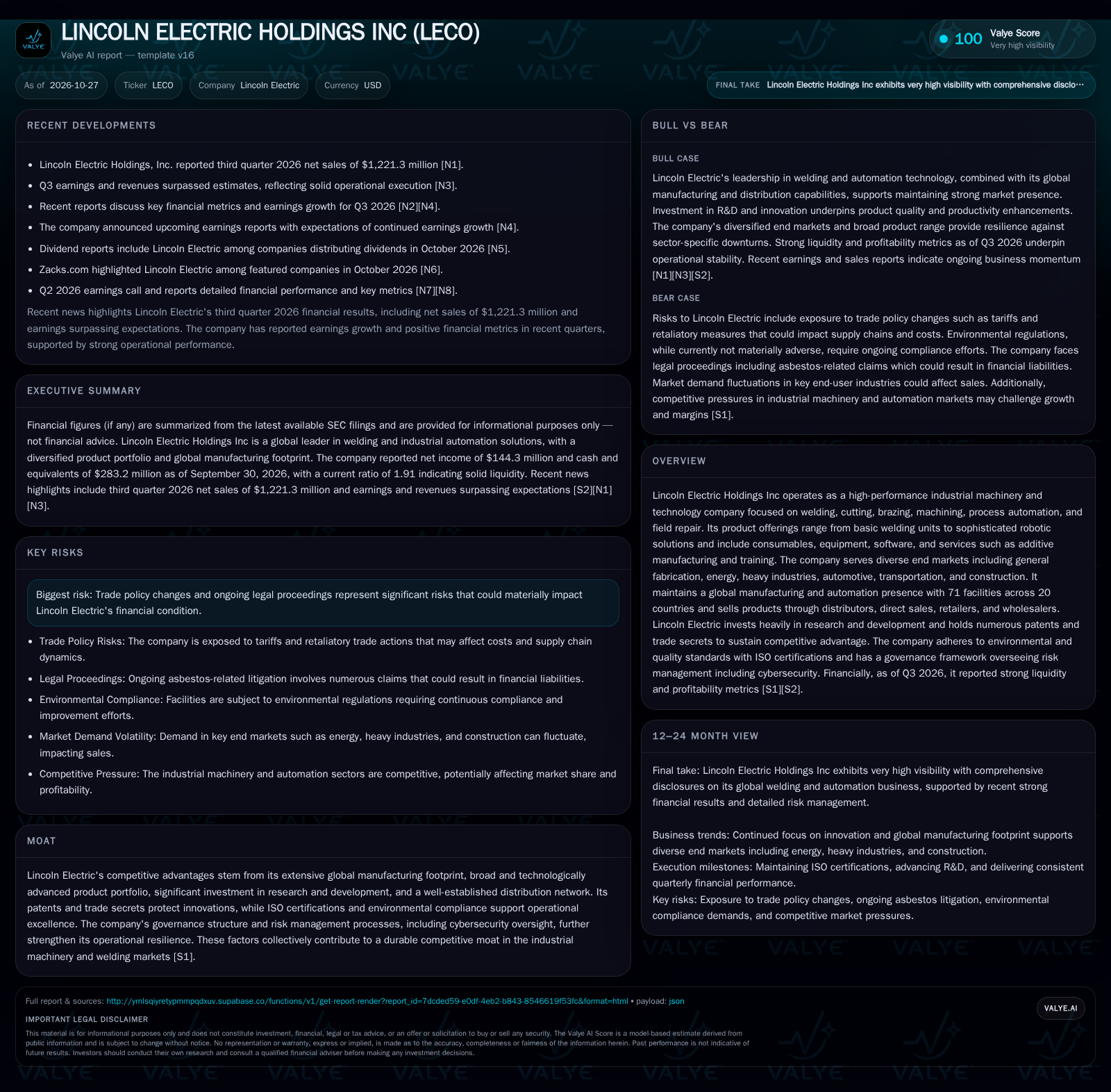
Lincoln Electric reported Q3 2026 net sales of $1.22 billion and net income of $144.3 million, outperforming expectations and underscoring its global reach in welding and automation solutions. The company’s diversified end markets, broad product portfolio, and sustained R&D investment support resilience, but exposure to trade policy, regulatory, and litigation risks remains material. The future trajectory will depend on Lincoln’s ability to defend margins through innovation, automation adoption, and operational execution as competitive intensity rises and end-market demand fluctuates. [N1] [N3] [S2]
Lincoln Electric’s latest quarterly performance demonstrates the enduring strength of its industrial franchise. The company reported profitability for the period. As it navigates an environment defined by trade and regulatory uncertainty, Lincoln Electric’s ability to leverage automation, defend pricing, and manage legal and compliance risks will shape its future value creation. The central question is whether these competitive advantages will be sufficient to maintain margin expansion and defend share as industrial cycles and technology adoption accelerate shifts in the welding and automation landscape. [N1] [N3] [S2]
Q3 Results and Global Footprint: Setting the Stage for Competitive Resilience
Lincoln Electric reported net sales of $1,221.3 million and net income of $144.3 million for the third quarter of 2026, with both revenue and earnings surpassing analyst expectations [N1] [N3] [S2]. This performance reflects resilient demand from a diverse set of end markets—including general fabrication, energy, heavy industries, automotive, and infrastructure—and strong operational execution. The company’s global manufacturing and integration network now spans 71 facilities in 20 countries, reinforcing its ability to serve customers worldwide and mitigate regional volatility [S1].
The company reported cash and liquidity metrics for the period; these figures do not by themselves establish operating runway, investment capacity, financial flexibility, or financing capacity. [S2] Importantly, the company continues to invest in research and development and holds a substantial portfolio of patents and trade secrets, supporting its ongoing push into automated and high-value welding solutions [S1].
The geographic diversification of Lincoln Electric’s manufacturing footprint not only mitigates risks associated with localized economic downturns but also introduces complexity in supply chain coordination and cost management. Variations in labor costs, regulatory environments, and logistical constraints across countries necessitate sophisticated operational planning and risk management frameworks. Furthermore, currency fluctuations and trade tariffs can impact cost structures and pricing strategies, requiring dynamic hedging and pricing adjustments. The company’s ability to optimize production allocation and maintain supply chain resilience amid these factors will be critical to sustaining competitive advantage and operational efficiency in a globalized manufacturing landscape.
How Lincoln Electric Monetizes the Welding Value Chain
Lincoln Electric’s business model is anchored in the sale of welding equipment, consumables (such as filler metals), and increasingly, automation and integration solutions. Historically, the company’s economics have benefited from the combination of durable equipment sales and recurring high-margin consumables, which are required for ongoing welding operations. Volume and mix are influenced by industrial capital spending cycles, with pricing power varying by product category and customer segment.
The expansion into automation and process integration introduces new revenue streams with potentially higher margins and greater stickiness—if customers adopt full-system solutions and rely on Lincoln Electric for ongoing support, software, and training. However, the capital intensity of automation solutions can affect working capital needs and project-based revenue recognition may introduce lumpiness. Fixed costs are significant in manufacturing and R&D, but global scale offers operating leverage as volumes recover or rise. The cited source reports dividend-related activity; that disclosure alone does not establish dividend-policy continuity, management confidence, or a material constraint on capital flexibility. [S1] [S2]
The interplay between capital intensity and revenue recognition in automation solutions creates nuanced financial dynamics. While automation projects may generate higher margins, their upfront capital expenditure and elongated sales cycles can lead to variability in quarterly earnings and working capital demands. This necessitates robust project management and forecasting capabilities to smooth revenue streams and optimize cash flow. Additionally, the transition toward integrated solutions may shift customer purchasing behavior from transactional equipment buys toward longer-term service and maintenance contracts, altering the revenue mix and potentially improving predictability. The degree to which Lincoln Electric can capitalize on these shifts will influence its financial stability and growth profile over industrial cycles.
Defending Share: Innovation, Integration, and the Threat of Substitution
Lincoln Electric’s competitive advantages stem from its broad portfolio, global manufacturing reach, and continuous R&D investment, which support both product innovation and operational excellence [S1]. Its distribution network—spanning direct, distributor, retail, and wholesale channels—enables wide market access. Patents and trade secrets help protect its technology, while ISO certifications reinforce quality and environmental compliance.
However, the welding and automation space is highly competitive, with global and regional peers targeting similar end markets. The rise of automation and digital solutions introduces new forms of competition—not only from traditional welding equipment manufacturers but also from industrial automation, robotics, and software-centric providers. The risk of substitution may increase as end users seek integrated, data-driven manufacturing solutions. Lincoln Electric’s ability to integrate hardware, software, and services could support switching frictions, but confirmation would require evidence of multi-year contracts or recurring revenue streams, which are not established in the current disclosures.
The threat of substitution in welding and automation is amplified by the rapid advancement of digital manufacturing technologies, including additive manufacturing and artificial intelligence-driven process optimization. As these technologies mature, customers may re-evaluate traditional welding methods in favor of more flexible or cost-effective alternatives. Lincoln Electric’s capacity to embed digital capabilities within its hardware offerings, and to develop interoperable platforms that integrate with broader factory automation ecosystems, will be essential to maintaining relevance. This integration could increase switching costs and deepen customer relationships, but the company must also navigate the risk of technology obsolescence and the emergence of non-traditional competitors with software-centric business models.
Automation Adoption and R&D Drive Sustainable Margin Expansion
If Lincoln Electric’s investments in automation, process integration, and advanced welding solutions accelerate customer adoption, the company could capture higher-margin, recurring revenue streams. Success would likely show up as sustained or expanding gross and operating margins, increased revenue from automation and software-enabled products, and evidence of significant new customer wins or multi-year solution contracts.
Upside would be confirmed by a rising proportion of sales from integrated automation solutions, visible growth in service and software revenues, and disclosure of large-scale, multi-year customer relationships. Additional signs would include improved operating leverage as fixed manufacturing and R&D costs are spread over higher volumes, and evidence that Lincoln Electric’s R&D pipeline is translating into commercially successful new products.
Resilient Performance Amid Cyclical and Regulatory Headwinds
The most plausible outcome is that Lincoln Electric continues to deliver steady performance, leveraging its global presence and diversified end markets to offset cyclical swings in individual sectors. Core welding consumables and equipment should remain the economic backbone, with automation and integration contributing incremental growth as adoption rises but not yet transforming the business mix.
In this scenario, margins remain stable or improve modestly, supported by ongoing R&D and operational discipline. Evidence supporting this path would include consistent sales and net income trends, stable or gradually improving margin metrics, and sustained R&D investment. Falsification would involve margin erosion due to pricing pressure or cost inflation, or a sharp downturn in sales tied to demand shocks in key end markets.
Trade, Litigation, and Demand Shocks Erode Profitability
A plausible adverse scenario would involve the convergence of trade policy shocks (such as new tariffs or retaliatory measures), costly litigation outcomes, and a downturn in core industrial end markets. These forces could drive up input costs, disrupt supply chains, and compress margins, while demand volatility reduces sales volumes.
Downside would be confirmed by declining revenues, margin contraction, or significant one-time charges tied to legal settlements or regulatory non-compliance. Further evidence would include reduced R&D or capital investment, signaling defensive cost management, or a deterioration in working capital metrics if supply chain disruptions persist.
What Will Determine Lincoln Electric’s Next Phase of Value Creation?
The proportion of revenue derived from automation, software, and system integration solutions—if disclosed—would clarify the pace of business model evolution.
Gross margin and operating margin trends, particularly as automation and high-value solutions scale, will indicate whether margin expansion is being achieved.
Evidence of multi-year contracts, recurring service revenues, or customer retention metrics would help test the durability of customer relationships and revenue visibility.
R&D spending as a percentage of sales and the commercial success rate of new product introductions will reveal whether innovation is translating into market share gains.
Any material legal or regulatory settlements, especially linked to asbestos litigation or environmental compliance, could impact potential financial flexibility and risk profile.
Geographic sales mix and exposure to regions with heightened trade policy risks should be monitored for vulnerability to external shocks.
If disclosed, metrics on software/service attach rates to hardware sales would illuminate the stickiness and profitability of integrated solutions.
Disclaimer: This is research-only, informational analysis and not investment advice. It may include AI-generated interpretation and general industry context. Always verify important details using primary sources.

Comments