
SunCoke Energy: Contract Stability, Environmental Exposures, and the Realities of Cokemaking Economics
Recent profit declines and a high-profile contract breach highlight SunCoke Energy’s dependence on long-term steel industry relationships and the operational rigidity of its cokemaking assets. As global coal demand strengthens, the company must navigate regulatory costs, inflexible plant economics, and market shifts to sustain its cash generation.
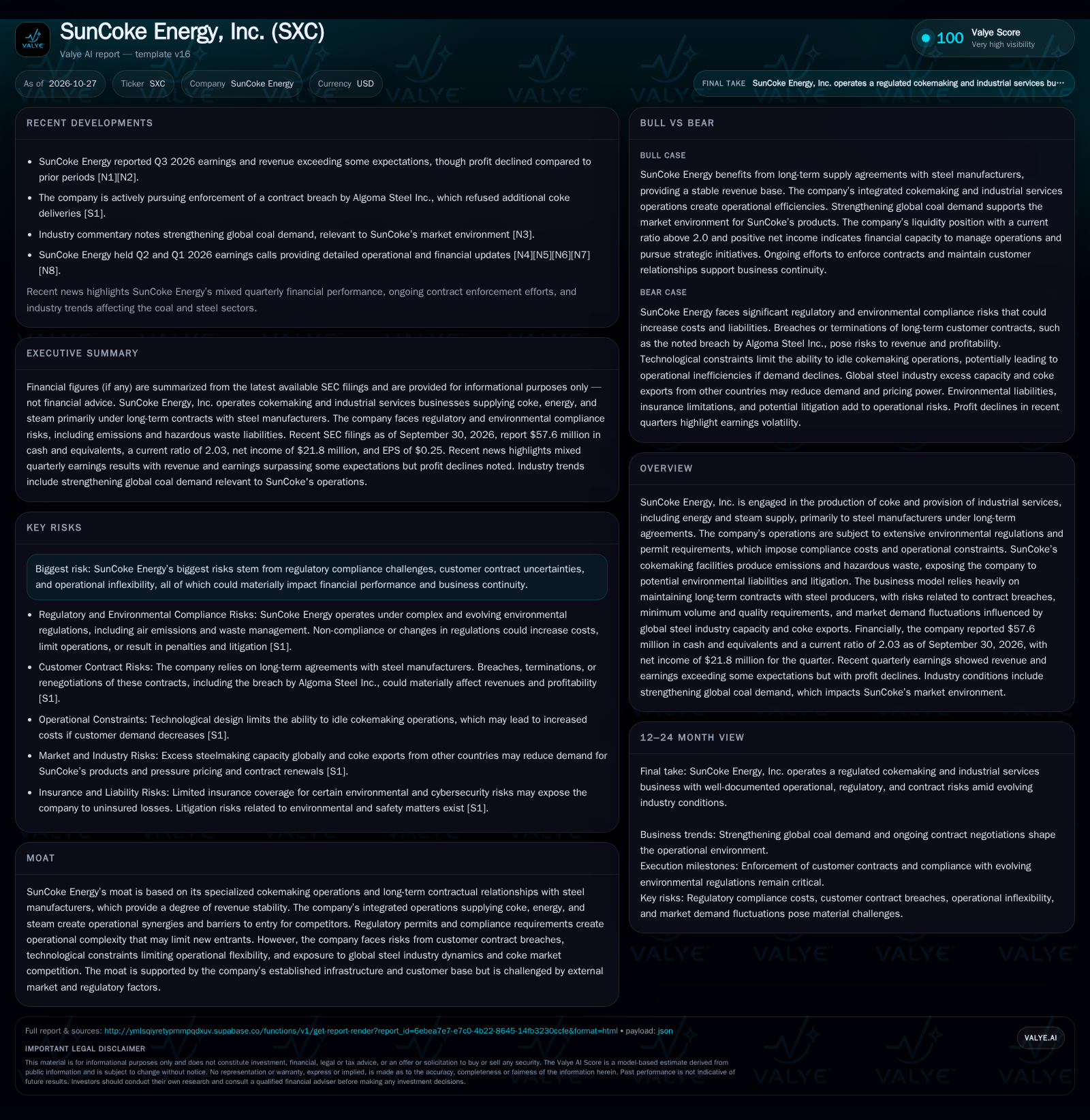
SunCoke Energy reported Q3 2026 revenue and earnings above some expectations, but profits declined amid ongoing regulatory and customer contract risks. The company’s business model relies on long-term agreements with steelmakers, but operational inflexibility and customer breaches—such as Algoma Steel’s refusal of additional coke—expose SunCoke to earnings volatility. Strengthening global coal demand supports the macro backdrop, yet environmental and market headwinds remain material.
SunCoke Energy’s Q3 2026 snapshot reveals a business navigating the crosscurrents of industrial rigidity and shifting customer dynamics. While the company’s revenue and earnings outpaced some market expectations, profit contraction and a high-profile contract breach have brought its structural vulnerabilities into sharper focus. The reliance on long-term contracts with steelmakers provides a measure of revenue visibility, yet exposes SunCoke to concentrated customer risk, especially when operational constraints make rapid cost reduction difficult. As industry trends point to strengthening coal demand, SunCoke must balance regulatory burdens and global competition with the need to enforce contracts and maintain utilization.
Recent Profit Declines and Contract Disputes Put Revenue Stability in the Spotlight
SunCoke Energy’s Q3 2026 results delivered revenue and earnings above some analyst expectations, but the company’s profit fell compared with prior periods [N1] [N2]. This divergence signals that while topline resilience persists, underlying margin pressure or cost increases are eroding net income. A material development is the contract breach by Algoma Steel Inc., which refused additional coke deliveries, prompting SunCoke to pursue enforcement and recovery efforts [S1]. This event highlights the company’s exposure to customer concentration and underscores the fragility of even long-term supply agreements. As of September 30, 2026, SunCoke reported $57.6 million in cash and equivalents, a current ratio of 2.03, and net income of $21.8 million for the quarter [S2]. These figures indicate operational continuity but do not insulate the business from the risks posed by customer disputes and changing market conditions.
Fixed Plant Costs and Contract Structures Shape Operating Leverage
SunCoke’s economics are fundamentally shaped by its capital-intensive cokemaking plants, which are difficult to idle or repurpose due to technological and environmental constraints [S1]. This creates high fixed costs and limited production flexibility—a dynamic that can amplify both upside and downside operating leverage. The company’s revenue is anchored by long-term contracts with steel manufacturers, typically featuring minimum volume and quality clauses, sometimes with penalties or termination risks if unmet [S1]. These structures theoretically provide revenue stability and utilization visibility, but also concentrate risk in a small number of counterparties. Variable costs are heavily linked to raw material (coal) prices, energy inputs, and compliance expenditures. Environmental compliance is a persistent cost center, as the company must meet evolving emissions and hazardous waste standards, often with limited insurance coverage for related liabilities [S1]. If customer demand falls while plants continue to operate, SunCoke may be forced to absorb underutilization costs, pressuring margins. Conversely, when demand and contract performance are robust, the high fixed-cost base can magnify incremental profit gains.
Long-Term Steel Relationships vs. Global Coke Supply and Regulatory Barriers
SunCoke’s competitive position is defined by its integrated supply of coke, energy, and steam to steelmakers under multi-year agreements—a model that can deter new entrants due to complex permitting, regulatory compliance, and capital requirements [S1]. However, these same customers are exposed to global steel cycles, and their procurement strategies may shift based on price, quality, or supply chain security. International coke exporters, particularly from regions with lower regulatory costs, provide a credible substitute and can pressure SunCoke’s pricing and renewal terms. The company’s moat is buttressed by established infrastructure and operational expertise, but it is not immune to renegotiation risk, as the Algoma Steel breach demonstrates [S1]. Environmental regulatory hurdles create both barriers and burdens: while they restrict new domestic entrants, they also add to SunCoke’s ongoing cost base and litigation exposure. Ultimately, SunCoke’s ability to retain and enforce long-term customer relationships—and adapt to global shifts in steel and coke demand—will determine its competitive durability.
If Contract Enforcement and Coal Demand Align, Margin Rebound Is Plausible
A favorable outcome for SunCoke would see the company successfully enforcing its contract with Algoma Steel, preserving revenue streams and sending a strong signal to other customers about the durability of its agreements. If global coal demand continues to strengthen, supporting higher coke prices and improved contract terms, SunCoke could benefit from both higher utilization and improved margins. The rigidity of its cost base would amplify profit gains in such an environment. Evidence confirming this scenario would include announced settlements or recoveries from contract disputes, new or renewed long-term supply agreements with favorable pricing, and sequential improvement in quarterly net income and margins. If SunCoke is able to consistently operate at or near contractual minimums, with minimal unplanned downtime and no further customer breaches, it would validate the positive leverage inherent in its business model.
Revenue Anchored by Contracts, but Margin Volatility Persists Amid Industry Shifts
The most plausible near-term scenario for SunCoke is continued revenue stability anchored by its existing long-term contracts, offset by periodic margin volatility driven by customer negotiations, changing steel production patterns, and the ongoing cost of environmental compliance. Contract breaches or renegotiations—such as the one with Algoma Steel—may become more frequent as global steel capacity ebbs and flows and alternative coke sources remain available. While the company’s high fixed costs limit its flexibility in downturns, they also enable margin expansion during periods of strong demand. Evidence for this scenario would be flat to modestly fluctuating revenue, net income that tracks closely with industry steel and coal cycles, and regular references to contract management and compliance costs in earnings communications. If SunCoke can maintain its plant utilization near contract minimums and avoid major regulatory or litigation shocks, it is likely to sustain this middle path.
Multiple Customer Breaches or Regulatory Shocks Could Trigger Earnings Compression
The adverse scenario would be triggered if additional key customers follow Algoma Steel’s lead in breaching, renegotiating, or terminating contracts, particularly if global steel demand softens or international coke competition intensifies. In such a case, SunCoke’s inability to idle plants quickly would force it to absorb significant fixed costs, driving down margins and potentially leading to negative operating leverage. Regulatory or environmental incidents—such as permit violations, new compliance mandates, or litigation losses—could further erode profitability and strain cash resources, especially given insurance limitations [S1]. Evidence confirming this trajectory would include a spike in contract terminations or disputes, rising plant underutilization or downtime, sequential declines in net income, and unexpected environmental or legal charges impacting results. Persistent margin compression and a deteriorating relationship with steel industry customers would reinforce the downside.
Milestones That Will Clarify SunCoke’s Resilience in a Shifting Steel and Energy Landscape
Resolution outcomes of the Algoma Steel contract dispute—settlement size, timing, and precedent for other customer relationships.
Quarterly plant utilization rates and their proximity to minimum contractual volumes (if disclosed), as a proxy for demand stability.
Number and terms of new or renewed long-term supply agreements signed, especially with diversified customers.
Quarterly net income and margin trends relative to prior periods and industry benchmarks, to assess the impact of cost and pricing dynamics.
Major environmental or regulatory developments—new compliance requirements, permit renewals, or litigation events—that could alter the cost base.
Any disclosure of additional customer contract breaches, renegotiations, or early terminations.
Trends in global coal prices and international coke trade flows, as external signals for demand and competitive pressure.
Insurance recoveries or unexpected charges related to environmental or cyber risks, which could affect cash flow volatility.
Disclaimer: This is research-only, informational analysis and not investment advice. It may include AI-generated interpretation and general industry context. Always verify important details using primary sources.

Comments