
Xylem’s Strategic Reorganization and Acquisitions: Positioning for Integrated Water Solutions Leadership
Recent segment reorganization, targeted divestitures, and the acquisition of WaterFleet signal Xylem’s pivot toward a more focused, higher-margin water solutions platform. With organic order growth and expanding EBITDA margins, the company now faces the challenge of integrating new assets, executing divestitures, and navigating regional demand volatility—all while defending its position in a fragmented, innovation-driven market.
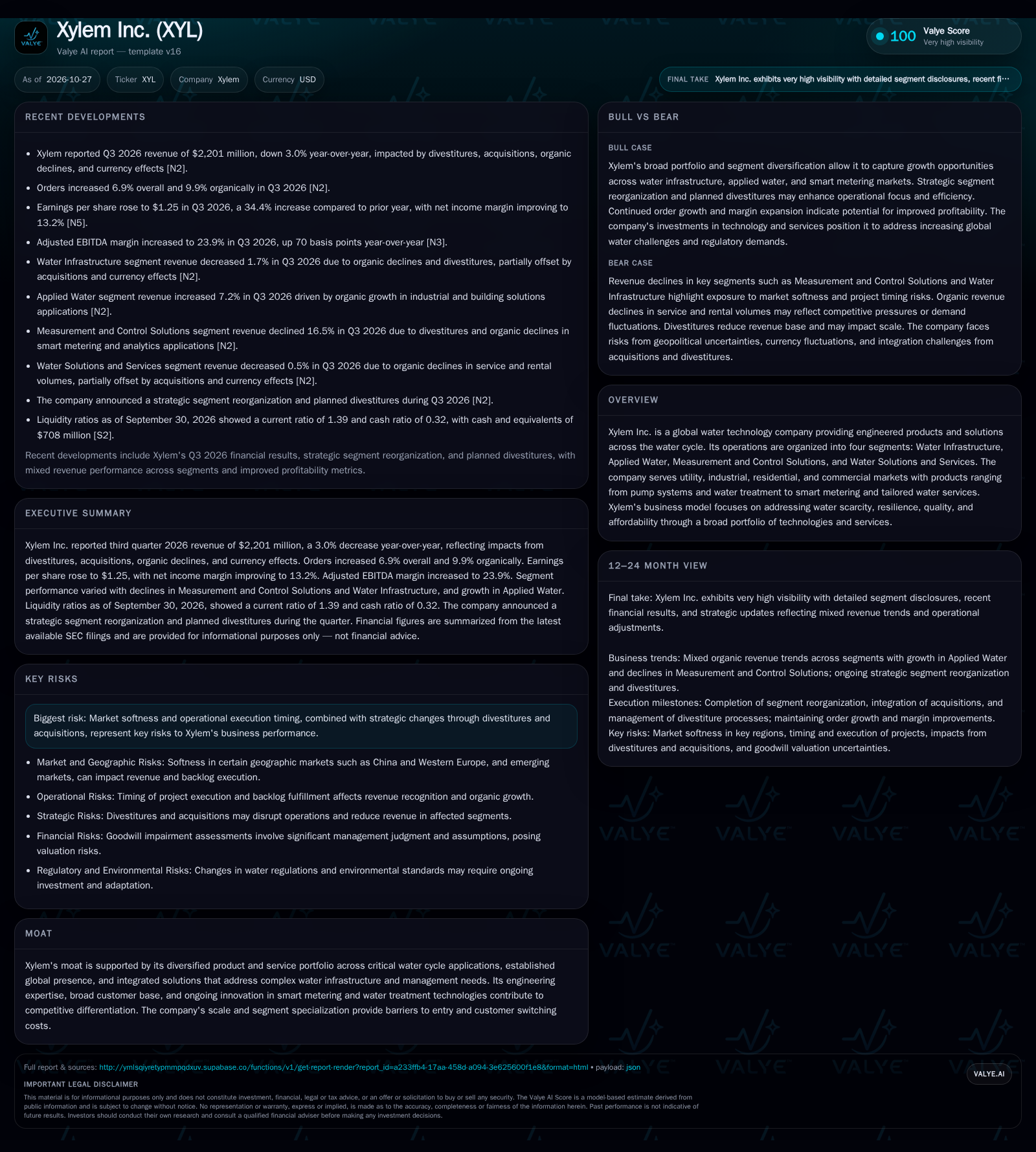
Xylem reported 6.9% overall and 9.9% organic order growth in Q3 2026, with adjusted EBITDA margin rising to 23.9%. The company is undergoing a strategic segment reorganization, planning divestitures, and integrating the WaterFleet acquisition to broaden its service offerings. These moves could sharpen operational focus and position Xylem for margin expansion, but execution risks remain amid market softness in key regions and the complexities of portfolio reshaping. [N2] [N3] [S2]
Xylem Inc. is reshaping its business for the next era of water technology leadership. With robust order growth, margin expansion, and a slate of strategic moves—including segment reorganization, targeted divestitures, and the acquisition of WaterFleet—the company is seeking to sharpen its operational focus and extend its reach in critical water solutions markets. This transition brings both opportunity and execution risk: Xylem must integrate new assets, optimize its portfolio, and respond to regional market headwinds, all while maintaining the innovation and reliability that underpin its competitive moat.
What’s Changed: Orders, Margins, and a Bold Portfolio Pivot
Xylem’s Q3 2026 results highlight three material developments: First, orders increased 6.9% overall and 9.9% organically, a signal of sustained customer demand despite pockets of regional weakness. Second, adjusted EBITDA margin rose 70 basis points year-over-year to 23.9%, suggesting effective cost control and operational leverage. Third, the company announced a strategic segment reorganization and planned divestitures, while acquiring WaterFleet for $217 million to expand its water solutions and services portfolio in North America. These facts matter because they signal both momentum and a deliberate shift in Xylem’s operating model—toward a more focused, higher-value portfolio with increased exposure to recurring and service-based revenue streams. However, the complexity of divestitures and integration, coupled with ongoing regional demand volatility, raises execution and transition risks. [N2] [N3] [S2]
How Xylem Generates Value: Segment Economics and the Shift Toward Services
Xylem’s business spans four segments: Water Infrastructure (pumps and treatment solutions), Applied Water (usage applications like HVAC and fire protection), Measurement and Control Solutions (smart metering, analytics), and Water Solutions and Services (on-demand, outsourced, and emergency water services). Historically, core equipment sales have provided upfront revenue, while aftermarket parts, monitoring, and service contracts contribute recurring, higher-margin income. The recent acquisition of WaterFleet and the segment reorganization suggest a deliberate pivot toward service- and solution-oriented models, which typically offer more stable, recurring revenue and higher margins than pure hardware sales.
Pricing power in water infrastructure products is often moderate due to competitive bidding and regulatory constraints, but differentiation through technology, integrated solutions, and service reliability can enable modest premium pricing or preferred supplier status. Operating leverage arises from scale in manufacturing and a growing installed base, which supports profitable aftermarket and service revenue. The company reported cash and liquidity metrics for the period; these figures do not by themselves establish operating runway, investment capacity, financial flexibility, or financing capacity. However, the success of the new portfolio mix will depend on Xylem’s ability to execute divestitures efficiently and ramp up service adoption without diluting margins or incurring excessive restructuring costs.
Defending the Moat: Differentiation in a Fragmented, Innovation-Driven Sector
Xylem’s competitive position is anchored in its breadth of offerings, global reach, and engineering expertise—attributes that could increase switching costs for utilities and industrial customers who value reliability and integration. The company’s move into smart metering, analytics, and mobile water services broadens its differentiation beyond traditional pumps and treatment, appealing to customers seeking end-to-end solutions and digital capabilities.
The water technology industry is fragmented, with competitors ranging from large diversified industrials to specialized regional players and emerging tech startups. Substitution risk is relatively low in core infrastructure, but technology-driven innovation (e.g., advanced sensors, AI-enabled analytics, or decentralized treatment) can shift customer preferences. Xylem’s scale and integration allow it to absorb regulatory and compliance costs more efficiently than smaller peers, but it must continually invest in R&D to maintain its edge. The challenge is to translate its portfolio breadth and innovation into sustainable pricing power and customer loyalty, particularly as new entrants target digital and service layers of the value chain.
Unlocking Value Through Focus: If Reorganization and Service Expansion Deliver
In a favorable scenario, Xylem successfully executes its segment reorganization and divestitures, streamlining operations and concentrating resources on higher-margin, growth-oriented segments. The integration of WaterFleet accelerates the penetration of mobile and on-demand water services, boosting recurring revenue and enhancing customer stickiness. Organic order growth continues above the industry average, and margin expansion persists as cost synergies and a shift toward services take hold.
Confirmation of this scenario would come from: (1) successful and timely completion of planned divestitures; (2) a rising mix of recurring service and solutions revenue as a share of total sales; (3) sustained organic order and revenue growth in the Water Solutions and Services segment; and (4) continued improvement in adjusted EBITDA margin. Evidence of customer wins for integrated or outsourced water solutions, and clear progress on cross-selling between legacy Xylem and acquired platforms, would further support this thesis.
Portfolio Reshaping Amid Mixed Demand: Most Likely Outcomes
The most plausible path is a transitional period marked by solid but uneven performance: Xylem manages to complete most divestitures and integrate WaterFleet without major operational disruptions, but regional market softness—especially in China and Western Europe—tempers top-line growth in some segments. Order momentum remains positive overall, but revenue growth is weighted toward North America and service lines. Margin gains are incremental as restructuring costs and integration expenses offset some operational efficiencies.
Evidence supporting this scenario would include: (1) sequential improvement in service and solutions revenue, but modest growth in hardware or infrastructure product lines; (2) stable or slightly improved EBITDA margins despite one-time restructuring charges; (3) commentary or disclosures about ongoing challenges in specific geographies; and (4) manageable, non-disruptive execution of the segment reorganization and asset divestitures.
Execution, Integration, and Regional Weakness: What Could Go Wrong
Adverse outcomes could emerge if Xylem encounters delays or setbacks in its divestiture process, or if the integration of WaterFleet and other recent acquisitions proves more complex and costly than anticipated. Prolonged market softness in key regions could erode order book momentum, while restructuring and transition costs may weigh on margins longer than expected. Disruption to customer relationships during the portfolio reshaping could open the door to competitors, particularly in segments where switching costs are lower or where digital solutions are rapidly evolving.
Downside confirmation would include: (1) missed or delayed divestiture milestones; (2) integration-related charges or operational disruptions; (3) declining organic order growth or backlog in core segments; (4) margin contraction due to higher-than-expected transition or restructuring costs; and (5) customer attrition or lost tenders in key accounts. Additional risk would be signaled by adverse developments in goodwill impairment, indicating that anticipated synergies or growth from recent deals are not materializing.
Milestones That Will Test Xylem’s Service-Driven Transformation
Progress and timing of planned divestitures—updates on which assets are sold, proceeds realized, and impact on segment mix.
Integration milestones for WaterFleet and other recent acquisitions—synergy capture, cross-selling, and retention of key personnel and customers.
Organic order growth trends by segment—with particular focus on Water Solutions and Services and Measurement and Control Solutions.
Adjusted EBITDA margin evolution—direction and magnitude of year-over-year changes, including the impact of restructuring costs.
Recurring revenue as a share of total—if disclosed, to track the shift toward service and solution business models.
Regional performance breakdowns—especially in China, Western Europe, and North America, to assess exposure to market softness.
Goodwill impairment charges or warnings—early signals of integration or portfolio underperformance.
Customer wins or renewals in integrated water services—evidence of competitive differentiation and solution adoption.
Disclaimer: This is research-only, informational analysis and not investment advice. It may include AI-generated interpretation and general industry context. Always verify important details using primary sources.

Comments