
Noble Corp plc: Fleet Strength, Earnings Volatility, and the Realities of Offshore Drilling Cyclicality
Noble Corp’s young, high-specification fleet and recent acquisition of Diamond Offshore position it as a key player in ultra-deepwater and harsh environment drilling. Yet, persistent net losses, a narrowed revenue outlook, and exposure to market and contract risks underscore the challenge of converting operational scale into sustained profitability.
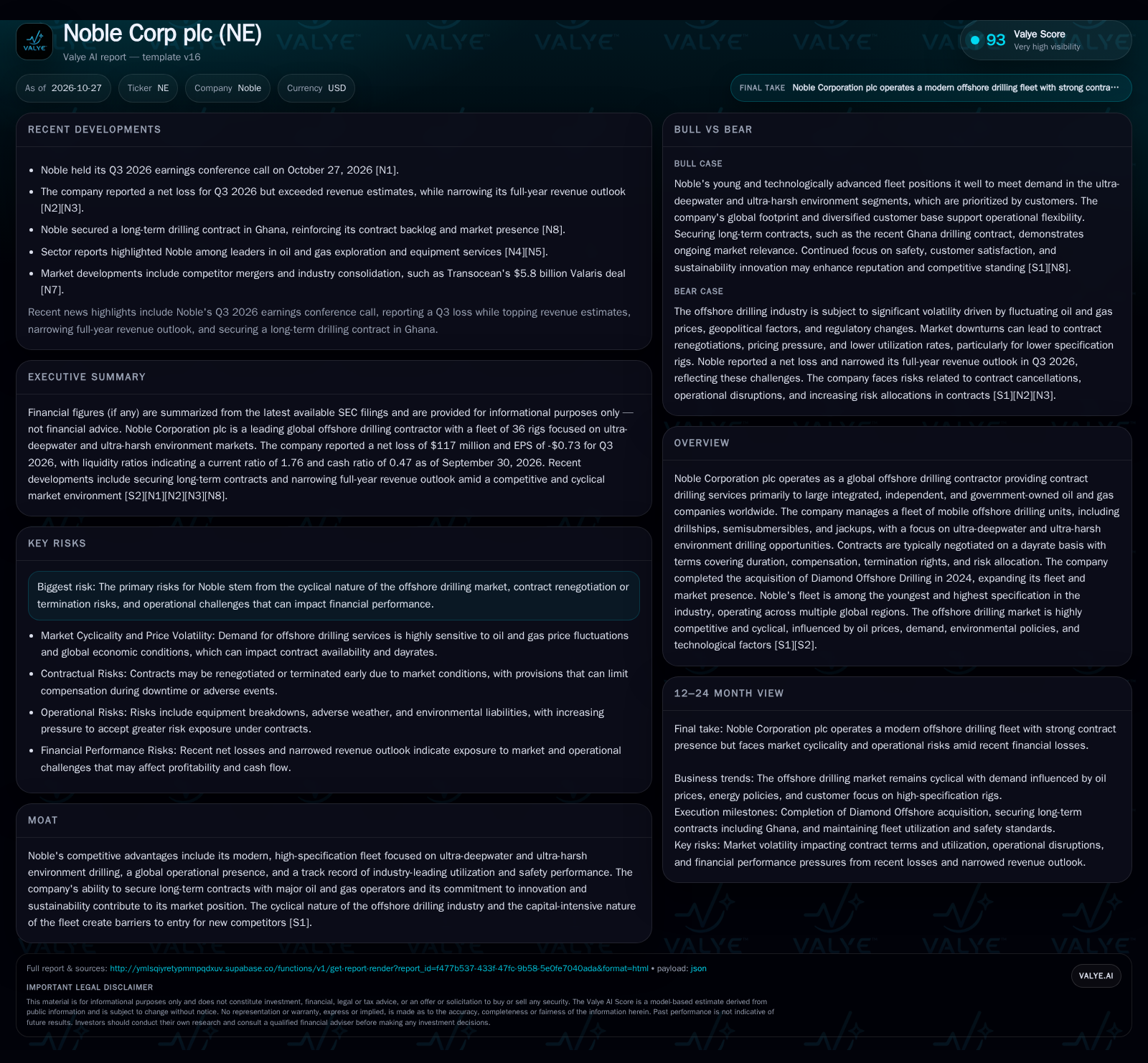
Noble Corp operates a modern, globally deployed offshore drilling fleet, recently expanded through the acquisition of Diamond Offshore. The company reported a Q3 2026 net loss of $117 million and has narrowed its full-year revenue outlook, despite securing a long-term contract in Ghana. The business model is capital intensive and highly exposed to oil price cycles, with competitive advantages in fleet quality but persistent financial and operational risks remaining material. [S1] [S2] [N1] [N2] [N3] [N8]
Noble Corp plc stands at a critical juncture in the offshore drilling sector—with a youthful, technologically advanced fleet and strategic growth via its Diamond Offshore acquisition. The company’s operational strength in ultra-deepwater and harsh environments provides a competitive edge, but recent financials reveal the strain of industry cyclicality: a net loss in Q3 2026, a narrowed revenue outlook, and persistent exposure to contract and market volatility. With a blend of long-term contract wins and continuing financial headwinds, the central question is whether Noble can translate its operational advantages into consistent profitability and resilience through the next cycle.
Recent Results Highlight Scale, Contract Wins, and Persistent Losses
Noble Corp reported a net loss of $117 million and EPS of -$0.73 for Q3 2026, reflecting ongoing financial pressure despite operational scale [S2]. The company’s fleet, at 36 rigs as of December 31, 2025, includes 25 floaters and 11 jackups concentrated in the high-specification, ultra-deepwater, and ultra-harsh environment markets [S1]. Liquidity metrics as of September 30, 2026, included a current ratio of 1.76 and $337.2 million in cash and equivalents [S2].
The September 2024 acquisition of Diamond Offshore Drilling expanded Noble’s fleet and global reach, consolidating its position among the industry’s largest players [S1]. Notably, Noble also secured a long-term drilling contract in Ghana during Q3 2026, which adds to its backlog and underscores customer demand for advanced rigs in select geographies [N8]. Despite exceeding revenue estimates for the quarter, Noble narrowed its full-year revenue outlook, indicating ongoing market and pricing challenges [N2] [N3].
How Noble’s High-Spec Fleet Drives Revenue—And Where the Economics Get Challenging
Noble’s revenue model is fundamentally driven by dayrate contracts with oil and gas operators, where each rig generates revenue based on negotiated daily rates and utilization. High-specification rigs, particularly in ultra-deepwater and harsh environments, command premium dayrates but also entail notably higher capital and operating costs. The company’s ability to secure long-term contracts, such as the Ghana agreement, can provide some revenue visibility and operational stability, but contract durations and terms are often subject to negotiation and early termination provisions [S1] [N8].
Operating leverage is significant: fixed costs for fleet maintenance, staffing, and compliance are high, and profitability is acutely sensitive to utilization rates and dayrate levels. When markets tighten, as reflected in Noble’s recent net losses and narrowed revenue outlook, the company’s cost structure can lead to outsized swings in earnings. The offshore drilling business is highly capital intensive; ongoing investments are required to maintain fleet competitiveness, comply with safety/environmental standards, and retrofit rigs for emerging customer requirements. This creates a high break-even threshold and makes Noble’s economics especially vulnerable in cyclical downturns.
Cash flow generation depends not only on contract wins but also on minimizing idle time and managing the cost base. In periods of weaker demand or pricing pressure, the risk is that even a modern fleet cannot cover fixed costs, leading to negative operating leverage.
Fleet Quality, Global Reach, and the Counterforces of Industry Cyclicality
Noble’s competitive strength lies in its young, high-specification fleet and global operational footprint, allowing it to serve integrated majors and national oil companies in technically demanding regions [S1]. The Diamond Offshore acquisition enhanced Noble’s scale and regional diversity, which may improve customer access and bargaining power. In the ultra-deepwater and ultra-harsh environment segments, barriers to entry are high due to technical requirements, regulatory compliance, and capital intensity.
However, the industry remains structurally competitive and cyclical. Noble faces competition from other large offshore drillers with similarly modern fleets, as well as from regional players and potential substitution by onshore/shale development or alternative energy investments. Contract pricing power is often limited by customer consolidation, procurement sophistication, and the surplus or shortage of available rigs. Environmental policies and technology shifts—such as increased scrutiny of fossil fuel investments or advances in automation—could also reshape demand.
The ability to differentiate on safety, uptime, and sustainability may help Noble retain and win contracts, but commoditization pressures and customer bargaining leverage are persistent counterforces.
Cycle Recovery, High Utilization, and Margin Expansion: What Would Signal a Turn
A constructive scenario for Noble would be driven by a sustained recovery in offshore oil and gas investment, leading to higher utilization rates and rising dayrates for high-specification rigs. This could be triggered by multi-year commitments from major oil companies, underpinned by higher and more stable oil prices and renewed appetite for deepwater and harsh environment development.
In this environment, Noble’s young fleet and expanded scale post-Diamond acquisition could allow it to capture a disproportionate share of new contracts, locking in favorable terms and higher margins. Multi-year contract wins—particularly if they include early termination penalties or cost recovery provisions—would improve revenue visibility and cash flow. Evidence of reduced idle time, increasing average dayrates, and upward revisions to the revenue outlook would signal this scenario is materializing.
Confirmation would come from a combination of rising backlog, improved quarterly profitability, and management commentary pointing to tightening rig supply and disciplined pricing. Conversely, a lack of new multi-year contracts or persistently weak dayrates would falsify this upside.
Operating in a Narrow Margin Band Amid Ongoing Cyclicality
The most plausible scenario is one in which Noble continues to operate in a cyclical, competitive market where periods of moderate contract wins and utilization are offset by pricing pressure and intermittent idle time. The company’s high-specification fleet enables it to win work in core deepwater and harsh environment segments, but the market remains oversupplied in certain regions or rig classes, limiting pricing power.
Financial performance is likely to oscillate around breakeven or modest profit/loss, with quarter-to-quarter variability driven by contract timing, dayrate movements, and cost discipline. The Ghana contract and similar wins provide some backlog support, but offsetting factors include the risk of contract renegotiations, customer delays, or operational disruptions.
Confirmation of this scenario would be continued reporting of narrow operating margins, occasional contract wins, and management commentary emphasizing cost control and selective bidding. A shift toward markedly higher or lower fleet utilization, or a sustained change in revenue outlook, would suggest departure from this base case.
Prolonged Market Weakness and Contract Attrition Pressure Results
A negative scenario would unfold if global oil and gas demand falters—due to sustained low prices, accelerated energy transition, or geopolitical disruptions—leading to a pronounced drop in offshore drilling activity. In this case, Noble could see increased contract cancellations, downward renegotiation of existing dayrates, and a rise in idle or underutilized rigs.
The company’s high fixed cost base would amplify losses, and liquidity could come under pressure if cash burn accelerates and new contract awards slow. Potential customer insolvencies or stricter environmental regulations could further reduce accessible projects or increase compliance costs.
This scenario would be confirmed by a shrinking contract backlog, a string of quarterly losses, negative operating cash flow, and management guidance cuts. Early warning signs would include a rise in rig stacking, increased customer requests for contract amendments, or withdrawal from certain regional markets.
Milestones and Metrics That Will Shape Noble’s Next Chapter
Quarterly fleet utilization rates—both overall and segmented by rig type—would help assess how well Noble is deploying its assets in a volatile market.
Average dayrates on new and renewed contracts, if disclosed, provide insight into pricing power and market direction.
Contract backlog, measured in both duration and dollar value, is a crucial indicator of future revenue visibility.
Operating cash flow trends and capex requirements will reveal Noble’s ability to self-fund fleet maintenance and upgrades without eroding liquidity.
Net change in cash and equivalents, especially if negative across multiple quarters, would signal potential liquidity challenges.
New contract wins or material contract amendments—especially those with early termination penalties or cost recovery provisions—would confirm Noble’s ability to secure favorable terms.
Management commentary on regional demand trends, customer procurement behavior, or environmental/regulatory headwinds would help contextualize near-term risks and opportunities.
If disclosed, rig downtime and safety incident rates would provide a window into operational efficiency and risk management.
Disclaimer: This is research-only, informational analysis and not investment advice. It may include AI-generated interpretation and general industry context. Always verify important details using primary sources.

Comments