
Boeing’s Recovery at a Crossroads: Contract Complexity, Operational Risks, and Sustainable Profitability Prospects
Boeing’s Q3 2026 results highlight rising revenues and a narrower loss, but persistent contract execution challenges and underfunded pension obligations underscore the fragile foundation behind the company’s gradual recovery. The interplay between long-term government contracts, cost estimation risks, and market volatility will define Boeing’s ability to regain durable profitability.
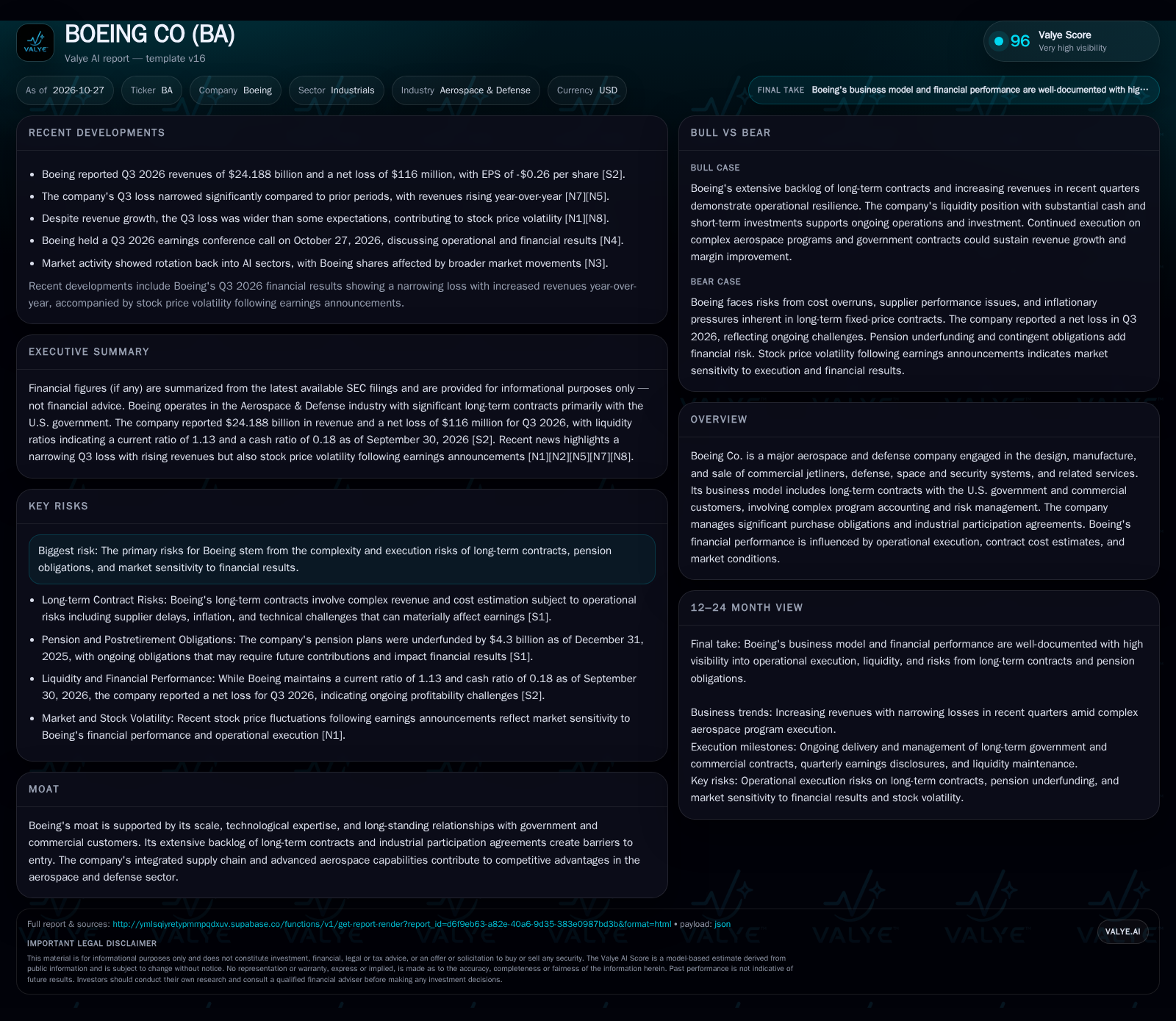
Boeing reported Q3 2026 revenues of $24.2 billion with a narrowed net loss, reflecting improved operational execution but ongoing exposure to contract and pension risks. Sustainable margin recovery hinges on better cost control and consistent delivery against its large backlog of government and commercial contracts. [S2] [N7] [N8]
Boeing’s latest quarter offers a mixed signal: the aerospace giant is posting rising revenues and a narrower loss, yet it remains in the red and faces persistent operational and financial headwinds. Its business is anchored by long-term government and commercial contracts—sources of both revenue visibility and risk—while pension underfunding and market volatility complicate the outlook. The central question now is whether Boeing can consistently execute on its massive backlog and rein in cost overruns to restore sustainable profitability in a sector defined by high stakes and thin margins.
Recent Financial Results Highlight Progress and Persistent Vulnerabilities
Boeing reported revenues of $24.188 billion for Q3 2026, with a net loss of $116 million and earnings per share of -$0.26. While this loss represents a narrowing compared to prior periods, it was still wider than some market expectations, contributing to notable stock price volatility after the earnings release. The company reported $9.498 billion in cash and $11.216 billion in short-term investments as of September 30, 2026. Current assets exceeded current liabilities, resulting in a current ratio of 1.13. However, the company’s pension plans remain underfunded by $4.3 billion as of the end of 2025, and purchase obligations related to inventory procurement and industrial participation agreements total $16.4 billion through 2034. These facts underscore Boeing’s ongoing balancing act between improved operational execution and significant structural commitments. [S2] [N7] [N8] [S1]
How Boeing’s Contract-Driven Model Shapes Profitability and Risk
Boeing’s revenue model is anchored in long-term contracts with government and commercial customers, particularly the U.S. Department of Defense and major airlines. These contracts provide high revenue visibility and the potential for significant scale, but they also carry complex cost estimation and risk-sharing provisions. Fixed-price government contracts, in particular, shift cost overruns onto Boeing, making accurate forecasting and operational discipline critical. The company’s mix of defense, commercial aerospace, and services segments creates both diversification and complexity in margin management. Pricing power is constrained by competition and the long-term nature of many contracts, while cost structure is heavily influenced by supply chain reliability and the ability to spread fixed costs over large production volumes. Operating leverage can be significant when production rates rise, but the inverse is also true: delays or quality issues can quickly erode margins. Capital intensity remains high, as evidenced by ongoing inventory procurement obligations and the need to invest in R&D and manufacturing infrastructure. Pension and postretirement obligations further complicate cash flow management, with underfunded plans potentially requiring future contributions that compete with other capital allocation priorities. [S1] [S2]
Barriers to Entry and Structural Advantages Amid Industry Turbulence
Boeing’s scale, technological expertise, and long-standing customer relationships—especially with the U.S. government—form the core of its competitive moat. The aerospace and defense sector is characterized by high barriers to entry: certification requirements, capital intensity, and the need for global supply chains deter new entrants. Boeing’s extensive backlog and industrial participation agreements provide a degree of revenue stability and lock in customer relationships over multi-year periods. However, the company faces persistent counterforces. Competitors in the commercial aircraft segment, primarily Airbus, exert pricing and innovation pressure, while defense peers and emerging international players threaten share in select markets. Supplier performance is a persistent vulnerability, as disruptions can cascade through production schedules and contract profitability. Additionally, technological substitution—such as advances in alternative propulsion or autonomous systems—could reshape the industry’s economics over time, though such shifts typically play out over decades. Boeing’s scale allows for significant lobbying influence, but it also means that operational missteps and reputational damage have outsize consequences.
Consistent Execution Unlocks Margin Expansion and Cash Flow Recovery
If Boeing can deliver on its existing backlog with fewer cost overruns and improved supplier performance, the company could see significant margin expansion and a return to sustained profitability. This scenario would likely be confirmed by a string of quarters with rising gross margins, positive operating cash flow, and earnings per share turning positive. A reduction in the pension underfunding gap, either through asset performance or additional contributions, would further ease financial pressure. Evidence for this upside would include steady or accelerating delivery rates, improved contract profitability disclosures, and reduced use of non-recurring charges tied to program delays or technical issues. Additional signals would be new contract wins at attractive terms and a stabilization or upward trend in the company’s share price, indicating renewed investor confidence. [S2] [N7]
Gradual Margin Improvement Amid Ongoing Contract and Market Volatility
The most plausible trajectory for Boeing is one of gradual progress: revenues continue to grow modestly, with periodic setbacks due to cost estimation errors, supplier issues, or macroeconomic shocks. Margins slowly improve as legacy program costs are absorbed and operational discipline increases, but the company remains vulnerable to episodic losses tied to contract execution risks. Share price volatility persists, as each quarterly report is scrutinized for signs of operational improvement or new setbacks. Evidence for this scenario would be sequential improvement in operating margins and cash flow, offset by occasional charges or negative surprises on major programs. [S2] [N8]
Cost Overruns and Supply Chain Shocks Drive Renewed Losses
A downside scenario would unfold if Boeing experiences new or worsening cost overruns on major programs, such as commercial jetliners or defense platforms, or if key suppliers fail to deliver on time or at contracted quality standards. In this case, the company could see a return to wider losses, negative operating cash flow, and potentially the need to raise additional capital to meet obligations. Pension and postretirement liabilities could become more pressing if financial markets underperform or if regulatory requirements force higher contributions. Confirmation of this scenario would come from announcements of new program delays, large contract loss provisions, or negative cash flow in multiple consecutive quarters. [S1] [S2]
What Will Determine Boeing’s Path Back to Sustainable Profitability?
Quarterly gross margin trends and any explicit disclosures of contract profitability would help test whether operational execution is improving.
Operating cash flow generation, particularly in the absence of large working capital swings, would indicate underlying business health.
Backlog conversion rates—how quickly and profitably the company delivers on its order book—are crucial to validating revenue visibility.
Updates on pension funding status and any changes to contribution requirements would clarify the scale of future cash commitments.
Supplier performance metrics, if disclosed, or news of material disruptions, would shed light on ongoing execution risk.
The frequency and scale of non-recurring charges related to program delays or technical issues would indicate whether legacy challenges are being resolved.
New long-term contract wins, particularly at favorable terms, would demonstrate competitive strength and pricing power.
Stock price reactions to earnings and guidance updates may signal shifting investor confidence in Boeing’s turnaround trajectory.
Disclaimer: This is research-only, informational analysis and not investment advice. It may include AI-generated interpretation and general industry context. Always verify important details using primary sources.

Comments