
Cavitation Technologies, Inc.:, No Revenue, and the Challenge of Moving Beyond Development Stage
With no revenue in the most recent quarter, a widening stockholders’ deficit, and liquidity ratios deep in distress territory, Cavitation Technologies, Inc. is at a critical juncture. The company’s reliance on equity financing and absence of disclosed commercial traction raise pressing questions about its ability to transition from development-stage survival to a viable business.
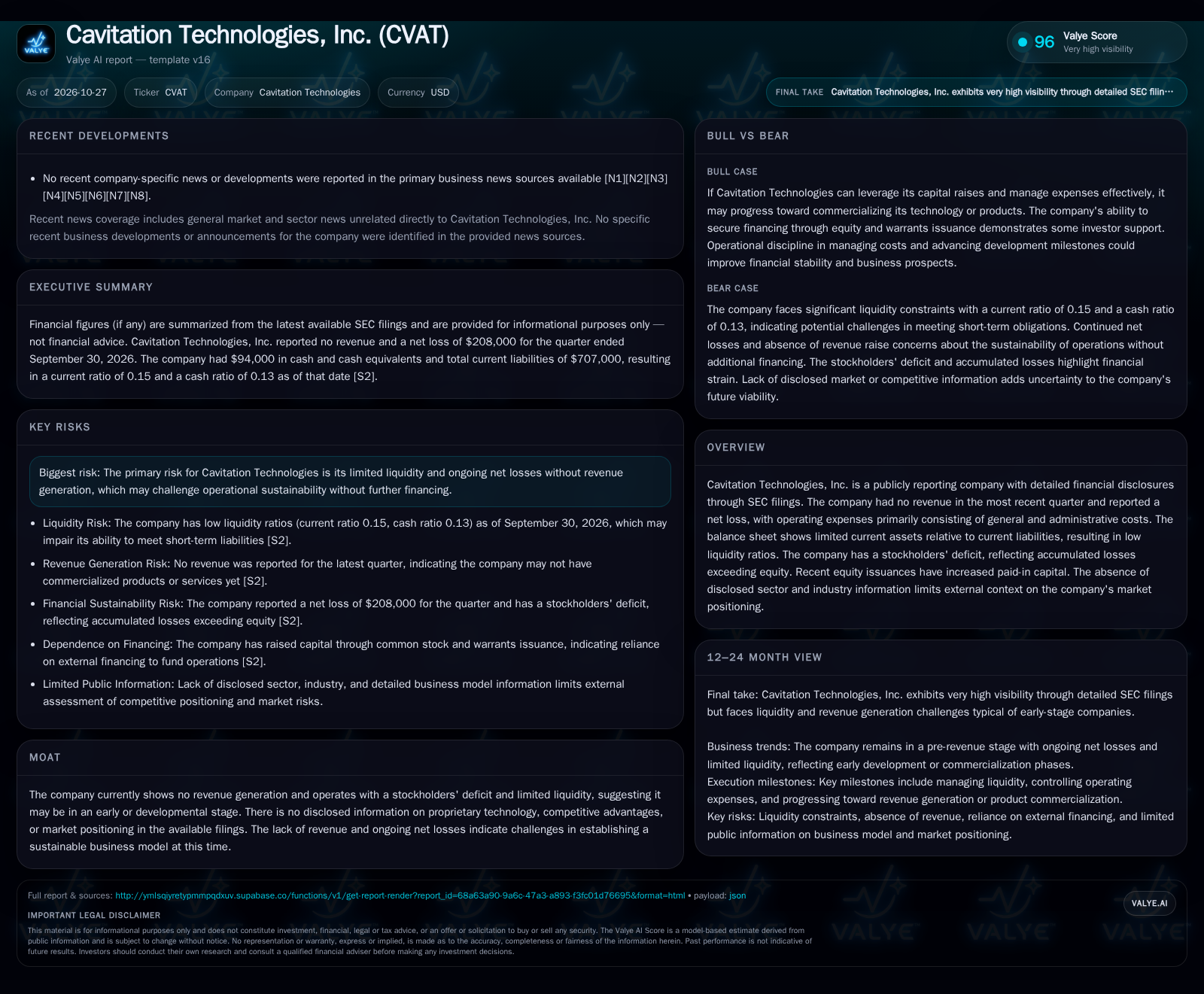
Cavitation Technologies, Inc. reported zero revenue and a net loss of $208,000 for the quarter ended September 30, 2026. Equity and warrant issuances have provided some funding, but the absence of revenue and ongoing losses highlight the company’s urgent need to either commercialize its offerings or secure further financing to sustain operations. [S2]
Cavitation Technologies, Inc. finds itself at a pivotal crossroads: the company reported no revenue for the most recent quarter, a net loss of $208,000, and a stockholders’ deficit that now stands at $739,000. Despite equity and warrant issuances boosting paid-in capital, the absence of commercial progress—coupled with an opaque business model and no disclosed market position—means the company must urgently demonstrate a path to revenue or secure additional financing to avoid deeper financial distress. [S2]
Liquidity Crisis and the Absence of Revenue Define the Present
As of September 30, 2026, Cavitation Technologies, Inc. reported zero revenue and a net loss of $208,000 for the quarter, marking a continued absence of commercial traction. The company’s cash and cash equivalents totaled just $94,000, while current liabilities reached $707,000, resulting in a current ratio of 0.15 and a cash ratio of 0.13. These figures signal severe short-term liquidity risk and an urgent need for external funding. The accumulation of losses has driven the stockholders’ deficit to $739,000, underscoring financial fragility. During the quarter, the company issued additional common stock and warrants, raising total additional paid-in capital to $27.5 million, but this has not translated into operational or commercial momentum. [S2]
The absence of any reported revenue and the ongoing net loss suggest that Cavitation Technologies remains in a pre-commercial or development stage, with no evidence of market validation or customer adoption to date. The company's financial situation leaves little margin for error, heightening the importance of either achieving rapid commercialization or securing further capital infusions.
How Cavitation Technologies’ Economics Could Evolve—If Commercialization Occurs
The company’s current economics are defined by the absence of revenue and persistent operating losses, with general and administrative expenses of $165,000 and no reported R&D spending in the latest quarter. This cost profile suggests a barebones operation focused on corporate overhead rather than active product development or sales. With no disclosed products, customers, or contracts, the commercial mechanics remain speculative.
If Cavitation Technologies manages to bring a proprietary technology to market, its potential economic model would depend on the nature of its offerings—whether equipment sales, licensing, or recurring service contracts. Equipment sales tend to be lumpy and working-capital intensive, while licensing or subscription models offer greater predictability and the potential for higher gross margins. However, moving from development to commercialization typically requires significant upfront investment in R&D, sales, and marketing, which would increase burn rate before any revenue inflection. Given the current capital structure—a stockholders’ deficit, low cash, and high current liabilities—the company would likely need substantial additional funding to support any scale-up, and its cost of capital could be high due to perceived risk.
Operating leverage could be significant if the business model is based on high-margin intellectual property or software, but any hardware-centric model would involve higher fixed costs and inventory risk. The company’s reliance on equity issuance to date suggests limited access to debt and an ongoing dilution risk for existing shareholders.
Competitive Positioning: Unknowns Dominate, but Barriers Remain High
Cavitation Technologies’ filings provide no specifics about sector, industry, or competitive landscape, making external benchmarking impossible. In general, companies developing novel industrial or process technologies face entrenched incumbents, long customer adoption cycles, and the need for strong validation data before earning commercial trust. If the company’s technology targets established process industries (as the name suggests), barriers to entry can be formidable—customers demand proven reliability, and the sales cycle can stretch for years.
Without disclosed intellectual property, customer relationships, or demonstrable product-market fit, Cavitation Technologies currently possesses no visible moat. The absence of R&D spending in the latest quarter raises questions about ongoing innovation or product development. In the broader context, any new entrant would need to demonstrate either a step-change in efficiency, cost, or compliance to displace existing solutions, and would likely face competition from both large diversified industrials and specialized startups.
Rapid Commercial Validation Could Reverse the Cycle—But What Would Prove It?
A favorable scenario for Cavitation Technologies hinges on the successful commercialization of a proprietary product or technology, leading to initial customer adoption and revenue generation. This would require the company to either complete development milestones or secure strategic partnerships that validate its offering. An influx of revenue—even modest—would signal product-market fit and could catalyze further investment or licensing opportunities.
What would confirm this scenario? Evidence would include the announcement of commercial contracts, reported revenue in subsequent filings, or disclosures of pilot projects or customer trials. A significant increase in R&D spending or new product launches would also suggest forward momentum. If the company can demonstrate recurring revenue streams or high-margin licensing deals, the business model could begin to show operating leverage, attracting new capital and improving the balance sheet.
Extended Pre-Revenue Phase and Ongoing Dilution Likely Without a Breakthrough
The most plausible near-term outcome is that Cavitation Technologies remains in a pre-commercial phase, continuing to incur operating losses while relying on periodic equity or warrant issuance for survival. The company’s cash burn, set against its minimal liquidity, suggests a need for further external financing within a short window. In this scenario, dilution risk for existing shareholders remains high, and the stockholders’ deficit could deepen absent a revenue breakthrough.
Confirmation of this trajectory would come from continued zero-revenue quarters, further increases in paid-in capital without corresponding top-line growth, and persistent low R&D or commercial investment. Conversely, disclosure of new financing rounds or bridge loans would signal ongoing dependence on external capital. The base scenario would be challenged if the company suddenly reports customer adoption or material revenue, indicating a shift toward commercialization.
Liquidity Exhaustion and Going Concern Risk if Financing or Revenue Fails to Materialize
In the adverse scenario, Cavitation Technologies fails to secure new financing or generate revenue in time to meet its short-term obligations. With a current ratio of 0.15 and only $94,000 in cash, default on payables, legal actions from creditors, or a formal going concern warning could become imminent outcomes. The company might be forced to halt operations, pursue asset sales, or seek restructuring under bankruptcy protection if additional capital cannot be raised.
Evidence supporting this scenario would include missed payments, auditor going concern qualifications, or abrupt reductions in operating activity. If the company’s filings begin to reference strategic alternatives, asset sales, or legal disputes over unpaid obligations, it would further validate this downside risk.
Milestones That Will Determine Whether Cavitation Technologies Can Transition to a Viable Business
Quarterly revenue: Any reported top-line figure would be a clear signal of commercial traction and product-market fit.
R&D expenditures: A material increase in research and development spending could indicate renewed product development or preparation for market entry.
New customer or partnership announcements: Disclosures of pilot projects, commercial contracts, or strategic alliances would suggest validation of the company’s technology.
Financing events: Additional equity, debt, or warrant issuances, as well as terms and magnitude, will reveal the company’s ability to attract capital and the likelihood of further dilution.
Balance sheet evolution: Changes in current assets, liabilities, and stockholders’ deficit will indicate whether liquidity is improving or deteriorating.
Operating expense trends: Monitoring whether G&A costs are being contained or rising relative to any increase in business activity would help test operational discipline.
Going concern language in filings: The appearance of warning statements from auditors or management would be a major red flag for solvency risk.
If disclosed, customer concentration or backlog: Would help assess sustainability and visibility of any future revenue streams.
Disclaimer: This is research-only, informational analysis and not investment advice. It may include AI-generated interpretation and general industry context. Always verify important details using primary sources.

Comments