
Amkor’s Advanced Packaging Bet: Navigating Cyclicality, Competition, and the AI-Driven Demand Shift
Amkor Technology’s Q3 2026 results underscore both the cyclical risks of the OSAT industry and the strategic promise of AI-driven advanced packaging. With a reported liquidity position, expanding U.S. manufacturing, and a strong focus on co-development with leading semiconductor players, Amkor aims to capture emerging growth opportunities—yet faces intensifying competition, capital intensity, and market volatility.
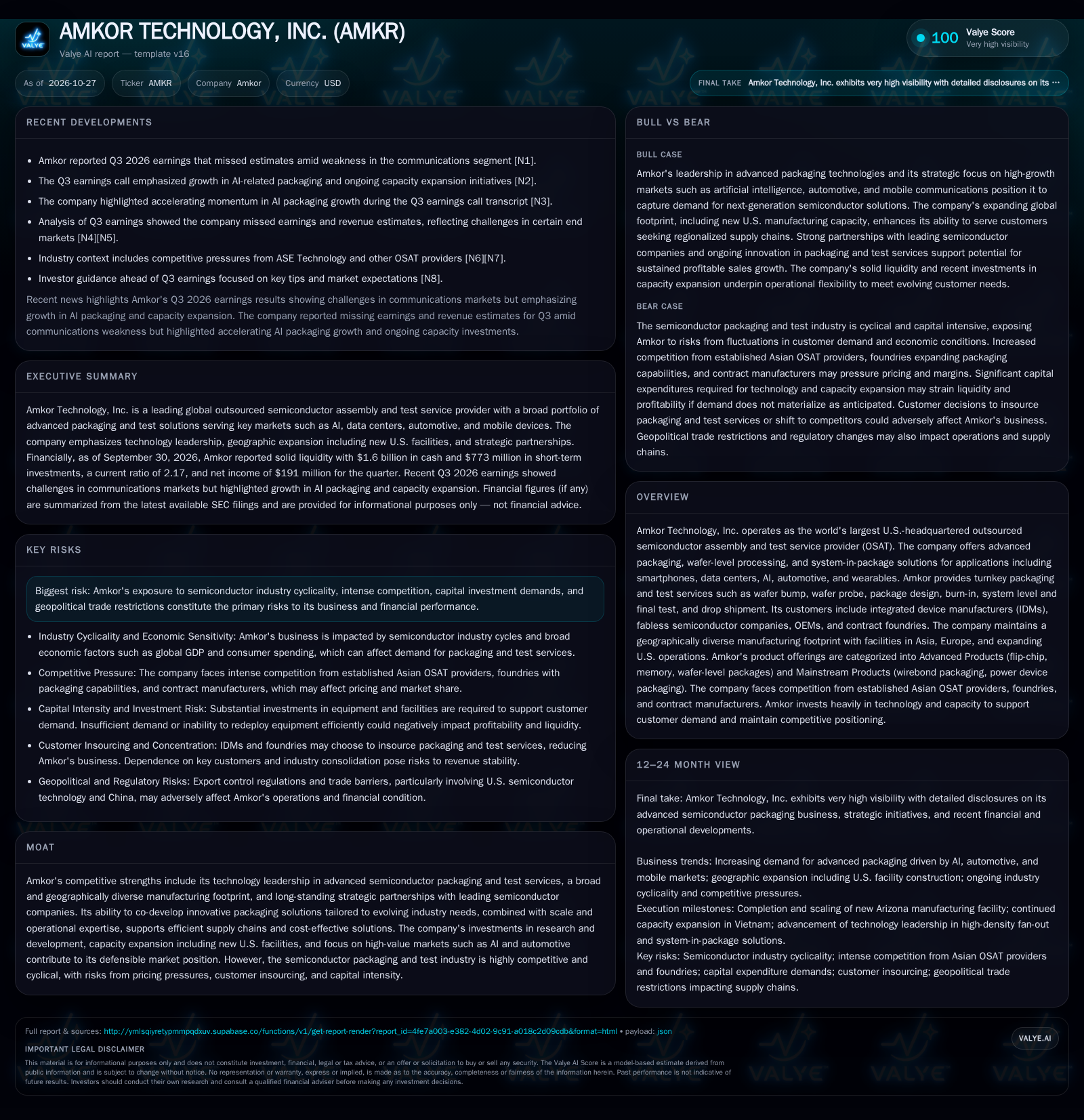
Amkor Technology reported Q3 2026 earnings that missed estimates due to communications market weakness, but highlighted accelerating growth in AI-related advanced packaging and ongoing capacity expansion. Its reported liquidity position, with $1.6 billion in cash and $773 million in short-term investments. The company’s strategy centers on advanced packaging technology leadership, U.S. manufacturing expansion, and deepening strategic partnerships. However, cyclicality, capital intensity, and fierce competition from Asian OSATs and foundries remain persistent risks. [S2] [N1] [N2]
Amkor Technology, the largest U.S.-headquartered outsourced semiconductor assembly and test (OSAT) provider, is at a crossroads where industry cyclicality meets secular opportunity. Its latest results reveal both the vulnerabilities of the communications market downturn and the promise of surging demand for advanced packaging in AI, data center, and automotive applications. As Amkor pours capital into U.S. and Vietnamese manufacturing and doubles down on technology leadership, the company must prove it can outpace rivals, manage capital risk, and ride the next wave of semiconductor growth.
Recent Results Underscore Both Weakness and Opportunity
Amkor reported Q3 2026 net income of $191 million, with basic EPS of $0.77 and diluted EPS of $0.76, as the company missed earnings and revenue estimates largely due to weakness in the communications segment. Management highlighted, however, that demand for AI-related advanced packaging is accelerating and remains a strategic focus for both capacity expansion and customer engagement. [S2] [N1] [N2]
How Capital, Mix, and Scale Shape Amkor’s Profit Potential
Amkor’s economics are defined by high operating leverage, significant capital intensity, and a fluid product mix. The company derives roughly 83% of net sales from Advanced Products—such as flip-chip, wafer-level packages, and memory—where pricing and margins generally benefit from technical complexity and customer co-development. Mainstream Products, including wirebond and power device packaging, comprise the balance with typically lower margins.
The business is sensitive to volume swings: high fixed costs in manufacturing facilities and specialized equipment mean that utilization rates drive profitability. When demand is strong—such as during upcycles in AI, automotive, or mobile—incremental volume can drop through to the bottom line. Conversely, downturns, like the recent communications segment weakness, can rapidly erode margins as capacity sits idle.
Amkor’s turnkey model offers customers a full suite of packaging and test services, which could enable stickier relationships if integration and co-development are valued. However, the company must continue to invest heavily in new equipment and technology (such as high-density fan-out and 2.5D/3D integration) to stay ahead, exposing it to the risk that new capacity may not be fully utilized if demand proves volatile. Funding these investments requires careful balance between cash flow generation, available liquidity, and, potentially, external financing if market conditions worsen.
Competitive Pressures Intensify as OSAT and Foundry Boundaries Blur
Amkor faces a fiercely competitive global landscape dominated by established Asian OSATs (such as ASE Technology, JCET Group, and Powertech Technology) and increasingly by foundries and contract manufacturers encroaching on packaging and test. The most relevant competitive dimensions are technology leadership (especially in advanced packaging), geographic reach, manufacturing scale, customer relationships, and ability to invest in capacity ahead of demand.
Asian peers often benefit from proximity to major fabless and IDM customers, scale advantages, and, in some cases, lower labor costs. Foundries, particularly those with advanced node capabilities, are integrating more packaging and test in-house, which could reduce the total available market for third-party OSATs. Amkor’s U.S. expansion may help capture customers seeking regionalized supply chains, especially for automotive and data center applications sensitive to geopolitical risk. However, the company must demonstrate that its technology portfolio and co-development partnerships can deliver defensible differentiation, not just a cost or location advantage.
AI and Automotive Demand Could Drive a New Era of High-Margin Growth
If demand for advanced packaging in AI, high-performance computing, and automotive applications accelerates faster than industry expectations, Amkor could see outsized revenue and margin expansion. The causal chain would involve: (1) leading semiconductor customers committing to long-term co-development partnerships, (2) strong ramp-up of new U.S. and Vietnam capacity, (3) successful commercialization of next-generation packaging technologies (e.g., 2.5D/3D, SiPh, Co-Packaged Optics), and (4) sustained high utilization rates that allow Amkor to leverage its fixed cost base.
Confirmation of this scenario would include robust order flow for advanced packaging, disclosures of multi-year customer engagements, and evidence that Amkor’s new facilities are operating at or near capacity. A meaningful increase in Advanced Products’ revenue mix, coupled with margin expansion and positive free cash flow after capex, would also support the thesis. This scenario would be falsified if AI and automotive demand prove more cyclical or price-sensitive than expected, or if customers shift toward insourcing or alternative suppliers.
Volatility Persists, but Advanced Packaging Offsets Weakness Elsewhere
The most plausible trajectory is that Amkor continues to experience cyclical volatility across end-markets—particularly communications—while advanced packaging growth in AI, automotive, and data center segments partially offsets these pressures. The company is likely to see utilization and profitability fluctuate quarter-to-quarter, with capital expenditures remaining high as it invests in new technology and manufacturing footprint.
Evidence confirming this scenario would include continued strength in Advanced Products, but with margin and earnings volatility tied to swings in customer demand and end-market health. Mixed signals from communications and consumer segments, alongside stable or growing contributions from AI and automotive, would reinforce a balanced but choppy outlook. This scenario would be challenged if communications or consumer markets deteriorate further without a commensurate pickup in advanced packaging, or if capital investments run ahead of demand and weigh on returns.
A Prolonged Downturn or Competitive Displacement Threatens Returns
A negative chain of events could see prolonged weakness in key end-markets (communications, consumer, or even automotive), coinciding with aggressive pricing and share gains by Asian OSATs or foundries. In this scenario, Amkor’s substantial investments in new capacity could become underutilized, leading to margin compression, negative free cash flow, and potential liquidity stress if not managed prudently.
This downside would be confirmed by persistent declines in utilization rates, shrinking Advanced Products revenue, and signs that major customers are shifting volume to competitors or insourcing. If new U.S. or Vietnam facilities ramp slowly or operate below break-even, and if capital expenditures outpace cash generation, Amkor could face balance sheet pressure. Geopolitical factors (such as new export controls) could also exacerbate supply chain or customer loss risk.
Milestones That Will Define Amkor’s Advanced Packaging Thesis
Utilization rates across new and existing facilities—particularly in Arizona and Vietnam—if disclosed, as a leading indicator of demand absorption and operating leverage.
Revenue and margin contribution from Advanced Products versus Mainstream Products, which would clarify the success of technology-driven growth.
Capex as a percentage of revenue and resulting free cash flow trends, to test if capital intensity is yielding proportionate returns.
Announcements of long-term or multi-year customer partnerships or co-development agreements, especially with leading AI and automotive semiconductor players.
Quarterly gross margin and operating margin trends, as signals of pricing power and cost absorption amid competitive and cyclical pressures.
Any disclosures on customer or end-market concentration, which would reveal dependence and potential vulnerability to insourcing or share loss.
Updates on the pace and scale of U.S. and Vietnam facility ramp-up, including any delays or cost overruns.
Regulatory or geopolitical developments affecting supply chains, customer demand, or the company’s ability to operate across regions.
Disclaimer: This is research-only, informational analysis and not investment advice. It may include AI-generated interpretation and general industry context. Always verify important details using primary sources.

Comments