
Sun Communities Refocuses on Core MH and RV Segments After Major Divestitures
Sun Communities has reshaped its portfolio by divesting non-core assets and doubling down on manufactured housing and RV communities in North America and the UK. The company’s hands-on management, integrated home sales, and long-term lease structures offer stability, but future performance will hinge on occupancy, pricing power, and the ability to maintain operational consistency across a large, partly third-party-managed footprint.
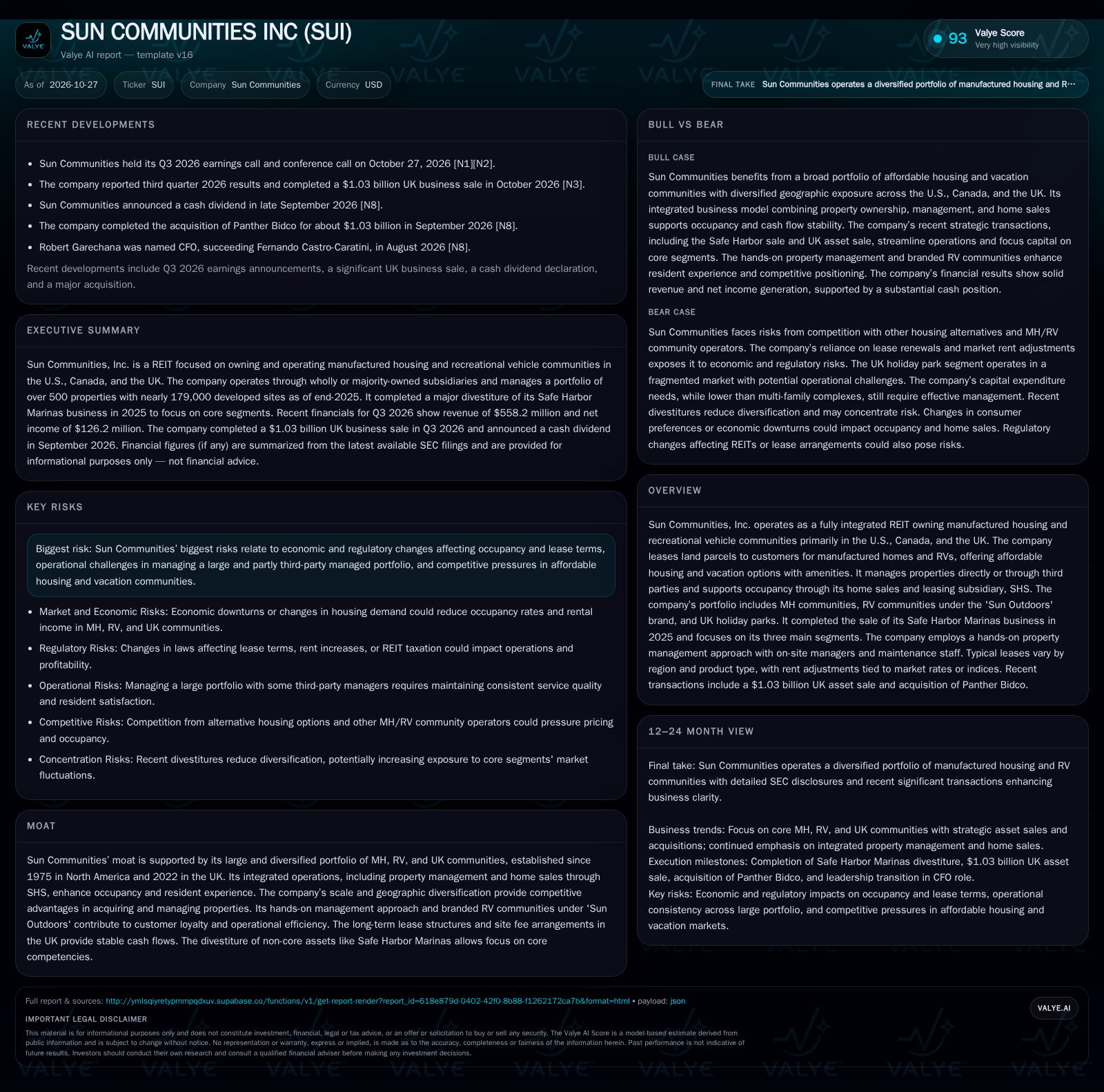
Following the sale of its Safe Harbor Marinas and a $1.03 billion UK business divestiture, Sun Communities is now concentrated on manufactured housing and RV communities. The company’s integrated model and scale provide operational advantages, yet success will depend on sustaining occupancy, managing rent adjustments, and navigating regulatory and competitive threats in affordable housing and vacation markets. [S1] [S2] [N3]
Sun Communities, Inc. has undergone a dramatic transformation over the past two years, exiting non-core businesses and sharpening its focus on manufactured housing (MH), recreational vehicle (RV) communities, and select UK holiday parks. With the $5.65 billion Safe Harbor Marinas sale in 2025 and a $1.03 billion UK business divestiture completed in Q3 2026, Sun is now a more concentrated REIT with over 500 properties and nearly 179,000 developed sites. The company’s integrated management approach and dedicated home sales arm provide levers for occupancy and rent growth, but the shift in portfolio composition raises new questions around concentration risk, operational consistency, and the durability of its competitive advantages in an evolving affordable housing landscape. [S1] [S2] [N3]
Portfolio Transformation and Financial Results Shape the Current Narrative
Sun Communities has completed two major divestitures in rapid succession: first, the $5.65 billion sale of Safe Harbor Marinas in 2025, followed by a $1.03 billion UK business sale in Q3 2026. These moves have streamlined the company’s portfolio, leaving 513 developed properties—294 MH communities, 166 RV communities, and 53 UK holiday parks—totaling 178,650 developed sites as of December 31, 2025. Q3 2026 financials post-divestiture show $558.2 million in revenue and $126.2 million in net income, signaling continued profitability as a more focused operator. Management held a Q3 2026 earnings call in late October and announced a cash dividend in September. This repositioning alters both the company’s risk profile and its growth playbook, concentrating exposure on core segments and reducing diversification. [S1] [S2] [N1] [N2] [N3] [N8]
How Sun Communities Monetizes Land, Leases, and Homes
Sun Communities’ revenue model is rooted in owning land and leasing it for manufactured homes and RVs, with additional revenue from home sales and leasing through its Sun Home Services (SHS) subsidiary. MH sites are typically leased on one-year or month-to-month terms—renewable by mutual consent—with rent increases often indexed to inflation or market conditions. This structure supports recurring revenue and some inflation pass-through, but also exposes the company to market and regulatory cycles. In the UK, site licenses for holiday parks are long-term (20–40 years) with annual site fees, which can provide a stable, predictable income stream but may limit near-term pricing flexibility.
The RV business, branded as 'Sun Outdoors,' is more seasonal and discretionary, with revenue driven by vacation demand and amenity usage. About 34% of RV properties are managed by third parties, which can reduce direct labor costs but introduces variability in service quality and margin capture. The SHS arm further monetizes the resident base by selling and leasing homes—over 12,510 occupied leased homes as of end-2025—helping to fill vacant sites and support occupancy. While capital needs for MH and RV communities are generally lower than for multifamily apartments (due to residents owning the homes), ongoing repair, refurbishment, and amenity investments are necessary to maintain competitiveness and occupancy. Operating leverage is achieved primarily through scale and efficient management, but is constrained by the hands-on, service-intensive nature of the business.
Scale, Brand, and Management Model Define Sun’s Edge—But Barriers Are Not Absolute
Sun Communities’ competitive advantages stem from its portfolio scale, geographic diversification, and integrated property management and home sales. Its national footprint allows for best-practice sharing, purchasing power, and brand recognition—especially in the RV segment under 'Sun Outdoors.' The company’s hands-on property management, with 849 on-site managers as of end-2025, supports resident satisfaction and operational consistency, though about a third of RV properties are managed by third parties, introducing some variability.
However, these advantages are not insurmountable. The manufactured housing and RV sector remains fragmented, with both large REIT peers and regional operators. Barriers to entry are meaningful—zoning restrictions, community entitlements, and the capital required for scale—but existing communities can face competition from new supply in unconstrained regions and from alternative affordable housing options such as apartments, single-family rentals, or build-to-rent developments. The sale of Safe Harbor Marinas and part of the UK business has reduced the company’s diversification, raising exposure to sector-specific risks and competitive pressures.
If Occupancy and Rent Growth Accelerate, Operating Leverage Could Drive Profitability
A favorable scenario for Sun Communities would see continued high occupancy levels in MH and RV segments, robust demand for affordable housing and vacation options, and the ability to increase rents in line with or above inflation. The SHS home sales and leasing arm could help fill vacant sites quickly, maximizing asset utilization. In this environment, Sun’s scale and integrated management model would allow incremental revenue to flow through at attractive margins, leveraging relatively fixed property management costs. Additional upside could come from the successful reinvestment of divestiture proceeds into high-yielding core assets, selective property acquisitions, or redevelopment projects.
Evidence that would confirm this scenario includes sustained or rising occupancy rates, consistent rent increases above CPI, expanding EBITDA margins, and disciplined capital deployment resulting in accretive property additions or upgrades. Strong resident retention and positive net absorption, particularly in newly acquired or repositioned communities, would further support this thesis.
Solid Occupancy and Stable Rents Anchor Predictable Cash Flow—But Growth Slows
The most plausible near-term outcome is for Sun Communities to maintain stable occupancy in its MH and RV portfolios, with moderate rent increases roughly tracking inflation or local market trends. The company’s integrated management and home sales model should help offset natural churn, but the concentrated portfolio post-divestiture may result in lower overall growth and less diversification benefit. Operating margins may remain steady if expense control holds, but upside from operating leverage is likely constrained by ongoing amenity investment needs and any wage or repair inflation.
Confirmation of this scenario would come from flat-to-slightly rising occupancy rates, rent growth in line with historical norms or inflation, and steady EBITDA margins. Capex as a percentage of property revenue would remain consistent, and reinvestment of sale proceeds would be focused on incremental rather than transformational growth. Falsifying evidence would include a material drop in occupancy, below-market rent growth, or rising operating expense ratios.
Economic or Regulatory Shocks Could Pressure Occupancy, Rents, and Capital Allocation
A negative scenario could unfold if an economic downturn or unfavorable regulatory changes reduce demand for manufactured housing or RV sites, leading to higher vacancy and weaker pricing power. Regulatory risks include potential rent control measures, changes to REIT tax treatment, or restrictions on lease terms, any of which could limit revenue growth or increase compliance costs. The reduced diversification post-divestiture means that setbacks in MH or RV—such as oversupply, reputational issues, or loss of pricing power—would have a magnified impact on earnings and cash flow.
Confirmation of downside would be visible in declining occupancy rates, rent concessions or below-inflation rent growth, margin compression from rising operating or capital costs, or evidence of difficulty redeploying divestiture proceeds into attractive assets. Additional risk would be signaled by increased tenant turnover, negative resident feedback, or operational disruptions in third-party-managed sites.
What Will Validate Sun Communities’ Post-Divestiture Strategy?
Occupancy rates by segment (MH, RV, UK) and changes versus prior periods, if disclosed, will clarify demand resilience and asset utilization.
Average rent growth by segment and renewal rates will illuminate pricing power and the company’s ability to pass through inflation or market increases.
Home sales and leased home absorption rates via Sun Home Services would help test the effectiveness of the integrated sales/leasing model in supporting occupancy.
EBITDA margin trends and property-level expense ratios will signal operating leverage and cost control effectiveness.
Capital allocation details—especially reinvestment of divestiture proceeds, acquisition cap rates, and development pipelines—will show whether the company is creating value post-asset sales.
Resident satisfaction scores, turnover rates, and complaint metrics (if disclosed) would provide insight into operational quality and long-term retention.
Any regulatory developments affecting lease terms, rent increases, or REIT tax treatment should be monitored closely for impact on revenue and profitability.
Third-party versus in-house management ratios for RV properties, and any change in performance or service quality between these models, would help assess operational risk.
Disclaimer: This is research-only, informational analysis and not investment advice. It may include AI-generated interpretation and general industry context. Always verify important details using primary sources.

Comments