
Polaris Inc.: Powersports Leadership and Channel Dynamics After Motorcycle Divestiture
Polaris continues to lead the North American off-road vehicle market with a diversified offering spanning ORVs, snowmobiles, and recreational boats.
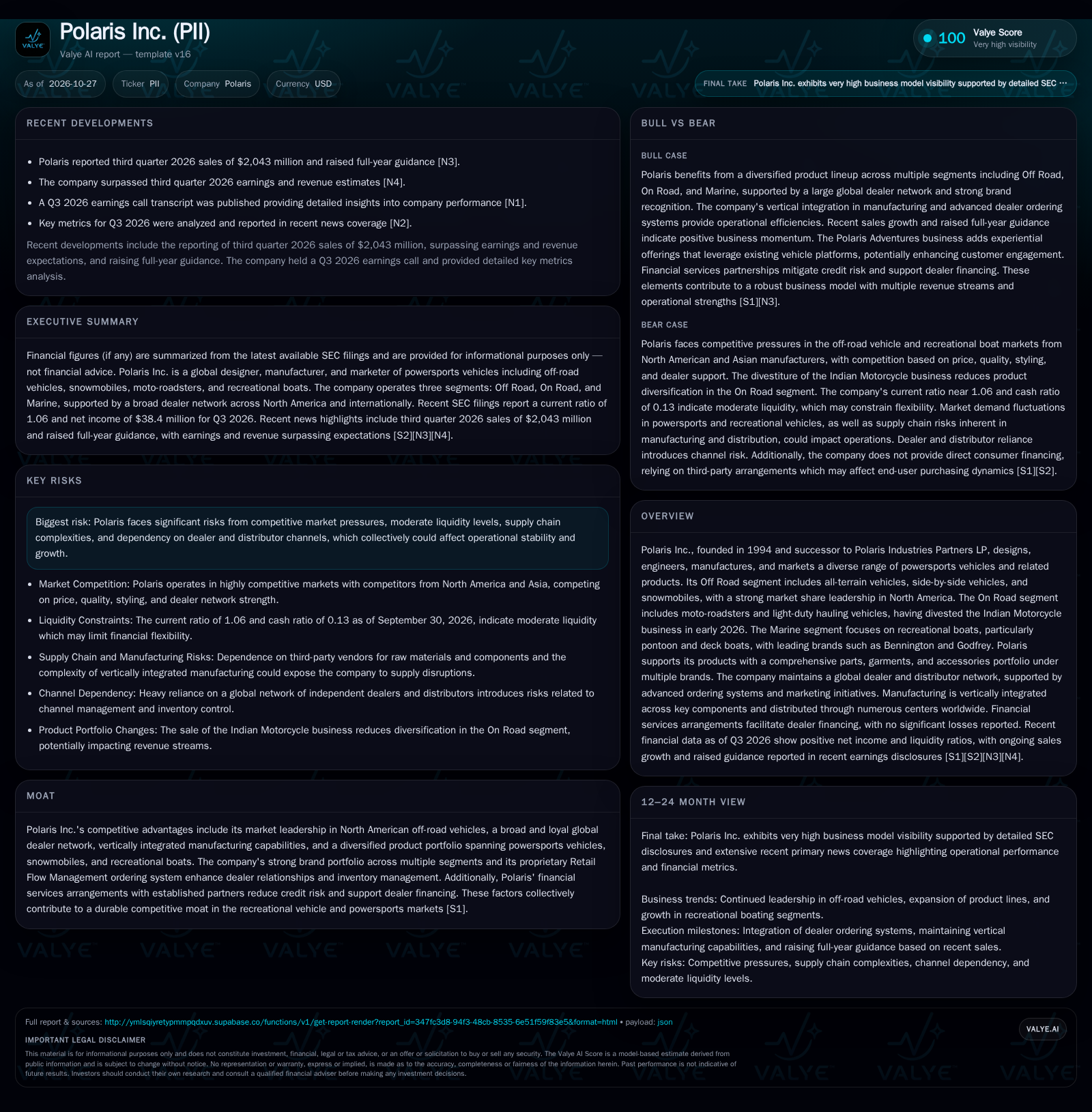
Polaris Inc. reported strong Q3 2026 results, with $2.04 billion in sales and raised full-year guidance, underpinned by its dominant North American off-road vehicle position and broad dealer network. The sale of its Indian Motorcycle business narrows its On Road segment, sharpening focus but reducing diversification. While vertically integrated manufacturing and advanced dealer systems provide operational leverage, reported liquidity position and ongoing channel dependency remain important watchpoints for the company’s next growth phase. [S2] [N3] [N4]
Polaris Inc. enters late 2026 as North America’s dominant off-road vehicle manufacturer, reporting robust third-quarter results and upwardly revised full-year guidance. With its product lineup spanning off-road vehicles, snowmobiles, and recreational boats, Polaris leverages deep dealer relationships and vertically integrated manufacturing to maintain its market edge. However, the recent sale of its Indian Motorcycle business narrows its On Road segment, raising questions about future diversification and growth levers. Reported liquidity position and channel dependence remain material factors as the company navigates a competitive, cyclical market environment.
Polaris’ Recent Performance and Strategic Adjustments Redefine Its Business Model
Polaris reported third quarter 2026 sales of $2.043 billion, surpassing earnings and revenue estimates, and raised its full-year guidance—demonstrating clear business momentum in the core powersports and marine segments. Net income for the quarter was $38.4 million, with basic EPS of $0.67. The company’s current ratio was 1.06 and cash ratio 0.13 as of September 30, 2026, indicating reported liquidity position. Notably, the early 2026 divestiture of the Indian Motorcycle business marks a significant strategic shift, narrowing the On Road segment’s scope and potentially sharpening focus on core off-road and marine franchises. Together, these developments highlight both Polaris’s near-term operational strength and evolving risk/reward profile. [S2] [N3] [N4]
Profit Drivers: Diverse Manufacturing, Dealer Networks, and Aftermarket Sales
Polaris’ revenue model is anchored by the sale of off-road vehicles (ORVs) and snowmobiles, complemented by a growing marine portfolio and a meaningful aftermarket business for parts, garments, and accessories (PG&A). The company’s global dealer network—over 2,400 in North America and 1,500 internationally—serves as the primary distribution channel. While this model supports broad market coverage and localized retailing, it introduces channel inventory risk and limits direct capture of end-user data.
Pricing power in the ORV segment is supported by Polaris’s market leadership and breadth of offerings, from entry-level to extreme-performance vehicles. However, the powersports market remains highly cyclical and sensitive to discretionary spending, with competition often pressuring margins during down cycles. Vertically integrated manufacturing—spanning 18 global facilities—provides operational control and may enable better cost management, but also raises fixed cost leverage and supply chain complexity.
Aftermarket sales (PG&A) typically deliver higher margins than new vehicle sales and offer recurring revenue potential, particularly as the installed base of Polaris vehicles grows. Financial services arrangements with Wells Fargo and internal affiliates enable dealer floorplan financing, reducing working capital drag and credit risk for Polaris itself. However, the company does not extend direct consumer financing, which could limit influence over end-user purchasing cycles compared to vertically integrated OEMs with captive finance arms.
The divestiture of Indian Motorcycle streamlines the portfolio but removes a potential higher-margin, brand-driven business that could have served as a countercyclical offset or growth lever.
Leading Position in Off-Road Vehicles Faces Rising Competitive and Substitution Challenges
Polaris is the market share leader in North American off-road vehicles, a position underpinned by product breadth, a loyal dealer network, and strong brand recognition. Its competitive advantages include a proprietary Retail Flow Management ordering system that enables daily dealer ordering and more dynamic inventory management, as well as vertically integrated manufacturing that may allow for faster time-to-market and quality control.
However, the company faces persistent competitive pressures from both established North American manufacturers and aggressive Asian entrants, many of whom compete on price, styling, and perceived value. Substitution threats also arise from adjacent recreational vehicle categories (e.g., motorcycles, watercraft, RVs), especially as consumer preferences shift or economic cycles tighten discretionary spending. The recent exit from the Indian Motorcycle business narrows the competitive set, but also cedes ground in the premium two-wheel space.
Marine operations add diversification, but this market is equally cyclical and faces its own set of established competitors. The global dealer footprint offers distribution reach, but also exposes Polaris to regional channel risks and supply chain disruptions that can impact availability and brand equity.
Margin Growth Potential Hinges on Dealer Network Leverage and Aftermarket Expansion
A favorable scenario would see Polaris leveraging its dealer network and product innovation to capture incremental share in both off-road and marine segments, while expanding high-margin PG&A and experience-based businesses such as Polaris Adventures.
Confirmation would come from sustained double-digit growth in PG&A, stable or improving operating margins despite input cost volatility, and evidence of increased dealer throughput or reduced channel inventory. If Polaris can successfully cross-sell aftermarket offerings and drive repeat engagement through experiential platforms, it may partially offset the loss of the Indian Motorcycle business. Additionally, strategic bolt-on acquisitions in marine or adjacent segments could reignite portfolio diversification.
This scenario would be challenged if aftermarket attachment rates stagnate, dealer inventory builds, or if competitive pricing pressure erodes gross margins.
Projected Outlook Involves Consistent Demand with Cyclical Variability and Efficiency Improvements
The most plausible outlook is for Polaris to maintain its leadership in core off-road segments while experiencing typical cyclical fluctuations tied to consumer confidence and recreational spending. Marine operations provide some diversification, but the company remains exposed to the broader economic cycle and weather-driven seasonality.
Incremental improvements in inventory management, product mix, and aftermarket penetration could support modest operating leverage, but material margin expansion may be constrained by competition and input cost volatility. The absence of the Indian Motorcycle business means the On Road segment is less of a growth driver, shifting the focus squarely to ORVs, snowmobiles, and marine.
This scenario would be confirmed by continued market share stability, modest sales growth in ORV and marine, and steady contributions from PG&A. It would be challenged if competitor share gains or a macro downturn lead to channel destocking or margin compression.
Profitability Risks Stem from Dealer Inventory Changes, Economic Slowdowns, and Supply Chain Issues
A negative scenario could unfold if consumer demand for powersports vehicles contracts due to rising interest rates, economic uncertainty, or unfavorable weather, triggering dealer destocking and order cancellations. Given the moderate current and cash ratios, such a downturn could quickly stress Polaris’s working capital and operational flexibility, particularly if inventory builds faster than sales.
Supply chain disruptions—whether from component shortages, logistics bottlenecks, or geopolitical events—could further exacerbate margin pressures by driving up costs or delaying product availability, undermining dealer and customer confidence. Channel dependency amplifies these risks, as dealers may reduce orders or seek alternative brands if inventory turns slow or support diminishes.
This scenario would be evidenced by rising dealer inventory (if disclosed), declining sales or order rates, margin contraction, and possible downward revisions to guidance. Any deterioration in the company’s ability to manage working capital or maintain dealer confidence would also be a red flag.
Challenges Ahead for Polaris’ Strategic Direction and Operational Strength
Trends in dealer inventory levels and order flow, especially in the context of the Retail Flow Management system, would help test whether channel health is being maintained or deteriorating (if disclosed).
PG&A (parts, garments, and accessories) attachment rates and year-over-year growth, as this segment drives margin expansion and recurring revenue (if disclosed).
Operating margin trends, particularly as input costs fluctuate and as the product mix shifts post-motorcycle divestiture.
Market share data in off-road vehicles and marine segments—sustained leadership would support the core thesis, while share loss would challenge it.
Cash conversion cycle and working capital metrics, to assess operational efficiency and resilience in a downturn (if disclosed).
Dealer network stability, including retention rates and regional expansion or contraction, as channel reach underpins sales and brand equity (if disclosed).
Strategic moves in adjacent markets or bolt-on acquisitions that could re-diversify the portfolio or drive new growth.
Disclaimer: This is research-only, informational analysis and not investment advice. It may include AI-generated interpretation and general industry context. Always verify important details using primary sources.

Comments