
Welltower’s Healthcare Real Estate Platform: Navigating Tenant Risk and Demographic Demand
Welltower’s scale in seniors housing and healthcare real estate positions it to benefit from demographic tailwinds, but the company’s reliance on third-party operators and exposure to regulatory shifts create a nuanced risk-reward profile. Recent earnings outperformance and substantial liquidity underscore operational momentum, yet future value hinges on the interplay between tenant health, reimbursement trends, and capital costs.
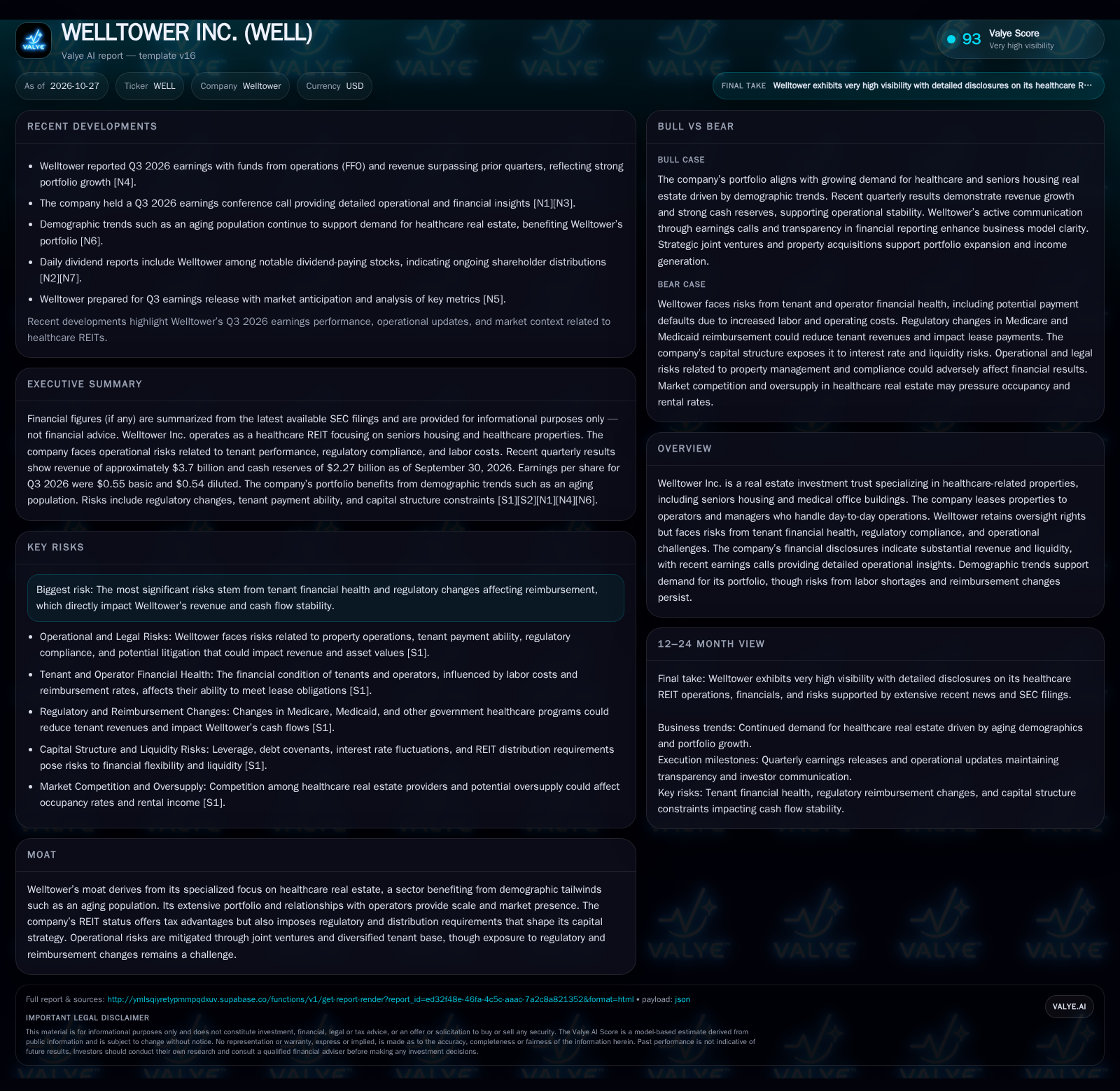
Welltower reported Q3 2026 revenue of $3.716 billion and cash reserves of $2.27 billion, exceeding prior quarters in both FFO and revenue. The company’s vast healthcare and seniors housing portfolio benefits from aging demographic trends, but it is exposed to tenant operating stress, regulatory reimbursement risk, and capital structure constraints. Sustained value creation will depend on Welltower’s ability to manage these risks while capitalizing on secular demand growth. [S2] [N4]
Welltower Inc. stands at the intersection of healthcare real estate and demographic transformation, leveraging its extensive portfolio of seniors housing and medical properties to capture growth from an aging population. Recent quarterly results reveal both robust revenue momentum and a sizable cash reserve, yet the company’s fortunes remain tied to the operational and financial health of its tenants, as well as the evolving regulatory and capital landscape. For investors, the key strategic question is whether Welltower can continue to grow cash flows and dividends while managing the mounting risks inherent in its asset-heavy, operator-dependent business model.
Recent Results Spotlight Growth and Liquidity—But with Persistent Exposure to Tenant and Regulatory Risks
Welltower reported Q3 2026 revenue of approximately $3.716 billion, with funds from operations (FFO) and revenue both surpassing prior quarters, indicating continued portfolio growth and operational momentum [S2] [N4]. [S2] Basic and diluted EPS for Q3 were $0.55 and $0.54, respectively [S2]. These figures reflect the company’s ability to capitalize on demographic tailwinds and sustained demand for healthcare real estate.
Despite these positives, Welltower’s model relies on third-party operators and managers, limiting direct control over day-to-day operations while retaining oversight and approval rights [S1]. The company continues to face operational and legal risks tied to tenant payment capacity, regulatory compliance, and rising labor and operating costs affecting its tenants [S1]. Regulatory and reimbursement risks, particularly changes in Medicare and Medicaid, also remain central to the company’s outlook [S1].
How Welltower’s Asset-Heavy Model Converts Demographic Trends into Cash Flows
Welltower generates revenue primarily through leasing its healthcare and seniors housing properties to third-party operators and managers. The company’s economics are tied to rental income, which can be structured as triple-net leases (where tenants cover most operating costs) or management agreements that may include variable rent components. This structure typically provides predictable cash flows and the potential for operating leverage as portfolio occupancy and rates rise.
Fixed costs are substantial due to the capital-intensive nature of real estate ownership—significant outlays for acquisitions, property development, and maintenance. Variable costs are more limited at the REIT level but can surface indirectly if property-level performance weakens and tenants struggle to meet obligations. Welltower’s growth depends on its ability to acquire, develop, or reposition properties at attractive yields, as well as its access to debt and equity capital at reasonable costs.
As a REIT, Welltower is required to distribute a significant portion of taxable income as dividends, shaping its liquidity management and constraining retained earnings. The company’s capital structure, including leverage and debt covenants, introduces sensitivity to interest rate movements and refinancing cycles. With $2.27 billion in cash and recent earnings outperformance, Welltower has near-term potential financial flexibility, but long-term economics remain sensitive to tenant health, regulatory policy, and the cost of capital [S2] [S1].
Scale, Specialization, and the Limits of Differentiation in Healthcare Real Estate
Welltower’s competitive position is anchored by its large, diversified portfolio focused on seniors housing, outpatient medical, and other healthcare properties. This specialization provides it with scale advantages in sourcing, asset management, and operator relationships, as well as the ability to access capital markets on favorable terms.
However, the company’s reliance on third-party operators means its performance is closely tied to the success and financial strength of these partners. In a sector facing labor shortages and rising operating costs, tenant distress can translate into missed lease payments, reduced occupancy, or asset impairment. The healthcare real estate space is also competitive, with other REITs, institutional investors, and private equity firms vying for assets and operator relationships. Furthermore, oversupply in certain markets could pressure occupancy rates and rental pricing.
Welltower’s moat is rooted in its sector expertise, established operator relationships, and the demographic-driven demand for healthcare real estate, but these advantages are tempered by the inherent risks of operator dependence and limited pricing power in highly competitive or oversupplied regions.
If Tenant Health Holds and Demographic Demand Accelerates, Cash Flow Growth Could Outpace Expectations
A favorable scenario for Welltower hinges on the continued strength of its third-party operators, sustained high occupancy, and the ability to periodically raise rents or acquire properties at attractive yields. If labor cost pressures stabilize and regulatory reimbursement policy remains supportive, tenants would be better positioned to meet lease obligations, translating into stable or rising rental income for Welltower.
Demographic trends—particularly the aging U.S. population—could drive above-average occupancy and support new property development or acquisitions. If Welltower leverages its scale to secure high-quality assets and operator partnerships, it could generate incremental FFO growth and maintain or raise its dividend payout.
Evidence that would confirm this scenario includes: sequential improvements in occupancy rates, rising same-property net operating income, continued FFO growth, and robust acquisition pipelines disclosed in future earnings calls. Conversely, increases in tenant distress, missed payments, or regulatory headwinds would undermine this thesis.
Most Likely Trajectory: Steady Growth with Episodic Volatility from Tenant and Policy Shocks
The most plausible outcome is that Welltower continues to benefit from secular demographic demand, supporting gradual revenue and FFO growth. However, this growth will likely be punctuated by episodic volatility as some tenants face operational challenges—particularly in periods of labor market stress or reimbursement changes.
Welltower’s diversified tenant base and portfolio breadth should help mitigate the impact of individual operator issues, but sector-wide shocks (such as significant Medicare/Medicaid policy shifts or a sharp rise in interest rates) could still weigh on results. The company is expected to maintain a significant dividend, but the pace of dividend growth may be constrained by the need to retain liquidity and manage its capital structure.
Confirmation of this scenario would include continued sequential FFO growth, stable or modestly rising occupancy, and ongoing operator diversification. A reversal—such as a material increase in missed tenant payments or asset write-downs—would challenge the steady-state thesis.
Tenant Distress or Regulatory Shocks Could Trigger Asset Write-downs and Dividend Strain
In an adverse scenario, labor cost inflation or regulatory reimbursement cuts could severely pressure tenant margins, increasing the risk of missed lease payments, defaults, or requests for rent concessions. If these pressures are widespread, Welltower could face a cascade of lower occupancy, asset impairments, and reduced cash flow.
Such a downturn could coincide with tighter credit markets or higher interest rates, making refinancing or new acquisitions more costly and limiting potential financial flexibility. In extreme cases, Welltower might need to reduce dividends, sell assets at unfavorable prices, or renegotiate debt covenants.
Evidence for this scenario would include a sharp rise in tenant non-payments, asset write-downs, negative FFO growth, or explicit disclosures of operator distress in earnings calls or filings. Improvement in tenant health or stabilization of regulatory policy would help falsify this downside thesis.
Operational and Financial Benchmarks That Will Define Welltower’s Value Proposition
Quarterly same-property net operating income (NOI) growth, if disclosed, would clarify underlying property-level performance and rental rate trends.
Sequential occupancy rates by asset type (seniors housing, outpatient medical, etc.) are critical for gauging demand resilience and tenant health.
Trends in tenant lease payment timeliness and any disclosed rent concessions or defaults would directly inform on operator stress.
Details on new property acquisitions, development pipelines, and cap rates would help test the company’s ability to deploy capital at attractive yields.
Changes in leverage ratios, interest coverage, and debt maturity schedules, as disclosed, would shed light on balance sheet risk and potential financial flexibility.
Updates on regulatory or reimbursement policy impacting tenants, especially in earnings calls or SEC filings, would indicate potential pressure points.
Dividend payout trends—whether maintained, raised, or reduced—offer insight into management’s view of sustainable cash flow.
Operator concentration metrics, if disclosed, would reveal exposure to individual tenant risk and diversification progress.
Disclaimer: This is research-only, informational analysis and not investment advice. It may include AI-generated interpretation and general industry context. Always verify important details using primary sources.

Comments