
NXP Semiconductors: Integrating Automotive Acquisitions for Edge AI and SDV Leadership
Recent acquisitions targeting automotive networking, safety-critical systems, and edge AI reinforce NXP’s ambition to deepen its role in software-defined vehicles and industrial IoT. Execution on integration and demand resilience will determine whether NXP can translate its broad portfolio and partnerships into sustained economic advantage.
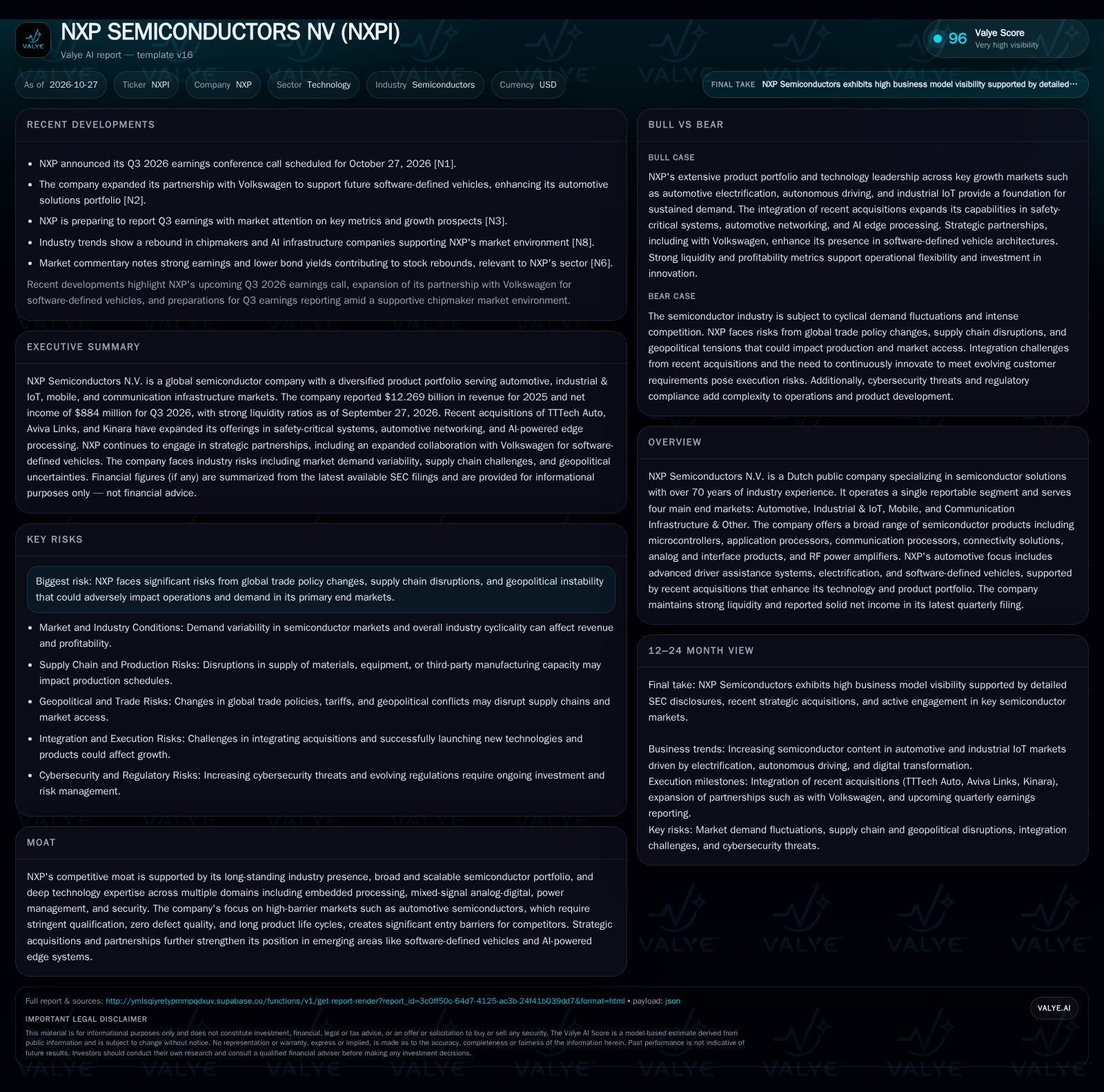
NXP’s $1.27B in recent acquisitions expands its automotive and AI edge processing capabilities, as it seeks to capitalize on rising semiconductor content in vehicles and industrial systems. Watch execution in automotive SDV, edge AI adoption, and supply chain resilience for the next phase.
NXP Semiconductors is at a pivotal point, leveraging a series of targeted acquisitions to sharpen its focus on the automotive sector’s most dynamic trends: software-defined vehicles, advanced networking, and AI at the edge. While the company’s fiscal discipline and product breadth provide a solid foundation, the challenge ahead is to integrate new capabilities and sustain growth in the face of industry cyclicality and execution risk. The next year will test whether NXP can turn strategic investments into durable economic advantage as the semiconductor content per vehicle continues to rise.
Recent Acquisitions and Core Financials Define the Near-Term Landscape
NXP completed three major acquisitions in 2025: TTTech Auto ($766M), Aviva Links ($222M), and Kinara ($284M), focusing on strengthening its automotive safety, networking, and edge AI portfolios [S1]. The company reported $12.27B in 2025 revenue, a modest decline from 2024, and Q3 2026 net income of $884M [S1] [S2]. As of September 2026, NXP reported $3.94B in cash and equivalents and a current ratio of 2.12 [S2].
These moves reflect a strategic push into high-value, high-barrier automotive applications—especially as software-defined vehicles (SDVs), electrification, and autonomy drive secular semiconductor demand. The question is whether NXP can integrate these new assets effectively while maintaining profitability and navigating a slightly contracting top line.
How NXP’s Revenue Mix and Operating Structure Shape Its Economic Model
NXP’s business model is anchored in designing and selling a broad range of semiconductor products, with the automotive market as its primary growth engine. Revenue is generated from a mix of microcontrollers (MCUs), application processors, connectivity chips, analog/interface products, and RF amplifiers, sold into automotive, industrial, mobile, and communications infrastructure channels [S1]. Pricing power tends to be strongest in automotive and industrial verticals, where qualification requirements, product lifespans, and safety certifications limit direct substitution and foster stickier customer relationships.
The company’s economics are shaped by high fixed R&D and capital costs—especially for advanced nodes and automotive-grade chips—but with variable gross margins depending on product mix and lifecycle stage. Integration of newly acquired technologies (e.g., edge AI NPUs from Kinara) could yield higher average selling prices and attach rates if successfully designed into SDV and industrial IoT platforms. However, the cyclical nature of the semiconductor sector means that volume swings can rapidly impact margins, and the need for continuous innovation demands ongoing investment.
The company reported cash and liquidity metrics for the period; these figures do not by themselves establish operating runway, investment capacity, financial flexibility, or financing capacity. [S2] The company’s ability to generate operating leverage depends on maintaining utilization in fabs and supply chains, while expanding content per end device.
A critical factor influencing NXP’s economic model is the balance between fixed and variable costs as it scales its automotive and edge AI offerings. Given the high upfront investment required for automotive-grade semiconductor development, including certification and long qualification cycles, the company’s ability to spread these fixed costs over increasing volumes is essential to improving operating leverage. However, this leverage is conditional on stable or growing demand and the successful integration of acquired technologies into scalable product lines. Failure to achieve volume growth or encountering prolonged integration challenges could compress margins despite the premium pricing opportunities in safety-critical applications.
Defending Share in High-Barrier Automotive and Industrial Domains
NXP’s competitive advantages stem from its deep domain expertise in automotive and industrial semiconductors, broad IP portfolio, and entrenched relationships with OEMs and Tier 1 suppliers. Automotive chips require rigorous qualification and long development cycles, which create switching frictions for customers and entry barriers for new competitors. The company’s recent acquisitions reinforce its position in safety-critical systems, high-speed in-vehicle networking, and edge AI processing—areas where differentiation and ecosystem integration matter most.
However, the competitive landscape is intense. Large diversified peers and automotive specialists are all investing in SDV enablement, AI accelerators, and connectivity. Substitute technologies—such as custom silicon from OEMs, vertical integration by automakers, or alternative AI edge solutions—pose a long-term threat if NXP fails to keep pace on performance or cost. The degree to which NXP’s platform can lock in design wins and become integral to evolving SDV architectures will determine its ability to defend and expand share.
Another dimension of NXP’s competitive positioning is its ecosystem strategy, which extends beyond individual products to integrated software and hardware platforms. As SDVs and industrial IoT systems become increasingly complex, customers favor suppliers who can offer end-to-end solutions that simplify development and reduce time to market. NXP’s acquisitions, particularly in edge AI and networking, aim to create such integrated offerings. The success of this approach depends on seamless interoperability, robust software stacks, and strong developer support. If NXP can establish itself as a preferred platform provider, it may benefit from network effects and higher switching costs, strengthening its competitive moat.
Unlocking Value Through Seamless Integration and SDV Platform Adoption
The most favorable scenario for NXP is rapid, successful integration of TTTech Auto, Aviva Links, and Kinara, resulting in differentiated platforms for safety-critical automotive, high-speed networking, and AI-powered edge applications. If NXP can leverage these assets into design wins with leading OEMs—particularly as SDV architectures become mainstream—the company could accelerate content per vehicle and capture premium pricing.
Evidence that would confirm this scenario includes: public announcements of major SDV or AI edge platform adoptions by top automotive manufacturers, growth in automotive segment revenue outpacing the broader market, and improved gross margins from higher-value product mix. Additional signals would be expansion of ecosystem partnerships, such as further collaborations with automakers or Tier 1s, and a visible pipeline of next-generation automotive silicon launches.
Integration Progress, Cyclical Demand, and Portfolio Breadth Sustain Core Performance
The most plausible trajectory is that NXP sees moderate growth as automotive and industrial customers continue to increase semiconductor content, but the company must navigate typical integration friction from recent acquisitions and ongoing demand cyclicality. Portfolio breadth across MCUs, processors, and connectivity solutions provides ballast against volatility in any single end market.
Expect revenue to track global automotive production trends, with incremental gains from SDV and AI edge adoption. Confirmation would come from stable or slightly rising automotive revenue, successful cross-selling of new capabilities, and management commentary indicating smooth integration progress.
Integration Setbacks and Macroeconomic Shocks Could Undermine Growth Ambitions
The primary downside scenario involves either significant integration challenges—delays or cost overruns in merging TTTech Auto, Aviva Links, or Kinara—or a sharp downturn in automotive and industrial demand due to macroeconomic or geopolitical shocks. If NXP fails to incorporate new technologies into its core product suite or loses key design wins to competitors, its growth narrative could stall.
Downside confirmation would include missed revenue or margin targets, public disclosures of integration problems, loss of major automotive customers, or evidence that acquired technologies are not gaining traction in customer platforms. External factors such as renewed trade barriers, supply chain disruptions, or sector-wide demand contraction would also amplify risk.
Milestones That Will Shape NXP’s Automotive and Edge AI Thesis
Progress on integrating TTTech Auto, Aviva Links, and Kinara—management updates on synergy capture, technology roadmap, and cost structure would help test the thesis.
Growth rate of automotive segment revenue relative to global vehicle production and semiconductor content trends.
Visibility into design wins or platform adoptions for SDV architectures, especially with top-tier automotive OEMs.
Gross margin trends, particularly in automotive and high-value edge AI products, as an indicator of successful product mix shift.
Updates on major partnerships or ecosystem collaborations, such as expanded SDV or industrial IoT alliances.
Supply chain resilience and ability to maintain inventory and production schedules amid global disruptions.
If disclosed, customer retention rates and average contract duration in automotive and industrial verticals would clarify revenue visibility.
R&D spend as a percentage of revenue and pace of new product launches in target growth domains.
Disclaimer: This is research-only, informational analysis and not investment advice. It may include AI-generated interpretation and general industry context. Always verify important details using primary sources.

Comments