
Beta Bionics: Automated Insulin Delivery at a Regulatory and Commercial Crossroads
Beta Bionics enters late 2026 with FDA-cleared devices, reported liquidity position, and a pipeline of next-generation diabetes technologies. Yet, its future hinges on regulatory progress, manufacturing execution, and sustained partnerships amid a fiercely competitive diabetes device market.
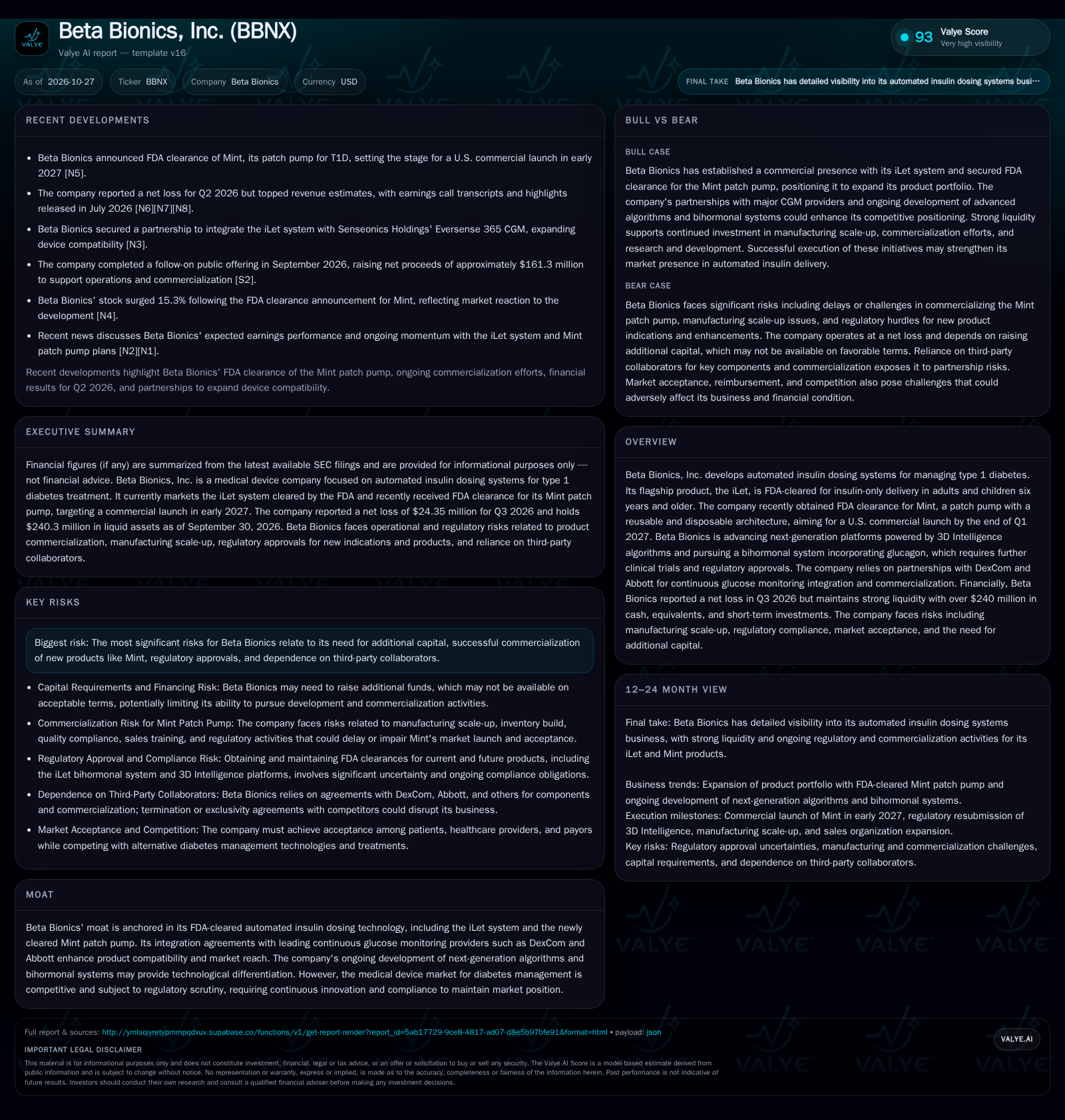
Beta Bionics develops automated insulin dosing systems, with its iLet device FDA-cleared for type 1 diabetes and the Mint patch pump newly cleared for launch in 2027. The company raised $161.3 million in a recent offering, bringing liquid assets to $240.3 million as of September 2026, but continues to operate at a net loss. Key thesis drivers are regulatory approvals, execution of commercial launches, and maintaining strategic partnerships with CGM providers. The path forward depends on delivering next-generation platforms, navigating manufacturing scale-up, and achieving market acceptance in a crowded, innovation-driven sector. [S2] [N5]
Beta Bionics, Inc. stands at a pivotal stage in the evolution of diabetes management technology. Its iLet automated insulin dosing system has achieved FDA clearance and commercial presence, while the Mint patch pump—freshly cleared by regulators—aims to expand the company’s reach in 2027. With over $240 million in liquidity after a substantial follow-on offering, Beta Bionics is well-resourced for its next phase. Yet, its business model is acutely exposed to regulatory, manufacturing, and partnership risks. The next 12-24 months will test whether Beta Bionics can translate technological progress and capital strength into sustainable commercial momentum and competitive differentiation in a rapidly innovating sector.
Recent FDA Clearance and Capital Raise Define Beta Bionics’ Near-Term Outlook
Beta Bionics’ most salient developments include the FDA clearance of the Mint patch pump for type 1 diabetes, setting up a U.S. launch in early 2027, and the completion of a $161.3 million follow-on equity offering in September 2026. These events bring the company’s liquid assets to $240.3 million as of September 30, 2026, providing significant financial resources for commercialization and R&D. However, Beta Bionics continues to operate at a net loss—$24.35 million in Q3 2026—reflecting the capital intensity of medical device development and the costs associated with scaling manufacturing, regulatory compliance, and market entry. The company’s voluntary withdrawal of its 510(k) submission for its next-generation 3D Intelligence platform highlights the ongoing regulatory complexity facing its pipeline. [S2] [N5]
How Automated Insulin Delivery Could Scale: Pricing, Volumes, and Margin Leverage
Beta Bionics’ revenue model is likely to center around a combination of device sales (iLet, Mint), recurring revenues from consumables (infusion sets, reservoirs, patch pump supplies), and potentially software/algorithmic upgrades, though commercial specifics are not disclosed. In automated insulin delivery, upfront device pricing is typically high, but recurring consumables and software services can drive margin expansion over time if user retention is strong. The integration with leading CGM platforms, such as DexCom and Abbott, may improve adoption rates but also introduces cost-sharing or revenue-splitting arrangements, depending on contract terms. Operating leverage is possible as manufacturing volumes increase and fixed R&D or regulatory costs are absorbed over a larger installed base. However, the need for sustained investment in clinical validation, regulatory filings, post-market surveillance, and customer support means high fixed costs are likely to persist until the business achieves scale. The company reported cash and liquidity metrics for the period; these figures do not by themselves establish operating runway, investment capacity, financial flexibility, or financing capacity.
A critical factor influencing Beta Bionics’ scaling potential lies in its ability to optimize the unit economics of its devices and consumables. While high upfront device prices can generate significant initial revenue, the long-term profitability hinges on maintaining high customer lifetime value through consumable sales and software subscriptions. This dynamic creates incentives for the company to invest in user-friendly interfaces, reliability improvements, and customer support to minimize churn. Additionally, pricing strategies must balance affordability to encourage payer reimbursement and patient uptake with margins that sustain R&D and commercial efforts. If Beta Bionics can leverage data analytics from connected devices to personalize therapy and demonstrate improved clinical outcomes, it could justify premium pricing and foster payer willingness to cover recurring costs.
Manufacturing scale-up presents both an opportunity and a risk in Beta Bionics’ economic model. Achieving economies of scale can reduce per-unit costs and improve gross margins, but this requires upfront capital investment and process optimization. Delays or inefficiencies in ramping production capacity could increase costs and constrain supply, undermining market penetration and revenue growth. Furthermore, reliance on third-party suppliers for key components may introduce vulnerabilities related to quality control, lead times, and pricing volatility. Risk mitigation strategies might include diversifying supplier bases, investing in in-house manufacturing capabilities over time, or negotiating long-term contracts to stabilize input costs. The interplay between manufacturing execution and commercial demand will be a pivotal determinant of Beta Bionics’ financial trajectory.
Integration, Innovation, and the Challenge of Diabetes Device Competition
Beta Bionics competes in a market defined by rapid innovation and entrenched incumbents—ranging from Medtronic and Insulet to Tandem Diabetes Care and emerging digital health players. Its partnerships with DexCom and Abbott for CGM integration enhance product appeal and may lower switching frictions for patients already using these sensors. The planned integration with Senseonics’ Eversense 365 CGM could further differentiate the offering. However, barriers to entry in diabetes tech are high for new features (such as bihormonal control), but switching costs for patients and providers can be moderate if insurance coverage or device interoperability shifts. The company's focus on advanced algorithmic dosing and bihormonal systems is a potential source of technological differentiation, but competitors are also racing to launch hybrid closed-loop and multi-hormone platforms. Regulatory delays or manufacturing hiccups could quickly erode any temporary lead.
The competitive landscape in automated insulin delivery is shaped by technological innovation cycles and evolving payer dynamics. Beta Bionics’ emphasis on advanced algorithmic dosing and bihormonal systems could provide a differentiated clinical benefit if it translates into superior glycemic control and reduced hypoglycemia risk. However, competitors with larger installed bases may leverage network effects, brand recognition, and established reimbursement pathways to maintain market share. Insurance coverage policies and formulary placements will critically influence patient access and switching behavior. Beta Bionics’ ability to generate robust real-world evidence demonstrating clinical and economic value will be essential to negotiate favorable coverage terms. Additionally, interoperability standards and data integration capabilities could become key competitive levers as healthcare systems increasingly prioritize connected, patient-centric care models.
What Success Looks Like: Regulatory Wins and Commercial Adoption Drive Operating Leverage
The most favorable scenario for Beta Bionics involves rapid market uptake of both iLet and Mint patch pumps, propelled by smooth regulatory resubmissions (for 3D Intelligence) and successful clinical validation of the bihormonal platform. If the company can streamline manufacturing, maintain supply chain reliability, and leverage its CGM partnerships for broad distribution, recurring revenues from consumables and software could grow rapidly. Evidence confirming this scenario would include accelerating device placements, high retention and refill rates, new payer contracts, and minimal adverse regulatory or recall events. Successful NDA submission and eventual approval for the glucagon component of the bihormonal system would further extend the company’s competitive moat. Conversely, delays in product launches or lackluster uptake would quickly falsify this upside case.
Commercial Progress Tempered by Execution Hurdles and Regulatory Rework
The most plausible outcome is that Beta Bionics achieves moderate adoption of iLet and a measured Mint launch in 2027, but faces intermittent regulatory hurdles and operational challenges typical for medical device upstarts. Market acceptance grows gradually, aided by CGM integration and payer coverage, but is partly offset by competitive launches and pricing pressure. The evidence to confirm this scenario would be steady (but not exponential) growth in device sales, recurring consumables revenue, and incremental regulatory progress—such as successful resubmission and clearance of the 3D Intelligence platform. Prolonged regulatory cycles, recalls, or supply chain disruptions would challenge even this moderate outlook.
Setbacks Cascade: Regulatory Delays, Commercial Friction, and Partnership Disruption
A negative scenario would unfold if Beta Bionics encounters prolonged regulatory setbacks—such as repeated delays in 3D Intelligence resubmission or NDA rejection for the bihormonal system—combined with manufacturing challenges or adverse events that trigger recalls or negative publicity. If key partnerships with CGM providers are altered, terminated, or if competitors secure exclusivity arrangements, Beta Bionics’ distribution and interoperability advantage could erode. Sluggish device uptake, high churn, or reimbursement headwinds would exacerbate losses and could force the company to seek additional capital on unfavorable terms. Evidence confirming this scenario would include missed commercial milestones, persistent or widening net losses, negative regulatory communications, and any material changes to major collaboration agreements.
Milestones That Will Decide Whether Beta Bionics Can Scale and Differentiate
Pace of Mint patch pump adoption and refill rates post-2027 launch (if disclosed) would help gauge commercial traction.
Progress and timing of 3D Intelligence platform resubmission and subsequent regulatory clearance.
Updates on clinical trial results and NDA submission/approval timelines for the bihormonal (insulin + glucagon) system.
Sustained device sales and recurring consumables revenue growth (if disclosed) as a signal of user retention and market acceptance.
Stability and expansion of partnerships with CGM providers, especially any contract renewals, terminations, or new integrations.
Incidence and resolution of product recalls, adverse events, or regulatory warning letters.
Quarterly cash burn trends and any shifts in net loss trajectory, as persistent high losses could necessitate further capital raises.
Any changes in competitive landscape, such as major new product launches or payer coverage shifts for rival automated insulin delivery systems.
Disclaimer: This is research-only, informational analysis and not investment advice. It may include AI-generated interpretation and general industry context. Always verify important details using primary sources.

Comments