
Expand Energy: Shale Scale, Integration Ambitions, and the Realities of Modern Gas Economics
Expand Energy stands at a strategic crossroads: it has merged into the leading independent U.S.
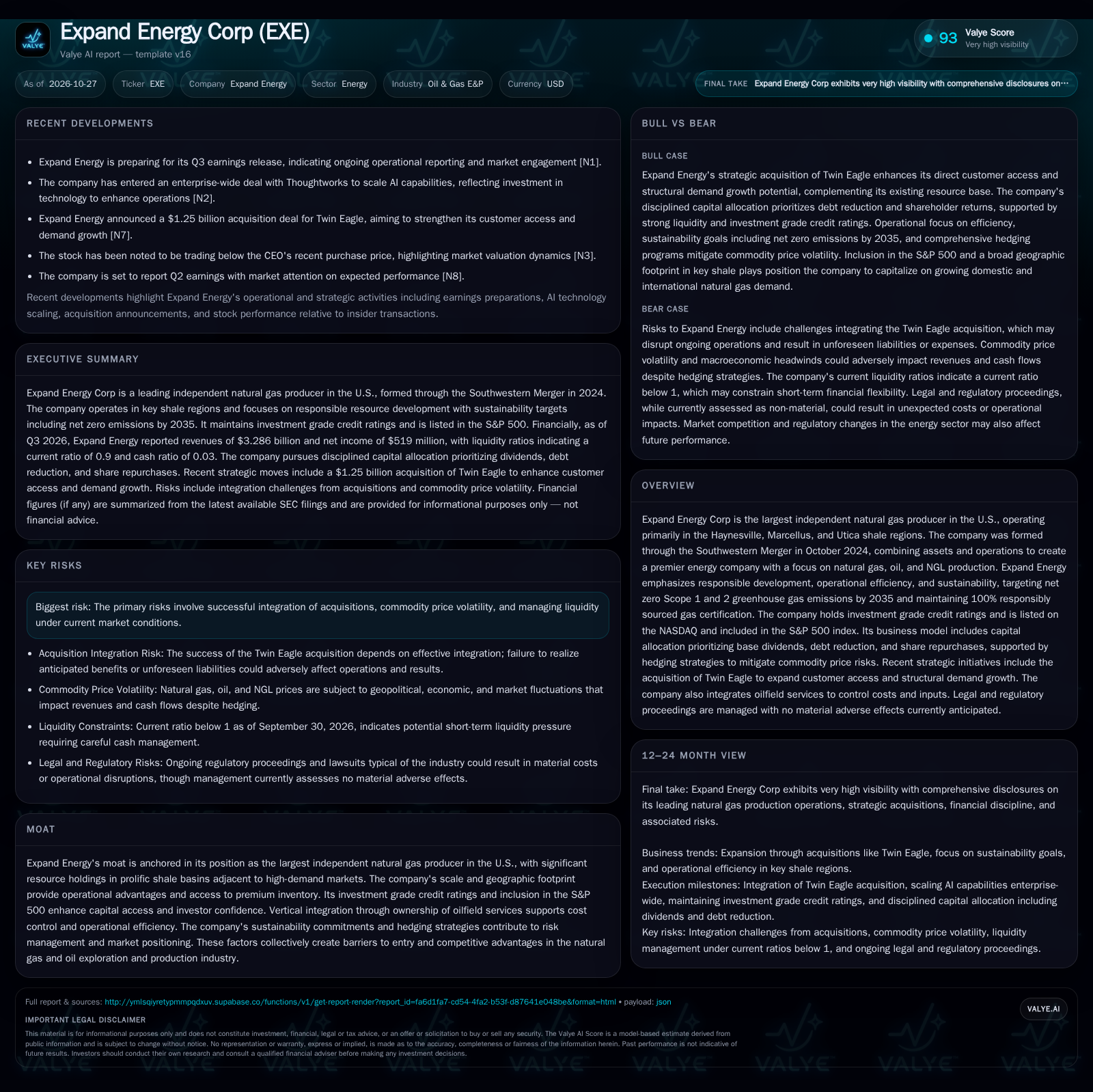
Expand Energy stands at a strategic crossroads: it has merged into the leading independent U.S. natural gas producer, is pursuing direct customer access through a $1.25B acquisition, and maintains investment grade credit. [S2] [N7]
Expand Energy Corp’s transformation into the largest independent natural gas producer in the U.S. has brought both scale-driven opportunities and complex new risks. With a sprawling asset base spanning the Haynesville, Marcellus, and Utica shales, and fresh ambitions to reach customers directly through the $1.25 billion Twin Eagle acquisition, the company is positioning itself to capture value across the gas value chain. However, its current ratio below 1, substantial integration tasks, and exposure to commodity swings mean that disciplined execution will be critical to realizing the full potential of its expanded platform. The coming quarters will reveal whether scale, hedging, and capital discipline can overcome the inherent volatility and integration hurdles of modern shale E&P.
What’s Changed? Scale, Strategic Moves, and Financial Realities Define the Moment
The most material recent developments for Expand Energy center around its new industry-leading scale, the $1.25 billion acquisition of Twin Eagle, and its current financial profile. The Southwestern merger completed in October 2024 vaulted Expand to the top of the independent natural gas producer ranks, consolidating key positions in the Haynesville, Marcellus, and Utica shales. This scale is now complemented by the announced purchase of Twin Eagle, designed to provide more direct customer access and tap into structural demand growth—an attempt to move beyond the traditional upstream-only model. [N7] [S2]
The company reported cash and liquidity metrics for the period; these figures do not by themselves establish operating runway, investment capacity, financial flexibility, or financing capacity. The company’s investment grade credit ratings and S&P 500 inclusion help maintain capital market flexibility, but the need for careful working capital and integration management is heightened post-merger and acquisition. [S2]
How Expand Energy’s Model Converts Scale into Value—And Where Friction Emerges
Expand Energy’s economics hinge on the interplay of scale-driven efficiency, commodity exposure, and selective integration across the gas value chain. The core business remains upstream: extracting natural gas, oil, and NGLs from high-productivity shale plays, with realized margins driven by the spread between production costs and volatile market prices. Larger scale allows for lower per-unit operating costs and improved negotiating leverage on service contracts and takeaway capacity.
The company’s acquisition of Twin Eagle is a bid to capture more value downstream, potentially reducing the spread lost to midstream and marketing intermediaries and securing more predictable demand for its output. If the integration is successful, this could improve realized netbacks and reduce margin volatility. However, this also adds operational complexity and exposes the business to new types of risk, including counterparty credit and regulatory exposure in customer-facing segments.
Expand’s vertical integration now includes oilfield services, which can buffer against inflationary cost pressures and provide some insulation from supply chain disruptions—a material advantage when drilling and completion cycles tighten. The company’s hedging program, covering over 60% of projected gas volumes through 2026, provides partial revenue and cash flow stability, but can limit upside if spot prices spike. [S2]
Capital needs remain significant: shale drilling is capital intensive, and the company’s model depends on continuous reinvestment to offset natural production declines. The balance between sustaining production, funding dividends, repurchases, and managing debt will be tested if commodity prices weaken or integration costs rise.
Structural Advantages and Strategic Vulnerabilities in the Shale Patch
As the largest independent natural gas producer in the U.S., Expand Energy enjoys clear scale advantages in procurement, access to premium acreage, and capital markets visibility. Its geographic spread across multiple prolific basins provides risk diversification and the ability to optimize drilling activity in response to regional price differentials.
Vertical integration—both via oilfield services and the pending direct customer access from Twin Eagle—could provide structural cost and margin advantages over smaller peers that rely more on third-party service providers and marketers. The company’s investment grade ratings and S&P 500 membership enhance its ability to access low-cost capital relative to smaller or more leveraged competitors.
However, these advantages carry counterforces. First, all upstream E&Ps are fundamentally exposed to commodity price swings; even with hedging, long-term returns depend on the company’s cost structure relative to the marginal cost of supply. Second, the move downstream through the Twin Eagle deal exposes Expand to competitive dynamics where it lacks established history, including against large midstream, trading, and utility players. Integration risk is heightened by the complexity of combining upstream and customer-facing operations. Finally, regulatory and environmental pressures are intensifying for all fossil-fuel producers, threatening both costs and demand over time.
If Integration Delivers, Expand Could Capture Value Across the Full Gas Chain
The most favorable scenario for Expand is that the Twin Eagle acquisition integrates smoothly, allowing the company to lock in more direct customer relationships, reduce margin leakage to intermediaries, and benefit from structural demand growth. Coupled with cost advantages from scale and oilfield service integration, this could result in both higher and more stable margins—even in a volatile commodity environment.
This scenario would be confirmed by evidence such as sustained or rising netbacks per unit of production, reduced reliance on spot market sales, and a demonstrated ability to maintain or grow dividends and share repurchases without increasing leverage. Successful cross-selling of gas to new customers or entry into premium end-use markets (such as LNG export, power generation, or industrial feedstock) would further validate the strategy.
Falsification would come from persistent integration costs, loss of key personnel, or customer attrition that erode the anticipated margin and demand benefits. If the company is forced to scale back capital returns or raise equity/debt to fund integration shortfalls, the upside thesis would be undermined.
Executing at Scale: Efficiency Gains Offset by Ongoing Commodity and Integration Risks
The most plausible outcome is that Expand Energy realizes moderate efficiency gains from its increased scale and vertical integration, but that these are partially offset by the ongoing realities of commodity price cyclicality and the inevitable friction of large-scale integration. Revenues and net income remain solid, supported by hedging and operational discipline, but liquidity remains tight and capital returns are managed cautiously.
This scenario would be confirmed by continued reporting of stable operating margins, modest improvements in G&A and field-level costs per Mcfe, and no material deterioration in credit ratings or access to capital. Integration costs for Twin Eagle are absorbed without major disruption, but the anticipated margin uplift is realized only gradually.
Evidence against this scenario would include sharp increases in operating costs, significant customer or personnel losses, or regulatory setbacks that erode the company’s ability to pass through costs or maintain production momentum.
Where the Model Could Break: Liquidity Squeeze and Integration Fallout
The adverse scenario is that integration of Twin Eagle proves costlier and more disruptive than anticipated, coinciding with a period of weak natural gas prices.
Operationally, this could manifest as missed production targets, higher than expected SG&A and integration charges, and margin erosion from customer churn or contract renegotiations. Regulatory or legal surprises—while not currently anticipated—could compound the problem.
This scenario would be confirmed by negative free cash flow, dividend cuts, material debt covenant pressures, credit rating downgrades, or forced asset sales. Falsification would come from evidence of disciplined cost management, successful customer retention, and stabilization of liquidity metrics even in a weak pricing environment.
Milestones and Metrics That Will Reveal Whether Expand’s Strategy Can Outrun Its Risks
Integration progress and realized synergies from the Twin Eagle acquisition—if disclosed, metrics on cost savings, customer retention, and netback improvement would be critical.
Production volumes and decline rates, especially in core Haynesville, Marcellus, and Utica assets, as these drive base cash generation.
Netback per Mcfe (after transportation, marketing, and integration costs), to test whether vertical integration is delivering on its promise.
Dividends and share repurchases: stability or growth in capital returns would signal confidence, while cuts or suspensions would indicate strain.
Credit rating actions or commentary from S&P, Moody’s, and Fitch, as these reflect market confidence in the company’s balance sheet and integration execution.
Progress on sustainability goals, such as net zero Scope 1 and 2 emissions by 2035 and responsible gas certification, as a proxy for regulatory and market risk management.
Customer concentration and contract renewal rates post-Twin Eagle, which would test the durability of new downstream relationships.
Disclaimer: This is research-only, informational analysis and not investment advice. It may include AI-generated interpretation and general industry context. Always verify important details using primary sources.

Comments