
Highwoods Properties: Portfolio Realignment, Development Ambition, and Office REIT Headwinds
Recent asset sales and development initiatives signal Highwoods Properties’ attempt to optimize its office portfolio and boost capital flexibility, but persistent sectoral headwinds and leasing risks challenge the durability of cash flows and long-term value creation.
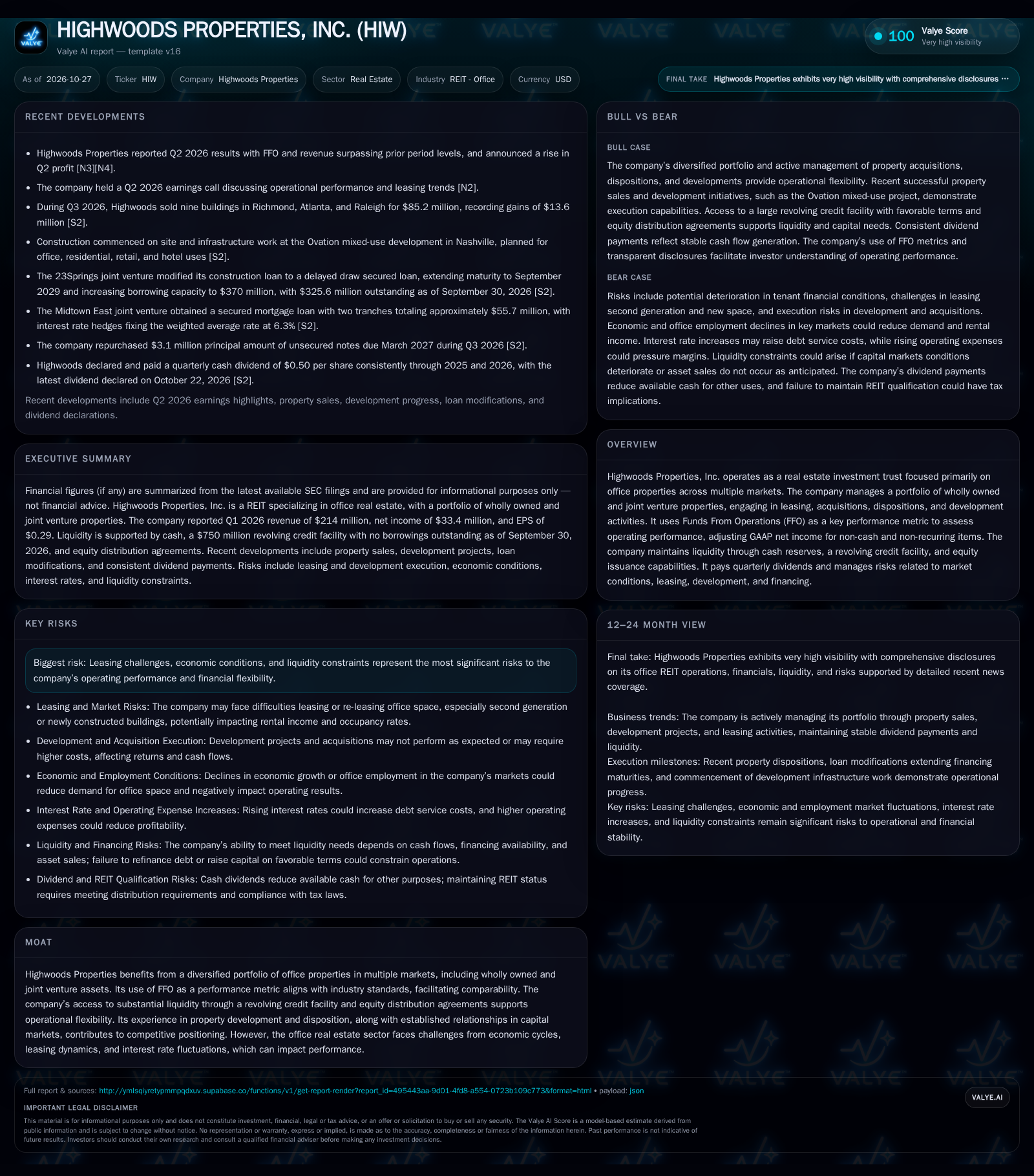
While recent quarters have delivered FFO and profit growth, the company remains exposed to sector-wide leasing challenges, rising financing costs, and the uncertain demand for office space. Execution on development projects and asset sales will be crucial for sustaining dividends and navigating shifting real estate economics. [S2] [N3] [N4]
Highwoods Properties, Inc., a major office-focused REIT, is navigating a period of structural transition as it sheds non-core assets and pursues new development amid persistent uncertainty in the office real estate market. The company’s recent property sales and the launch of the Ovation mixed-use development project highlight an effort to adapt its portfolio to shifting demand and capital needs. While FFO and net income have shown resilience, sector-wide leasing challenges and interest rate headwinds remain central risks, making the success of asset repositioning and development execution critical for sustaining shareholder returns.
Recent Dispositions and Development Mark a Strategic Pivot
Highwoods Properties sold nine office buildings in Q3 2026 for $85.2 million, reducing its same-property portfolio from 143 to 127 properties (a drop of 1.9 million rentable square feet) since the end of 2025. This represents a significant portfolio realignment, aimed at shedding non-core or underperforming assets and focusing on more resilient or strategic markets. Concurrently, the company has commenced infrastructure work at the Ovation project in Nashville, a large-scale mixed-use development intended to add office, residential, retail, and hotel components to the portfolio. These moves suggest a strategy to diversify asset types and potentially reduce reliance on pure office demand, while unlocking capital for reinvestment or shoring up liquidity. [S2]
Financially, Highwoods reported Q1 2026 revenue of $214 million and net income of $33.4 million, with FFO for the nine months ending September 30, 2026, at $296.5 million ($2.63 per share). The company maintains $32.4 million in cash and a $750 million undrawn credit facility, providing ample theoretical liquidity. Dividend payments remain steady at $0.50 per share quarterly, with the latest declared for December 2026. [S2] [N3] [N4]
Office Leasing Economics and the Shifting Value Equation
Highwoods’ revenue model is grounded in leasing office properties, typically through multi-year lease agreements, with cash flows driven by base rent, escalations, and ancillary income streams. The recent push into mixed-use development at Ovation may introduce new revenue components (retail, residential, hospitality), but the core business remains exposed to office sector economics—namely, tenant demand, occupancy rates, and rent growth. Operating leverage is high: fixed costs (property taxes, maintenance, interest) dominate, meaning occupancy swings and rent reductions can quickly compress margins.
The company’s disposition of nine assets in Q3 2026 and ongoing portfolio pruning are attempts to optimize capital allocation, potentially shedding lower-yielding or higher-risk assets to fund development or strengthen the balance sheet. The $85.2 million in proceeds can be redeployed toward growth projects or used to manage debt and dividend obligations. Development activities, such as Ovation, require substantial upfront capital and introduce execution and absorption risks; the payback period is long, and returns depend on successful leasing and market conditions at completion.
Liquidity is a theoretical strength: an undrawn $750 million revolving credit facility and equity distribution agreements allow for flexible funding. However, REITs are structurally dependent on external capital for growth and often to maintain dividend payouts, as they must distribute most taxable income. The company reported cash and liquidity metrics for the period; these figures do not by themselves establish operating runway, investment capacity, financial flexibility, or financing capacity.
Market Positioning: Navigating an Evolving Office Landscape
Within the office REIT sector, Highwoods competes with both national and regional landlords, as well as alternative real estate asset classes vying for investor and tenant capital. Its portfolio diversification across multiple markets and participation in joint ventures offer some geographic and risk dispersion. The move toward mixed-use development (Ovation) could provide a competitive edge if executed well, broadening the appeal beyond traditional office tenants and tapping into integrated urban demand.
However, the broader office market faces structural headwinds: hybrid work and remote adoption, tenant downsizing, and rising vacancy rates in many metro areas. These trends heighten leasing risk and compress effective rents, especially for second-generation or commodity office space. Highwoods’ ability to retain and attract creditworthy tenants, re-lease expiring space, and command premium rents will be central to maintaining competitive positioning.
Portfolio Optimization and Mixed-Use Success Drive Outperformance
The most favorable outcome for Highwoods would be successful execution on asset sales and development projects, coupled with stabilization or improvement in office demand in its core markets. If the company can lease up newly developed spaces at Ovation and achieve strong pre-leasing or absorption rates, it could unlock higher-margin mixed-use income streams and diversify away from pure office cyclical risk. Reinvestment of asset sale proceeds into higher-yielding or more resilient segments could further enhance cash flow and dividend sustainability.
Evidence supporting this scenario would include robust pre-leasing at Ovation and other development projects, continued gains on asset sales (above book value), sequential improvement in occupancy and rental rates, and stable or rising FFO per share. Demonstrated ability to raise capital on favorable terms—either through equity or debt—without dilutive effects or material cost increases would further confirm potential financial flexibility and market confidence.
Incremental Asset Rotation and Prudent Capital Management Sustain the Status Quo
The most plausible outcome is a steady, managed transition in which Highwoods continues to dispose of select assets and reinvests in development and higher-potential markets, but faces ongoing leasing and rent pressure in the core office portfolio. Dividend coverage is maintained through a combination of operating cash flow and asset sale proceeds, though FFO growth is modest. Development projects such as Ovation progress on schedule, but absorption is gradual and does not meaningfully offset sectoral weakness in the near term.
Confirmation of this scenario would be a stable or slightly declining occupancy rate, modest FFO per share growth, and ongoing asset sales at or near book value. If disclosed, a manageable debt maturity profile and no material increase in interest expense would further support this base case.
Leasing Weakness and Capital Market Stress Undermine Resilience
A negative outcome could materialize if office demand deteriorates further, leading to rising vacancies, lower effective rents, and increased tenant defaults. If Highwoods is unable to re-lease expiring space or must offer substantial concessions, cash flow could decline, pressuring FFO and potentially forcing a dividend cut.
Additional warning signs would include a prolonged inability to dispose of non-core assets, rising interest expense, or negative credit rating actions.
What Will Determine Whether Highwoods’ Strategy Delivers Durable Value?
Quarterly trends in portfolio occupancy and leasing spreads—particularly for second-generation and new developments—will clarify demand resilience and pricing power.
Pre-leasing rates, absorption velocity, and tenant quality at the Ovation project and other development initiatives, if disclosed, would test the mixed-use diversification thesis.
Net proceeds and book gains from asset sales, along with the pace of disposition activity, will reveal management’s ability to recycle capital at attractive valuations.
FFO per share growth or contraction, as well as the payout ratio relative to FFO, will track dividend sustainability and underlying cash flow health.
Changes in interest expense, effective borrowing rates, and debt maturity profile—especially in light of recent loan modifications and hedging—will signal potential financial flexibility or pressure.
Utilization of the revolving credit facility or equity distribution agreements would indicate shifts in liquidity needs or external funding reliance.
Management’s forward guidance on development timelines, leasing velocity, and market outlook will provide early warning of execution risk or emerging tailwinds.
Disclaimer: This is research-only, informational analysis and not investment advice. It may include AI-generated interpretation and general industry context. Always verify important details using primary sources.

Comments