
Royal Caribbean: Strong Demand, Expanding Capacity, and the Realities of Cruise Industry Leverage
Royal Caribbean Cruises Ltd. is riding a wave of post-pandemic demand and operational efficiency, prompting raised 2026 earnings guidance and aggressive fleet expansion.
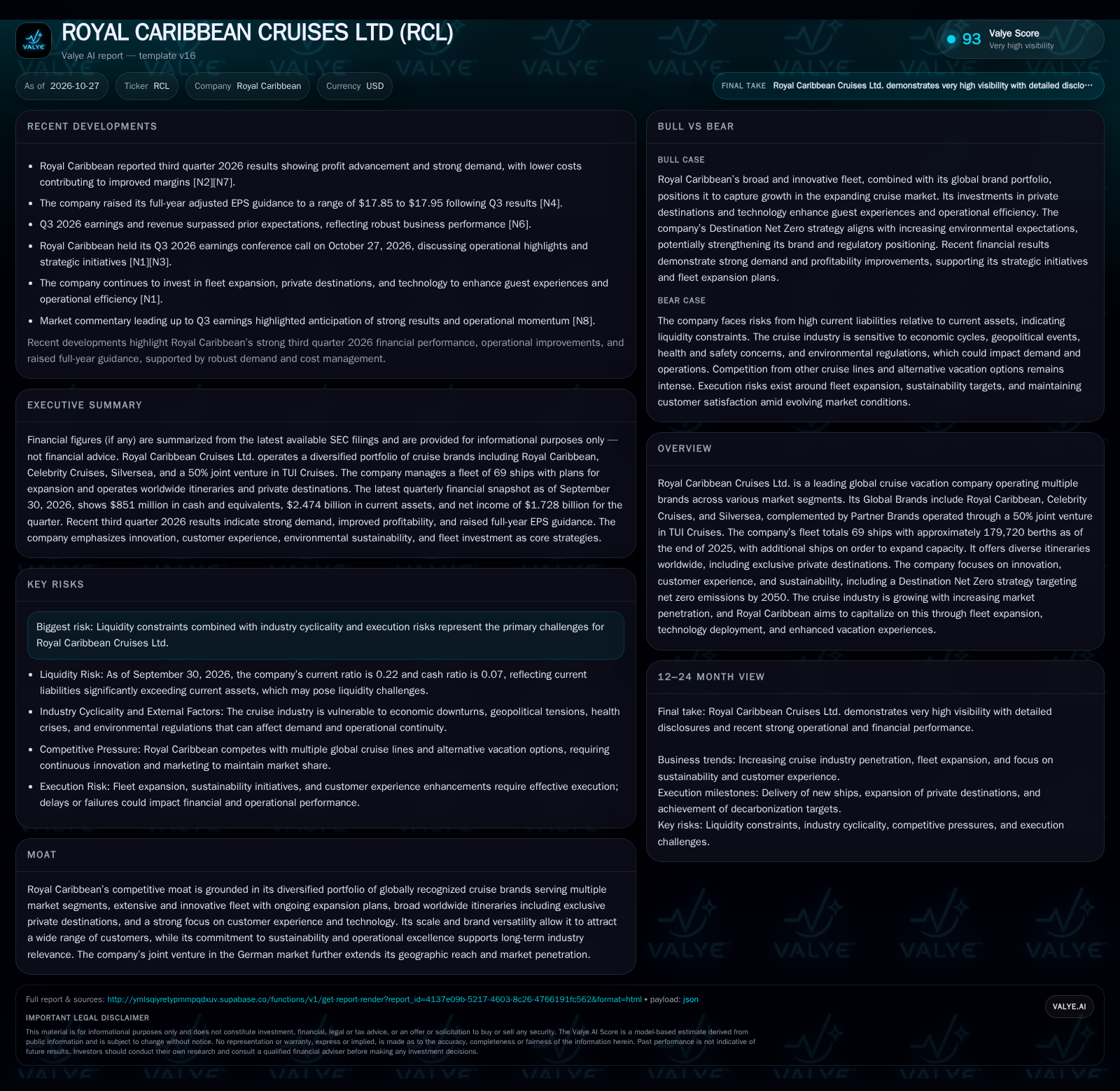
Royal Caribbean’s Q3 2026 results show robust demand and improved profitability, leading to higher full-year EPS guidance and continued fleet and destination investments. The company’s strategy hinges on capacity growth, guest experience innovation, and environmental initiatives, but success will depend on managing execution risk and navigating the sector’s cyclicality and competitive pressures. [S2] [N2] [N4]
Royal Caribbean Cruises Ltd. is demonstrating the duality of opportunity and vulnerability that defines today’s cruise industry. On one hand, the company’s latest quarterly results revealed surging demand, profit gains, and enough operational momentum to justify boosting its full-year 2026 earnings forecast. As Royal Caribbean leans into fleet growth, private destinations, and digital innovation, the central question is whether operating leverage and market expansion can consistently outpace its financial leverage and execution risks. [S2] [N2] [N4]
Profit Surges and Guidance Raised—But Liquidity Remains Tight
Royal Caribbean reported net income of $1.728 billion for the quarter ended September 30, 2026, with basic EPS of $6.46 and diluted EPS of $6.45. The company raised its full-year adjusted EPS guidance to a range of $17.85 to $17.95, citing robust demand and improved cost management. These results outperformed prior expectations and reflect operational improvements and strong booking trends. However, as of September 30, 2026, Royal Caribbean’s current assets totaled $2.474 billion against current liabilities of $11.413 billion, producing a current ratio of 0.22 and a cash ratio of 0.07. This illustrates a persistent liquidity constraint despite profitability. [S2] [N2] [N4] [N6] [N7]
How Scale, Pricing, and Capital Shape Cruise Economics
Royal Caribbean’s business model depends on high fixed costs—ship construction, maintenance, crew, and destination development—contrasted with variable costs tied to occupancy and itinerary. Revenue streams are diversified across ticket sales, onboard spending (food, beverage, excursions, casino, retail), and increasingly, premium experiences at exclusive private destinations. Pricing power is cyclical and depends on macroeconomic conditions, industry capacity, and customer demand elasticity.
Operating leverage is high: incremental passengers contribute disproportionately to profit once fixed costs are covered. This dynamic amplifies both upside in strong demand periods and downside during slowdowns. Fleet expansion, with multiple new ships on order, requires heavy upfront capital and increases depreciation and interest expense, while successful launches can drive revenue and brand refresh cycles.
Liquidity management is critical in this capital-intensive, seasonal business.
The capital intensity of cruise operations also introduces a temporal mismatch between investment and return. Shipbuilding cycles span several years, requiring upfront commitments before market conditions are fully visible. This timing risk necessitates careful forecasting and scenario planning to avoid overcapacity or underinvestment. Additionally, the long service life of vessels means that technological or regulatory shifts can impose retrofitting costs or obsolescence risks, impacting depreciation schedules and capital allocation decisions. Thus, Royal Caribbean’s ability to adapt fleet composition and deployment strategies dynamically is crucial to sustaining profitability amid evolving market and environmental standards.
Brand Breadth, Exclusive Destinations, and the Battle for Share
Royal Caribbean’s scale and brand portfolio—spanning mass-market (Royal Caribbean), premium (Celebrity Cruises), ultra-luxury (Silversea), and European (TUI Cruises via JV)—allow it to target a wide customer spectrum. This breadth supports cross-selling and market segmentation, potentially reducing vulnerability to demand shocks in any single demographic.
A key differentiator is the company’s investment in exclusive private destinations, now three with plans for seven by 2028. These destinations offer controlled guest experiences, higher onboard and destination-based spend, and competitive insulation versus ports accessible to all cruise lines. However, such assets require substantial capital and operational investment.
Competition remains fierce, especially from other global cruise operators and alternative vacation options (resorts, tours, adventure travel). Barriers to entry are significant due to capital requirements and regulatory complexity, but pricing power is limited by industry-wide capacity growth and periodic discounting. Technology and sustainability are emerging as important differentiation axes, with Royal Caribbean positioning on both fronts.
If Occupancy and Pricing Hold, Operating Leverage Drives Outperformance
The most favorable scenario for Royal Caribbean is one in which sustained demand growth, high occupancy, and stable or rising ticket and onboard pricing combine with operational efficiency to drive substantial incremental margin. Successful fleet launches and the opening of new private destinations could further enhance guest experience, command premium pricing, and increase ancillary revenue per passenger.
Confirmation would come from continued quarterly beats on revenue and profit, high booking visibility, and robust onboard spend metrics. Evidence of rising brand preference and strong customer retention—if disclosed—would also support the upside case.
Navigating Growth with Persistent Balance-Sheet Constraints
The most plausible trajectory is that Royal Caribbean continues to benefit from a healthy cruise demand environment, with new ships and destinations supporting moderate top-line growth and margin expansion. Incremental gains in occupancy and pricing may be partly offset by interest expense, capex, and potential refinancing costs.
This base case is confirmed by steady, if unspectacular, earnings growth, successful delivery of new ships on time and on budget, and the ability to fund operations and investments without resorting to distressed asset sales or emergency capital raises. The scenario would be falsified by a sharp deterioration in booking trends, cost overruns on new builds, or an inability to service or refinance near-term debt.
Liquidity Crunch or Demand Shock Could Trigger Strategic Retrenchment
The main risk for Royal Caribbean is a scenario where external shocks—economic downturn, geopolitical incident, or health crisis—drive a sharp fall in bookings, occupancy, and onboard spend. This would rapidly erode cash flow, making it difficult to cover outsized short-term liabilities. If refinancing options tighten or cost of capital spikes, the company could face forced asset sales, ship delivery delays, or even covenant breaches.
Testing the Royal Caribbean Thesis: Expansion, Liquidity, and Demand Signals
Quarterly booking trends, occupancy rates, and average pricing for both tickets and onboard spend—if disclosed—would provide direct evidence of demand momentum and pricing power.
Progress on fleet expansion: delivery timelines, new ship launches, and capacity additions versus plan.
On-time and on-budget completion of new private destinations, and their impact on guest satisfaction and incremental revenue per passenger.
Operational cost trends, including fuel, labor, and interest expense, as these can quickly erode profit in a high-fixed-cost model.
Evidence of refinancing activity, debt maturities, or asset sales—especially if prompted by liquidity needs.
Metrics or disclosures related to sustainability initiatives and progress toward Destination Net Zero, which could affect regulatory risk and brand reputation.
Customer retention and repeat guest rates, if disclosed, as indicators of brand strength and pricing durability.
Disclaimer: This is research-only, informational analysis and not investment advice. It may include AI-generated interpretation and general industry context. Always verify important details using primary sources.

Comments