
Sensata’s Margin Rebound and End-Market Diversification: Sustainable Inflection or Cyclical High?
With operating margins rebounding sharply and each core segment posting organic growth, Sensata’s 2026 results mark a turning point after recent restructuring and past impairment charges. The company’s challenge now is to translate content-driven growth and cost discipline into durable free cash flow, while managing a still-heavy debt load and navigating the cyclical realities of its automotive and industrial markets.
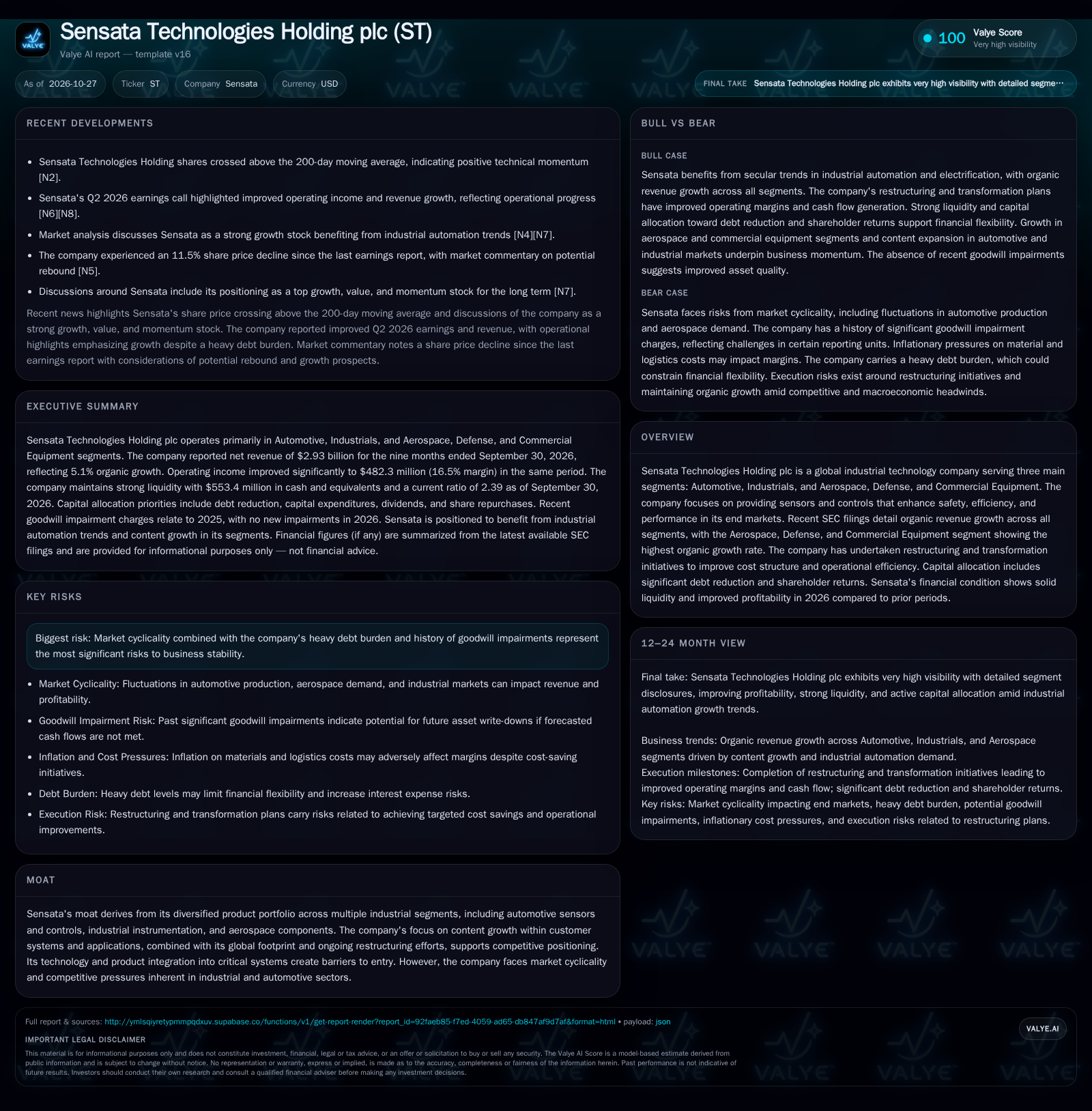
Sensata Technologies reported $2.93 billion in net revenue and a sharp jump in operating margin for the first nine months of 2026, with all segments delivering organic growth—most notably Aerospace. Cost structure improvements and debt reduction were prioritized, but the company’s exposure to cyclical end-markets and a sizable debt burden remain key variables for future value creation. The next phase depends on sustained content expansion, further productivity gains, and resilience to market swings and input costs. [S2] [N6] [N7]
Sensata Technologies’ 2026 operating results show a company at a crossroads: after a period marked by restructuring, asset impairments, and market-driven volatility, the business has delivered a marked improvement in profitability and cash generation. All three core segments—Automotive, Industrials, and Aerospace, Defense, and Commercial Equipment—posted organic growth, with the latter two outpacing legacy automotive. Margin expansion and robust cash flows have enabled debt paydown and shareholder returns, but the company’s heavy debt load and cyclical exposures continue to shape investor expectations. The question is whether Sensata’s content-driven growth and operational transformation can deliver lasting value across cycles—or whether margin gains prove fleeting as macro and industry headwinds evolve.
2026 Results Signal a Margin Recovery and Segment Breadth
For the nine months ended September 30, 2026, Sensata reported net revenue of $2,929.1 million, representing a 5.1% increase on both a reported and organic basis [S2]. Operating income surged to $482.3 million (16.5% of revenue), a notable improvement from $137.4 million (4.9%) in the prior period [S2]. This margin expansion reflects the impact of ongoing restructuring and targeted cost reductions. Cash from operations totaled $557.8 million, with the company ending the period with $553.4 million in cash and equivalents and a current ratio of 2.39 [S2].
Segment performance was differentiated: the Automotive segment grew 2.2% organically, Industrials 5.3%, and Aerospace, Defense, and Commercial Equipment 13.5% [S2]. The sharpest growth came from the Aerospace and Commercial Equipment segment, suggesting Sensata is making progress in diversifying beyond its traditional automotive core. Capital allocation was focused on debt reduction ($433.2 million), capex ($68.5 million), dividends, and share repurchases [S2]. No new goodwill impairments were recorded in 2026, contrasting with a significant charge in 2025 [S2].
How Sensata’s Content Growth and Cost Discipline Drive Economics
Sensata’s core business model relies on selling high-value sensors and controls that are integrated into automotive, industrial, and aerospace systems. The economics are driven by content growth (increasing dollar value per system), volume leverage (OEM and industrial production cycles), and product mix. Pricing power is typically modest in automotive due to intense OEM pressure, but higher in aerospace and specialized industrial applications, where switching costs and qualification barriers are more substantial.
Fixed costs are significant—R&D, manufacturing footprint, and SG&A—but the company’s restructuring and transformation initiatives have aimed to reduce overhead and improve variable cost flexibility. As demonstrated in 2026, margin expansion is possible when content per vehicle/equipment rises and cost structure is actively managed. Operating leverage is thus material, especially in periods of demand recovery or new platform wins.
Capital needs remain nontrivial: Sensata invests in R&D to keep pace with electrification, automation, and regulatory requirements, and maintains capital expenditures to support manufacturing and quality assurance. The company’s recent prioritization of debt reduction reflects both a desire to lower interest expense and a recognition of the risks associated with a high leverage profile.
Defensible Niche or Vulnerable Supplier? Sensata’s Place in a Fragmented Market
Sensata operates in highly competitive, often fragmented markets—automotive sensors, industrial instrumentation, and aerospace controls. Its primary advantages are breadth of product portfolio, deep integration into customer platforms, and a reputation for quality and reliability. In automotive, it faces competition from both diversified giants and niche sensor specialists, with pricing and platform access as constant battlegrounds.
The company’s move toward greater content growth—embedding more sensors and controls per vehicle or equipment—can create switching frictions for OEMs once designed in, but does not guarantee recurring revenue unless supported by aftermarket or service contracts. In aerospace and industrial, qualification requirements and long sales cycles create some barriers to entry, but these segments are not immune to cyclical or geopolitical shocks.
Technology substitution risk is real: as electrification, autonomy, and digitalization accelerate, Sensata must continuously update its offerings to avoid displacement by newer sensing modalities or integrated digital solutions. The ongoing restructuring is partly a response to these competitive and technological pressures.
Unlocking Sustained Value: If Content Growth and Cost Gains Compound
A favorable scenario is one where Sensata’s content-per-unit strategy in all segments continues to outpace underlying market volumes. This would require successful innovation in sensor and control technologies aligned with electrification, automation, and regulatory trends in transportation and industrial markets. If cost discipline holds, operating margins could stabilize above historic norms, driving strong cash generation even if top-line growth moderates.
Confirmation would come from continued segment outperformance (especially Industrials and Aerospace), further margin expansion, and evidence of share gains or platform wins in next-generation vehicles and industrial systems. A declining leverage ratio—through both debt paydown and improved EBITDA—would also support the case for re-rating. Evidence of long-term contracts or recurring aftermarket/service revenue would further validate the durability of the business model.
When Diversification Balances Cyclical Headwinds and Debt Constraints
The most plausible outcome is for Sensata to maintain modest organic growth, with segment diversification partially buffering but not eliminating exposure to automotive and industrial cycles. Margin improvement from restructuring may plateau, with future gains dependent on incremental productivity and successful innovation. Cash flows remain robust enough to continue debt reduction and shareholder returns, but the company’s leverage and market cyclicality prevent a full valuation rerating.
This scenario would be confirmed if organic growth persists in the mid-single digits across segments, operating margins remain in the mid-teens, and there are no new material goodwill impairments or operational setbacks. If input cost inflation or OEM production volatility intensifies, margin progress could stall, but the diversified segment mix should limit downside.
If Cyclical Exposure and Debt Overhang Erode Gains
In a less favorable scenario, a sharp downturn in automotive or industrial production—driven by macro shocks, supply chain disruptions, or OEM destocking—could reverse recent revenue and margin gains. If input cost pressures persist or worsen, the company’s ability to offset these with price or further cost cuts may be limited. High leverage could amplify downside risk, especially if credit markets tighten or if cash flows weaken, making debt service more onerous.
Evidence would include a return to low single-digit or negative organic growth, margin compression, renewed goodwill impairment charges, or any need to pause or reverse shareholder returns to preserve liquidity. A spike in net debt/EBITDA or any rating downgrade would further validate the downside case.
Milestones to Test Sensata’s Transformation and Resilience
Organic revenue growth rates by segment—especially Industrials and Aerospace—as indicators of diversification and end-market health.
Quarterly operating margin progression and gross margin trends as a measure of sustained cost discipline and pricing power.
Net debt reduction and leverage ratio (net debt/EBITDA) to track financial risk and capital allocation effectiveness.
R&D intensity and new product launch cadence—if disclosed—as signals of innovation and future content growth.
Aftermarket and service revenue mix (if disclosed), which would clarify recurring revenue potential and margin resilience.
Evidence of new platform wins or long-term contracts, particularly in electrified or automated vehicle architectures.
Any renewed goodwill impairment charges or asset write-downs, which would indicate forecast risk or segment underperformance.
Volatility in input costs and Sensata’s ability to pass through or offset inflationary pressures.
Disclaimer: This is research-only, informational analysis and not investment advice. It may include AI-generated interpretation and general industry context. Always verify important details using primary sources.

Comments