
Franklin Street Properties: Navigating Sunbelt Office Headwinds with Strategic Realignment
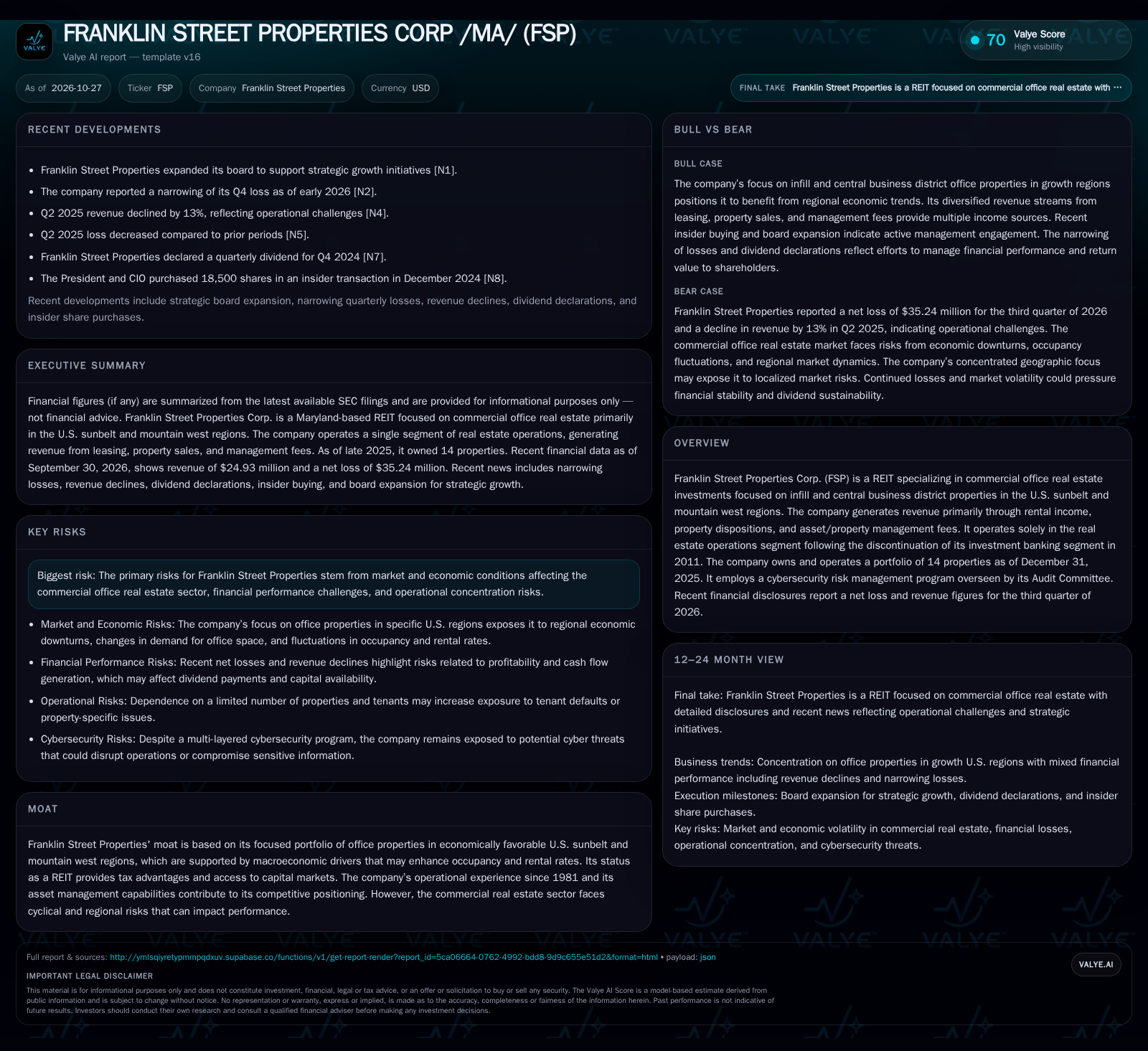
Franklin Street Properties faces persistent net losses and revenue declines as it concentrates on office assets in the U.S. sunbelt and mountain west. Board expansion and insider buying signal active engagement, but the company's ability to adapt its portfolio, cost structure, and capital allocation will determine whether it can weather sector-specific headwinds and restore value.
The cited source reports dividend-related activity; that disclosure alone does not establish dividend-policy continuity, management confidence, or a material constraint on capital flexibility. Board expansion and insider buying point to strategic repositioning, but ongoing operational and market risks challenge the path to sustainable profitability. The company's future hinges on occupancy trends, portfolio optimization, and its ability to align costs with evolving office demand [S1] [S2] [N1] [N2] [N4] [N5] [N7] [N8].
Franklin Street Properties is contending with the realities of a challenged office REIT sector: declining revenues, persistent net losses, and the need to reposition its portfolio in the face of evolving demand patterns. With a concentrated exposure to sunbelt and mountain west office markets and only 14 properties, Franklin’s fate is closely tied to regional economic health and the broader office sector’s struggle to adapt post-pandemic. Recent moves—including board expansion and insider buying—signal a willingness to pursue strategic change, but the company’s ability to restore growth and protect shareholder value will depend on how effectively it can manage occupancy, optimize its asset base, and control costs amid ongoing uncertainty.
Persistent Net Losses and Portfolio Concentration Shape Today’s Reality
Franklin Street Properties reported a net loss of $35.24 million on $24.93 million in revenue for the third quarter of 2026, underscoring continued profitability challenges [S2]. The company’s revenue base has weakened, with a 13% year-over-year decline in Q2 2025, reflecting operational headwinds in its core office markets [N4]. As of December 31, 2025, Franklin owned and operated 14 office properties, maintaining a concentrated exposure to the sunbelt and mountain west regions [S1]. Recent developments include a board expansion intended to support strategic growth and an insider purchase of 18,500 shares by the President and CIO, indicating active management engagement [N1] [N8]. The cited source reports dividend-related activity; that disclosure alone does not establish dividend-policy continuity, management confidence, or a material constraint on capital flexibility. [N7] These facts highlight a company at an inflection point—balancing efforts to stabilize financial performance with the realities of a shifting office demand landscape.
How Franklin Street Properties’ Business Model Faces Operating Leverage and Capital Allocation Tradeoffs
As a REIT, Franklin Street Properties generates revenue primarily from rental income, supplemented by property dispositions and asset/property management fees [S1]. The economics of office REITs are characterized by high operating leverage: fixed property-level expenses (taxes, maintenance, insurance) persist regardless of occupancy, while rental income can fluctuate significantly with tenant retention and market demand. This dynamic means that even modest declines in occupancy or rental rates can translate into outsized impacts on net income.
The company’s small portfolio (14 properties) amplifies exposure to property- and tenant-specific risks. With asset concentration in select regions, Franklin is especially sensitive to local office demand trends, which have been pressured by hybrid work adoption and corporate space rationalization. The company reported cash and liquidity metrics for the period; these figures do not by themselves establish operating runway, investment capacity, financial flexibility, or financing capacity. The reported cash and equivalents of $34.25 million as of Q3 2026 provide a liquidity snapshot but do not, by themselves, establish runway or investment capacity [S2].
Property dispositions and selective acquisitions are common REIT levers to recycle capital and optimize portfolios. However, realizing gains on sales in a soft office market may be challenging, while acquisitions could be constrained by both capital availability and market conditions. Dividend payments—central to REIT investor expectations—create further tension, as sustaining distributions amid losses can erode potential financial flexibility. Ultimately, the company’s ability to align its cost base, manage capital allocation, and adapt its portfolio will determine whether it can restore positive operating leverage and long-term value.
Competing for Tenants and Capital in a Shifting Office Real Estate Landscape
Franklin Street Properties operates in a highly competitive environment against both large diversified REITs and regionally focused peers. Its geographic focus on the sunbelt and mountain west was, in prior cycles, a relative strength—these regions benefited from population and job growth. However, the pandemic-era shift toward hybrid work, combined with rising sublease inventory and tenant consolidation, has challenged office landlords across the U.S., including in previously resilient markets.
The company’s modest scale (14 properties) limits its ability to spread fixed costs, invest in extensive amenities, or offer portfolio-wide solutions to large tenants, compared to national REITs. Asset selection—favoring infill and central business district locations—may help mitigate some demand risk if these properties are better positioned for post-pandemic office use, but this is not assured. Substitution risk is high: tenants can downsize, relocate to more flexible or modern spaces, or opt for coworking and hybrid arrangements, eroding traditional leasing economics.
Access to capital is a structural advantage for listed REITs, but persistent losses and declining revenue may increase Franklin’s cost of capital relative to better-performing peers, limiting its ability to compete for acquisitions or undertake major redevelopments. The company’s operational experience and asset management capabilities are potential differentiators, but the core challenge remains: retaining tenants and optimizing rents in a market where bargaining power has shifted toward occupiers.
A Turnaround Hinges on Portfolio Optimization and Regional Economic Recovery
Franklin Street Properties could outperform the sector if it successfully repositions its portfolio—through targeted asset sales, value-add investments, and tenant-focused leasing strategies—while benefiting from a rebound in sunbelt and mountain west office demand. This scenario would likely require economic growth in its core regions, a moderation of remote work trends, and effective cost control to restore operating leverage.
Evidence that would confirm this upside scenario includes: rising occupancy rates and rental spreads in the company’s properties; successful execution of property sales at or above book value, recycling capital into higher-yielding opportunities; stabilization or growth in revenue and a return to positive net income; and the resumption of dividend growth. Additional confirmation could come from expanded third-party management fee income, signaling asset management capabilities valued by external owners.
Realistic Expectations: Navigating Prolonged Weakness with Incremental Adjustments
The most plausible outcome for Franklin Street Properties is a slow, uneven recovery characterized by ongoing revenue pressure and efforts to incrementally improve portfolio quality and cost efficiency. Office demand in the sunbelt and mountain west may stabilize at lower levels, with some properties performing better than others based on location and tenant mix. The company could continue to sell non-core or underperforming assets, use proceeds to reduce leverage or fund selective upgrades, and maintain dividends at reduced or flat levels.
In this scenario, net losses may persist but gradually narrow as cost controls take effect and the market absorbs excess supply. Confirmation would include modest improvements in occupancy, a stabilization of revenue declines, and management commentary focused on operational discipline rather than aggressive growth. Board expansion and insider buying would be consistent with a patient, long-term approach rather than a near-term turnaround.
Evidence that would falsify this scenario includes a sharp deterioration in occupancy or rent collections, forced asset sales at deep discounts, or dividend suspension due to cash flow constraints.
Prolonged Office Weakness and Capital Constraints Drive Value Erosion
If office market headwinds intensify or persist longer than expected, Franklin Street Properties could face compounding challenges: declining occupancy and rental rates, tenant defaults, and rising capital expenditures to maintain or reposition assets. With only 14 properties, even a handful of large vacancies or lease expirations could materially impact revenue, accelerating losses and eroding book value.
Higher borrowing costs or constrained financing options could limit flexibility to invest in property upgrades or pursue opportunistic acquisitions.
Evidence against this scenario would be stabilization in tenant retention and successful execution of non-dilutive asset sales.
Testing the Franklin Street Properties Thesis: What Needs to Be Tracked
Quarterly occupancy rates across the 14-property portfolio, as a leading indicator of demand and revenue resilience.
Trends in rental rates (new leases and renewals) versus prior periods—a useful metric if disclosed—to assess pricing power or concessions.
Volume and pricing of property dispositions: whether asset sales occur at or above book value or indicate distress.
Changes in regional office market fundamentals (vacancy rates, leasing velocity, sublease inventory) in the sunbelt and mountain west.
Evidence of new or expanded third-party management contracts, which would support the case for fee income diversification.
Disclaimer: This is research-only, informational analysis and not investment advice. It may include AI-generated interpretation and general industry context. Always verify important details using primary sources.

Comments