
IQVIA’s Data-Driven Expansion: Balancing Clinical Research Growth with Financial Constraints
IQVIA continues to leverage its global healthcare data and AI-powered analytics to capture rising demand for clinical research and healthcare intelligence, reporting strong revenue growth and raised guidance for 2026.
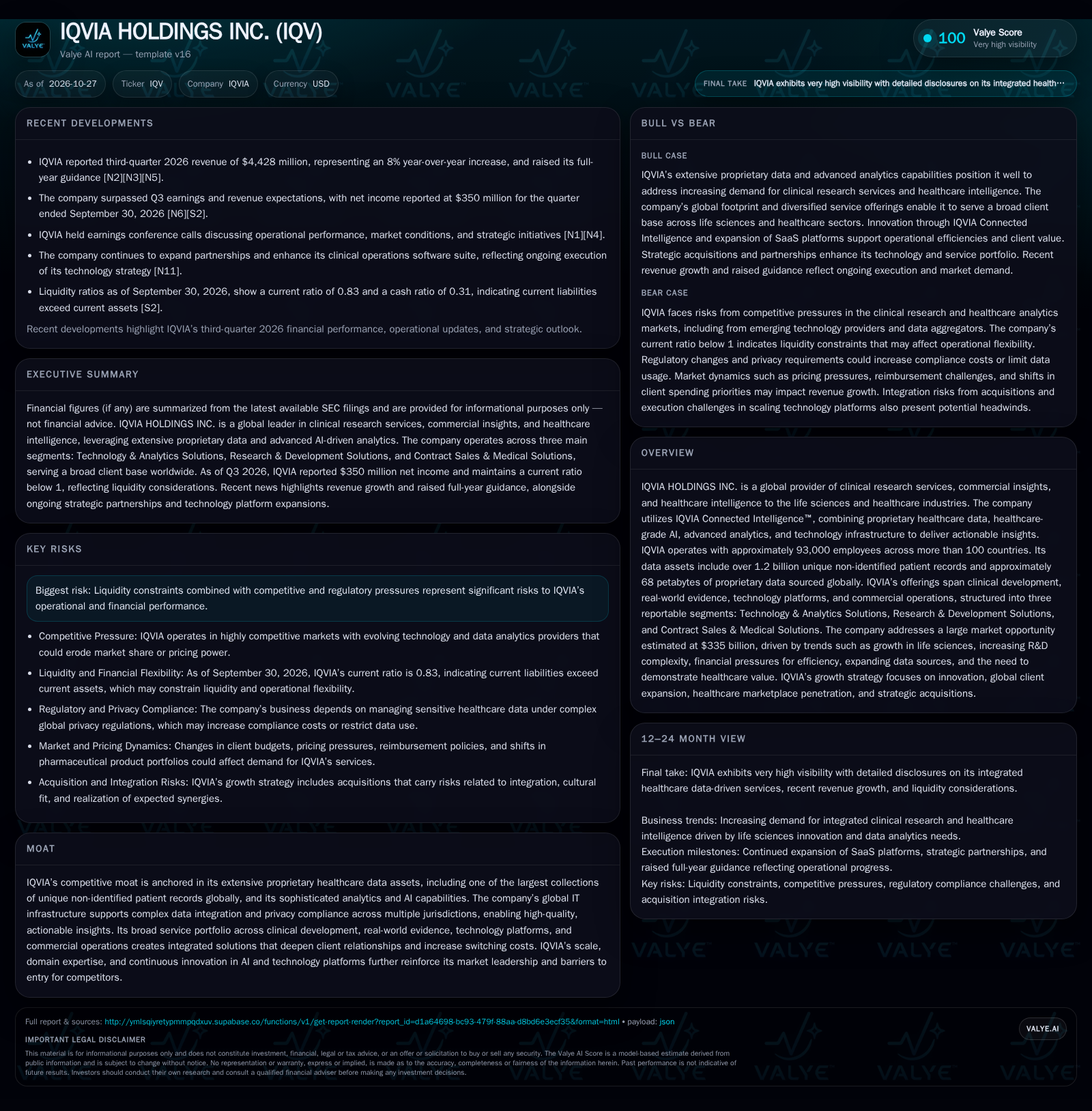
IQVIA reported an 8% year-over-year revenue increase for Q3 2026, raised full-year guidance, and maintains a global presence with differentiated healthcare data assets. The core question is whether IQVIA’s scale, data moat, and AI-driven platforms can offset liquidity and competitive pressures to deliver durable growth and profitability. [S2] [N2] [N3] [N5]
IQVIA HOLDINGS INC. stands at the intersection of healthcare data, advanced analytics, and global clinical research, reporting robust revenue growth and raised outlooks for 2026. The company’s differentiated scale in non-identified patient records and integration of AI-powered insights provide considerable leverage in a fast-evolving life sciences landscape. Yet, beneath the momentum, IQVIA’s below-1 current ratio and rising competition from digital-native and AI-first entrants raise questions about the company’s ability to sustain both growth and profitability without balance-sheet reinforcements. The challenge is whether IQVIA’s data-driven platform and operational expertise can maintain their edge as the industry digitizes and as capital discipline becomes more critical. [S2] [N2] [N3] [N5]
Recent Performance: Revenue Growth Meets Financial Tightness
IQVIA reported $4,428 million in revenue for Q3 2026, representing an 8% increase year-over-year and surpassing market expectations. The company also raised its full-year guidance, indicating confidence in continued demand for its clinical research and healthcare intelligence services. Net income reached $350 million for the quarter, with basic and diluted EPS of $2.13 and $2.10, respectively. [S2] [N2] [N3] [N5]
How IQVIA Monetizes Healthcare Data and Analytics
IQVIA’s business model is built on leveraging proprietary healthcare data, advanced analytics, and SaaS technology platforms to serve life sciences, pharmaceutical, and healthcare clients globally. The company’s three primary segments—Technology & Analytics Solutions, Research & Development Solutions, and Contract Sales & Medical Solutions—enable a blend of recurring and project-based revenue streams. In Technology & Analytics Solutions, cloud-based software platforms support clinical and commercial processes, likely with subscription or usage-based pricing that can drive high gross margins and operating leverage as customer adoption scales. The R&D Solutions segment benefits from long-term clinical trial contracts and real-world evidence generation, typically characterized by multi-phase, milestone-driven revenue recognition. Contract Sales & Medical Solutions, while service-heavy, offer client stickiness but may be more exposed to labor costs and margin pressure.
The core economic engine is IQVIA’s ability to aggregate, standardize, and analyze vast and proprietary healthcare datasets—over 1.2 billion unique patient records and coverage of 90% of global pharma sales—which underpins differentiated insights and high-value consulting and platform offerings. This data-driven approach allows IQVIA to command premium pricing, especially for regulated, mission-critical services. However, the business remains capital- and labor-intensive, with continuous investment needed in data infrastructure, compliance, technology upgrades, and regulatory adaptation. Operating leverage is achieved when incremental revenues from data or SaaS sales outpace cost growth, but the need to fund R&D, acquisitions, and integration efforts can compress free cash flow, especially with current liquidity constraints. [S1] [S2]
Defending the Data Moat in a Shifting Competitive Arena
IQVIA’s primary competitive advantage lies in its unparalleled proprietary data assets, global infrastructure, and deep domain expertise. The company’s ability to integrate, anonymize, and deploy vast quantities of patient and pharmaceutical data at scale creates high switching costs for entrenched clients, particularly in regulated industries where data quality and compliance are paramount. Its platform approach—offering everything from clinical trial design and site selection to real-world evidence and commercial execution—fosters end-to-end client relationships that are difficult to displace.
However, the competitive landscape is evolving. Digital-native healthcare analytics firms, big tech entrants, and niche SaaS providers are increasingly targeting discrete segments of the value chain, leveraging cloud-native architectures, AI/ML capabilities, and sometimes lower cost structures. These competitors may not match IQVIA’s breadth, but they can undercut on price or innovate faster in specialized domains such as decentralized trials, patient engagement, or real-time data analytics. Additionally, global regulatory changes and tightening privacy rules can lower barriers to entry for agile data aggregators or regional players. The question is whether IQVIA’s scale and integration will continue to outweigh the speed and focus of smaller, tech-first competitors, or if the company will need to accelerate its own innovation and partnership activity to maintain its moat. [S1]
Unlocking Value Through Platform Expansion and Margin Leverage
In a favorable scenario, IQVIA capitalizes on sustained demand for outsourced clinical research and healthcare analytics as pharmaceutical and biotech clients pursue efficiency, speed, and regulatory compliance. Continued investments in Connected Intelligence and SaaS platforms enable the company to expand wallet share with existing clients, penetrate new geographies, and scale high-margin recurring revenue streams. If integration of acquisitions proceeds smoothly and the company successfully cross-sells technology solutions across its global client base, operating leverage improves and free cash flow rebounds, allowing reinvestment without the need for dilutive financing.
Evidence for this scenario would include sustained double-digit growth in SaaS and analytics subscription revenues (if disclosed), improvement in the current ratio or a reduction in net working capital requirements, and successful launches or adoption of new AI-driven modules in core platforms. Margin expansion and positive operating cash flow trends, alongside growing backlog or multi-year contract wins, would further support the thesis that IQVIA’s scale and data assets are translating into durable economic value.
Integrated Solutions Drive Growth, but Capital Constraints Limit Aggression
The most plausible outcome is that IQVIA maintains mid-to-high single-digit revenue growth, driven by continued demand for integrated clinical research and healthcare intelligence services. The company’s large installed client base, proprietary data, and breadth of offerings provide a buffer against competitive attrition, but pricing power is tested as clients scrutinize budgets and as technology-enabled competitors nibble at less sticky service lines.
Liquidity constraints and a sub-1 current ratio likely force management to prioritize organic growth and incremental platform upgrades over large acquisitions or aggressive expansion. Operating margins are stable or improve modestly as SaaS adoption grows, but free cash flow remains under pressure from ongoing investment needs and working capital management. Confirmation of this scenario would be steady (if unspectacular) sequential growth in both revenue and net income, continued raised or reaffirmed guidance, and no major changes in capital structure. Falsification would come from a sharp deterioration in liquidity, inability to fund growth initiatives, or material loss of major accounts to digital-first competitors.
Liquidity Crunch or Regulatory Shifts Disrupt the Growth Engine
An external shock—such as a major client defection, pricing reset, or adverse regulatory change limiting data usage—could quickly expose the limits of the company’s potential financial flexibility. If competitors succeed in unbundling lucrative parts of IQVIA’s value chain or if clients accelerate insourcing of analytics functions, revenue growth could decelerate and margins compress.
Confirmation of this scenario would include a further decline in the current ratio, negative operating cash flow, asset sales or dilutive equity/debt issuance, and missed earnings or revenue guidance. Regulatory developments that restrict cross-border data flows or require costly compliance retrofits could also trigger a reset in the company’s growth and margin trajectory. A weakening of client retention rates or a marked slowdown in new contract wins would further corroborate a downside case.
What Will Prove IQVIA’s Data-Driven Advantage Endures?
Quarterly trend in SaaS and analytics subscription revenue (if disclosed), as a proxy for recurring, high-margin growth.
Improvement or deterioration in the current ratio and net working capital requirements, reflecting changes in liquidity management.
Net operating cash flow and free cash flow generation relative to capital expenditure and acquisition outflows.
Pace of new platform launches or material upgrades in Connected Intelligence and clinical operations software.
Client retention rates, contract renewal activity, or multi-year contract wins in core R&D and technology segments (if disclosed).
Impact of regulatory changes or compliance costs on data access, platform capabilities, and international expansion.
Announcements of major partnerships or competitive wins/losses versus digital-native or AI-first healthcare analytics providers.
Disclosure of asset sales, new financings, or changes to capital allocation that signal a response to liquidity constraints.
Disclaimer: This is research-only, informational analysis and not investment advice. It may include AI-generated interpretation and general industry context. Always verify important details using primary sources.

Comments