
Zurn Elkay Water Solutions: Specification Demand, Portfolio Growth, and Margin Enhancement
Zurn Elkay Water Solutions leverages its broad, specification-driven product suite and strong end-market positioning in institutional and commercial construction. Recent tariff refunds, portfolio refinements, and ongoing restructuring are reshaping its margin profile and capital allocation, while the company continues to face cyclical and regulatory headwinds typical of its fragmented industry.
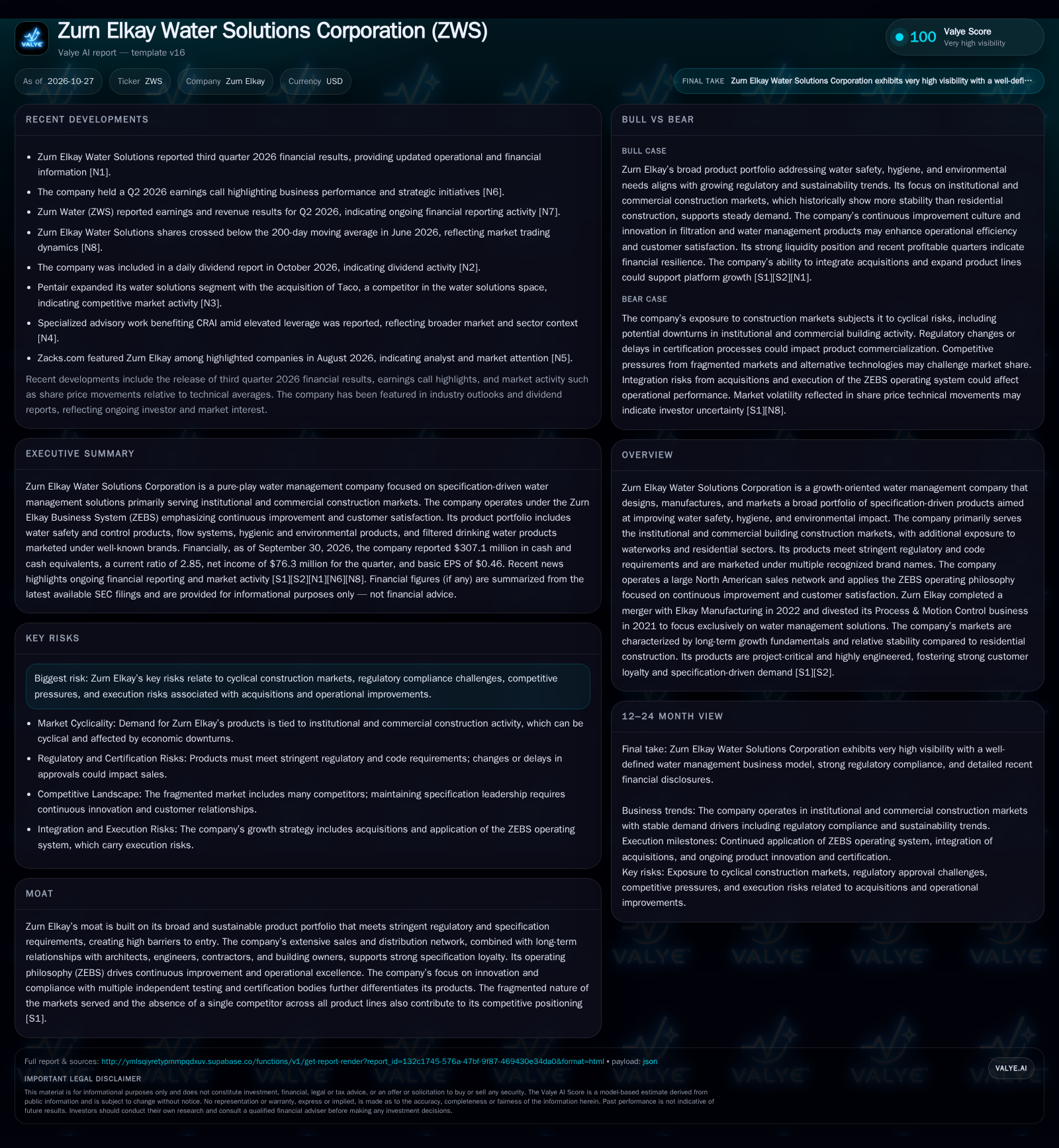
Zurn Elkay’s Q3 2026 results show ongoing profitability, a sizable cash balance, and continued margin-focused restructuring. The company’s end-market focus and specification-driven portfolio support resilience, but cyclical construction activity, regulatory complexity, and competitive fragmentation remain core challenges. Strategic actions around portfolio optimization and recent tariff refunds are providing operating flexibility and room for reinvestment, though end-market demand and successful integration of recent acquisitions will be key to sustaining growth and margin expansion [S2] [N1] [N6].
Zurn Elkay Water Solutions stands at a pivotal juncture, balancing the benefits of a broad, specification-driven product portfolio with the realities of cyclical construction markets and ongoing internal transformation. Its recent financial results show a reported cash position and continued profitability, buoyed in part by sizable tariff refunds and ongoing restructuring efforts. As the company continues to optimize its footprint and absorb new acquisitions, the key question is whether these operational and strategic moves can sustain margin improvement and organic growth, especially in a market where regulatory demands and competitive fragmentation are both opportunity and headwind.
Recent Financial Developments and Strategic Actions Shape the Near-Term Landscape
For the quarter ended September 30, 2026, Zurn Elkay reported net income of $76.3 million and maintained a cash balance of $307.1 million, resulting in a current ratio of 2.85 and a cash ratio of 0.99 [S2]. Notably, Zurn Elkay received $49.1 million in tariff refunds during the first nine months of 2026, following a Supreme Court decision affecting reciprocal tariffs under IEEPA, with additional recoveries possible but not yet recognized [S2].
The company executed the acquisition of Intellihot, a water heating solutions provider, adding $55 million in goodwill and $44.5 million in other intangibles to its balance sheet [S2]. This move extends Zurn Elkay’s reach into adjacent product categories, though the full impact on earnings and integration synergies remains to be seen. Meanwhile, restructuring initiatives—focused on workforce reductions and facility rationalization—resulted in $4.1 million in charges year-to-date, with management signaling that further footprint optimization is likely [S2].
These actions reflect a company simultaneously harvesting short-term financial wins (tariff refunds), investing in product breadth, and realigning its cost base, all against a backdrop of ongoing exposure to construction market cycles and regulatory dynamics.
How Specification and Portfolio Breadth Drive Value Creation
Zurn Elkay’s core economics are built around specification-driven, project-critical products for institutional and commercial buildings. These products—ranging from valves and backflow preventers to filtered drinking water delivery systems—typically comprise a small percentage of total project cost, yet are essential for regulatory compliance and operational safety [S1]. This specification lock-in supports pricing stability and high end-user loyalty, partially insulating the company from pure price competition and enabling a value-over-volume approach.
Revenue growth is primarily tied to construction activity in institutional and commercial segments, with additional upside from retrofits driven by water efficiency and regulatory mandates. Because these end-markets are less volatile than residential construction, Zurn Elkay enjoys a more stable revenue base. However, project timing, funding cycles, and regulatory changes can still drive quarter-to-quarter variability.
The company’s cost structure includes a mix of fixed (manufacturing footprint, R&D, sales network) and variable (raw materials, distribution) components. Recent restructuring aims to reduce fixed costs and optimize asset utilization, potentially boosting operating leverage as volumes recover or grow.
Capital needs are relatively modest outside of M&A and strategic investments, as much of the product innovation is incremental and tied to evolving codes and customer requirements. However, acquisitions like Intellihot introduce additional integration costs and intangible amortization, which could temporarily pressure margins or free cash flow until synergies are realized.
Fragmentation, Brand Strength, and the Race for Specification Leadership
Zurn Elkay operates in a fragmented water management landscape, with competitors ranging from large diversified industrials to niche specialists. Few, if any, rivals match the company’s breadth across safety, flow, hygiene, and filtration solutions, giving Zurn Elkay a cross-category advantage in serving large institutional and commercial projects [S1].
The company’s recognized brands—Zurn®, Elkay®, Wilkins®, among others—are specified by architects, engineers, and contractors, embedding products early in the project pipeline and creating high switching frictions. This specification-driven approach limits direct price wars but does not eliminate competition, as alternative technologies, new entrants, and customer consolidation can erode share or compress margins if Zurn Elkay fails to innovate or meet evolving codes.
Recent competitive moves, such as Pentair’s acquisition of Taco, highlight the growing importance of scale, portfolio breadth, and the ability to offer integrated solutions [N3]. While Zurn Elkay’s pure-play focus allows for targeted innovation and customer intimacy, it must continually defend its position by maintaining regulatory leadership, expanding into adjacent categories, and ensuring robust channel relationships through its extensive network of independent sales agencies.
Substitution risk remains modest so long as regulatory barriers and the mission-critical nature of products persist. However, if alternative water management or filtration technologies gain traction, or if large customers push for more standardized, lower-cost solutions, Zurn Elkay’s margin profile could come under pressure.
Margin Expansion and Growth Through Integration and Regulatory Tailwinds
A favorable outcome for Zurn Elkay centers on successful integration of acquisitions and realization of operational efficiencies from ongoing restructuring. If the company can effectively absorb Intellihot and extract synergies—such as cross-selling, supply chain optimization, and R&D leverage—while continuing to streamline its manufacturing and administrative footprint, operating margins could expand materially over the next several quarters.
Regulatory trends toward water safety, sustainability, and contaminant reduction (e.g., PFAS, lead) could accelerate retrofit demand and drive specification upgrades, especially in the institutional and commercial segments. Zurn Elkay’s portfolio, already certified to stringent standards, is well positioned to capture this incremental demand.
Confirmation of this scenario would include sustained or rising gross and operating margins, continued low customer churn in core segments, positive revenue contribution from acquired businesses, and evidence of share gains in high-specification product lines. Additional tariff refunds or successful recovery of further cash would provide incremental capital for reinvestment or shareholder returns.
This scenario could be falsified by rising integration costs, stalled margin improvement, or evidence that acquired products are not gaining traction in the core customer base.
Portfolio Breadth and Specification Drive Steady Results Amid Cyclical End-Markets
The most plausible trajectory for Zurn Elkay is continued steady performance anchored in its specification-driven portfolio and diversified end-market exposure. Institutional and commercial construction activity is likely to remain stable or grow moderately, supporting baseline demand for core products. Restructuring actions and recent portfolio moves (e.g., Intellihot acquisition) gradually improve margins, but gains are incremental rather than transformative.
Product innovation remains focused on compliance and incremental upgrades rather than disruptive shifts, sustaining the company’s position as a preferred supplier for architects and contractors.
Evidence confirming this scenario would include stable gross and operating margins, moderate revenue growth in line with broader nonresidential construction trends, and successful but measured integration of recent acquisitions. Falsification would come from unexpected declines in institutional/commercial construction, regulatory shocks, or loss of key specification positions in major projects.
End-Market Weakness, Integration Stumbles, and Regulatory Delays Pressure Performance
A negative scenario for Zurn Elkay would involve a pronounced slowdown in institutional or commercial construction, either from macroeconomic shocks, project delays, or public funding shortfalls. Such a contraction would directly reduce demand for the company’s specification-driven products, exposing the limits of its end-market insulation.
Concurrently, if integration of recent acquisitions like Intellihot proves more difficult than expected—resulting in higher costs, distraction of management focus, or customer attrition—margin improvement could stall or reverse. Regulatory or certification delays, particularly for new or upgraded products, could further disrupt revenue timing and erode customer confidence.
Downside confirmation would include declining sales in core segments, margin compression despite cost-cutting, negative operating leverage, and any increase in restructuring charges beyond anticipated levels. Signs of customer defection or loss of specified positions on major projects would be particularly concerning.
This scenario could be challenged if broader construction activity remains resilient, integration costs are contained, and regulatory headwinds prove transitory.
Milestones and Evidence That Will Define Zurn Elkay’s Next Chapter
Gross and operating margin trends in coming quarters—evidence of restructuring and integration payback, or warning signs of cost overruns.
Revenue growth rates in core institutional and commercial segments, especially relative to broader construction market benchmarks.
Amount and timing of any additional tariff refunds or recoveries, as these could provide incremental cash for reinvestment or returns.
Progress on Intellihot integration—synergy realization, cross-selling metrics, and retention of key customers (if disclosed).
Specification win rates and customer retention metrics for flagship product lines; a useful metric would be the share of projects won versus lost on specification.
New product launches or certifications, particularly in filtration and water safety, as evidence of ongoing innovation and regulatory leadership.
Restructuring charges and facility rationalization updates—frequency, size, and management commentary on expected future actions.
Competitive developments, such as further consolidation among peers or entry of new technologies, which could shift the margin or share landscape.
Disclaimer: This is research-only, informational analysis and not investment advice. It may include AI-generated interpretation and general industry context. Always verify important details using primary sources.

Comments