
Equity LifeStyle Properties: Portfolio Scale and Rent Growth Shape Lifestyle Real Estate Outcomes
With over 173,000 sites across North America, ELS leverages its scale and focus on desirable lifestyle communities to drive stable cash flows—yet faces near-term profit pressures and external headwinds. The durability of its rent growth strategy and acquisition discipline will determine whether its moat can withstand increased competition, interest rate volatility, and evolving consumer preferences.
Equity LifeStyle Properties (ELS) operates one of the largest portfolios of manufactured home and RV communities in North America, pursuing stable cash generation through long-term land leases and amenity-driven resident experiences. Recent quarterly results show continued rent growth assumptions but a slip in Q3 profits, highlighting both the resilience and vulnerability of the model in a shifting macro environment. The company's ability to sustain occupancy, execute disciplined acquisitions, and adapt to competitive and regulatory pressures will shape its future value creation. [S1] [S2] [N1] [N5]
Equity LifeStyle Properties (ELS) stands as a leading REIT in the lifestyle-oriented residential sector, operating a vast portfolio of manufactured home and RV communities and marinas across North America. The company's scale, focus on high-demand locations, and integrated management approach have historically underpinned stable cash flows and resident retention. However, recent earnings reveal both the strengths and stress points of this model: while rent growth and operational focus persist, Q3 profit declines signal exposure to rising costs, competitive pressures, and macroeconomic uncertainty. The next phase for ELS will hinge on its ability to sustain rent and occupancy momentum, execute disciplined growth, and navigate the evolving landscape of residential real estate investment. [S1] [S2] [N1] [N5]
Recent Earnings Highlight Scale Advantages and Margin Challenges
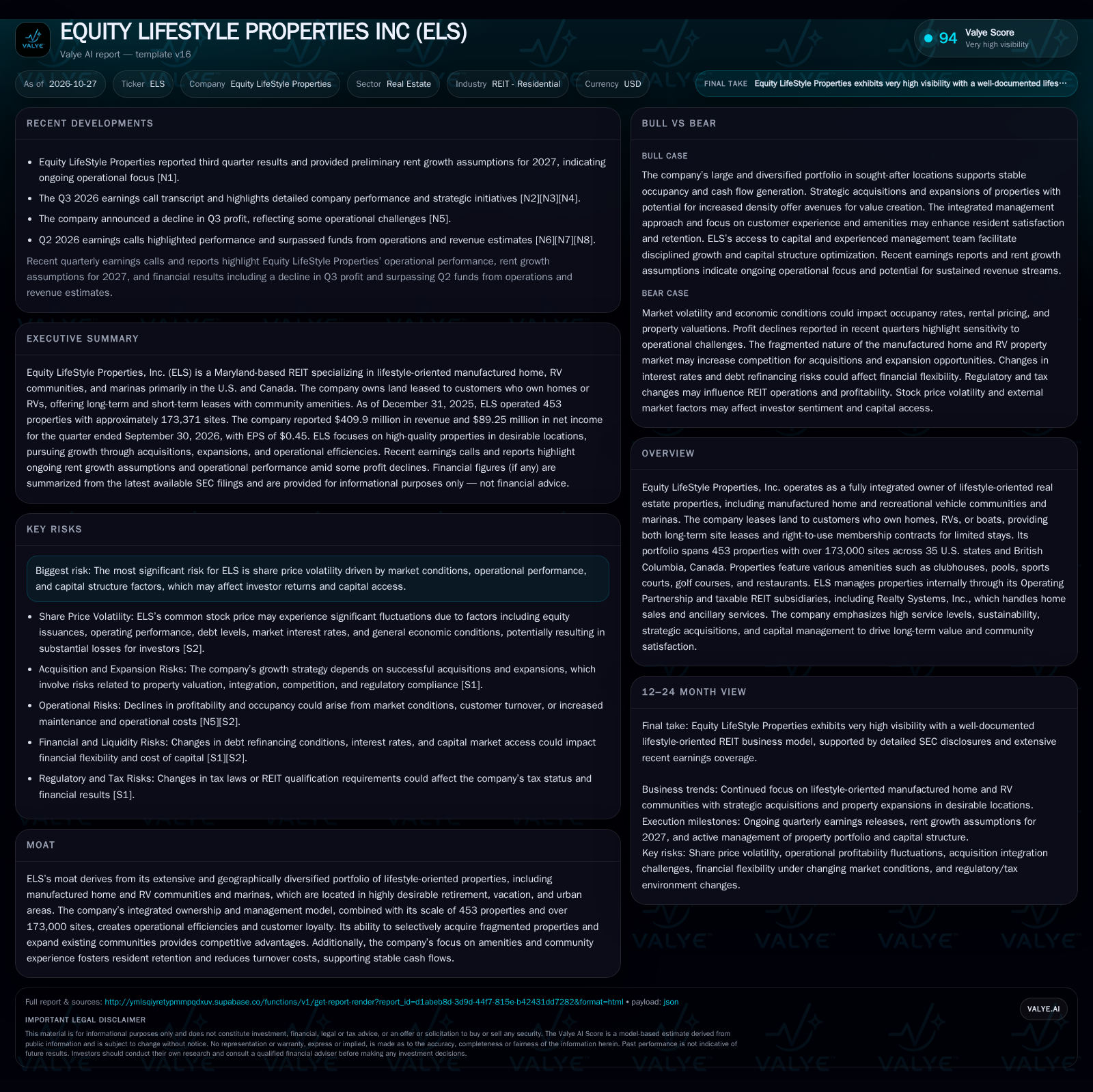
As of September 30, 2026, Equity LifeStyle Properties reported revenue of $409.9 million and net income of $89.25 million for the trailing quarter, with basic and diluted EPS of $0.45. The company operates 453 properties with approximately 173,371 sites across 35 U.S. states and British Columbia, representing one of the largest lifestyle-oriented REIT portfolios. Despite this scale, ELS disclosed a decline in Q3 profit, a notable shift after surpassing funds from operations and revenue estimates in Q2. Management continues to project rent growth into 2027, but the recent dip in profitability underlines the sensitivity of the operating model to cost inflation, occupancy changes, and competitive dynamics. [S1] [S2] [N1] [N5]
Monetizing Land, Community, and Experience at ELS
The core of ELS’s economics lies in leasing land to customers who own their manufactured homes, RVs, or boats—transforming real estate ownership into a steady stream of site rental income. The model mixes long-term leases with right-to-use membership contracts, providing both predictable cash flows and some exposure to short-term seasonality, especially in vacation and marina properties. Ancillary revenues flow from home sales, leasing, and community amenities such as clubhouses, pools, and golf courses.
ELS’s cost structure is characterized by high fixed costs—property maintenance, amenities, and corporate overhead—offset by the operating leverage of a large, largely developed asset base. Variable costs tend to be lower relative to revenues once communities reach mature occupancy, but inflation in labor, utilities, and insurance can compress margins, as hinted by the recent profit decline. Capital needs are ongoing: acquisitions, expansions, and property upgrades require disciplined allocation, with returns depending on the ability to raise rents or increase site density. The company reported cash and liquidity metrics for the period; these figures do not by themselves establish operating runway, investment capacity, financial flexibility, or financing capacity. [S2]
Rent growth is the primary lever for top-line expansion, but is constrained by market competition, resident affordability, and regulatory caps in some jurisdictions. The ability to add new sites or upgrade amenities can further boost revenue, but involves upfront capital outlays and uncertain payback periods.
Defensive Strengths in Scale, Location, and Customer Experience
ELS’s competitive position is built on three pillars: portfolio scale, concentration in desirable locations (retirement, vacation, and urban sites), and a focus on resident experience through amenities and integrated management. These factors foster stable occupancy and customer retention, which support recurring cash flows and lower turnover costs.
However, the manufactured home and RV park sector remains fragmented, with regional and local operators competing for acquisitions and development opportunities. Larger REITs and institutional investors are increasingly attracted to the sector due to its cash flow characteristics, raising purchase multiples and intensifying competition for assets. Substitute products—such as traditional multifamily rentals, seasonal vacation rentals, or new build-to-rent communities—can siphon demand, especially if ELS is unable to keep pace with evolving resident expectations or maintain pricing power.
Regulatory risk is also nontrivial: rent control, zoning restrictions, and changing tax regimes can alter the economics of individual sites or entire markets. While ELS’s scale offers some buffer against these threats, it also means that adverse policy changes in major states could materially impact aggregate results.
Sustained Rent Growth and Disciplined Acquisitions Could Boost Cash Flows
The most favorable scenario for ELS hinges on its ability to continue raising rents at or above inflation while maintaining high occupancy across its portfolio. If consumer demand for affordable, amenity-rich living remains robust—particularly among retirees and seasonal travelers—the company can leverage its scale to drive incremental margin expansion through operating efficiencies and selective amenity upgrades.
Disciplined acquisitions that add properties with strong cash flow profiles or expansion potential, combined with effective integration, could further boost earnings. If ELS can avoid overpaying for new assets and manage capital costs despite market competition, portfolio growth would be accretive. Confirmation of this scenario would come from sustained or accelerating same-property NOI growth, stable or improving occupancy rates, and evidence of successful property expansions or densification projects.
Upside would be further supported by a benign interest rate environment, which would lower debt costs and facilitate refinancing or further investment.
Cost Pressures Balanced by Stable Rent Growth Limit Margin Gains
The most plausible trajectory is one where ELS achieves moderate rent growth in line with management’s 2027 assumptions, but faces ongoing pressure from rising expenses—particularly labor, insurance, and property maintenance. Occupancy remains high, supported by demographic tailwinds and the value proposition of manufactured home and RV living, but competitive entry and resident price sensitivity cap pricing power in certain markets.
Acquisition activity continues, but at a slower or more selective pace given elevated asset prices and tighter underwriting standards. Operating margins stabilize but do not meaningfully expand, with profit growth closely tracking rent increases and portfolio scale. Confirmation would come from quarterly earnings that show steady, if unspectacular, year-over-year NOI and EPS progression, alongside commentary indicating cautious optimism but acknowledgment of persistent cost headwinds.
Margin Squeeze and Asset Competition Threaten Competitive Edge
In an adverse scenario, ELS could see occupancy erode due to economic downturns, consumer belt-tightening, or increased competition from new entrants and alternative housing formats. If cost inflation outpaces rent growth—due to wage pressures, higher insurance premiums, or regulatory compliance—margins would compress further, as already hinted by the recent Q3 profit decline.
Aggressive competition for property acquisitions may force ELS to pay higher multiples, depressing future returns and raising integration risks. Adverse regulatory changes (such as rent controls or unfavorable zoning) could further erode cash flows, particularly in key Sunbelt or coastal markets. Downside confirmation would include sequential declines in occupancy, negative same-property NOI growth, and management guidance downgrades or cautionary commentary on acquisition economics.
Conditions Influencing the Durability of ELS’s Rent Growth and Acquisition Strategy
Trends in same-property net operating income (NOI) growth, especially relative to expense inflation, will be crucial for evaluating margin stability and operating leverage.
Portfolio-wide occupancy rates and changes in resident turnover, if disclosed, would help assess the stickiness of the resident base and the effectiveness of the amenity and community experience strategy.
Actual rent increases realized in 2027 versus management’s current assumptions will provide direct evidence of pricing power and market demand.
Acquisition pace and pricing—including cap rates on new deals—will indicate whether ELS is deploying capital prudently or taking on increased integration and valuation risk.
Capital expenditure levels and returns on property expansions or amenity upgrades (if disclosed) would clarify whether reinvestment is driving incremental value or simply offsetting obsolescence.
The impact of debt refinancing costs, interest rate changes, and overall balance sheet flexibility on cash flow and investment capacity should be monitored through future filings and earnings commentary.
Regulatory and policy developments in major states or provinces—such as rent control measures or changes to REIT taxation—could materially shift the risk-reward profile.
Disclaimer: This is research-only, informational analysis and not investment advice. It may include AI-generated interpretation and general industry context. Always verify important details using primary sources.

Comments