
Ensign Group’s Integrated Post-Acute Platform: Real Estate Leverage, Acquisition Scale, and the Next Phase of Operational Execution
Ensign Group’s combination of skilled nursing operations, a captive REIT, and a disciplined acquisition engine has built a large, geographically diverse post-acute care platform. The company’s growth hinges on successfully integrating new facilities, managing regulatory headwinds, and leveraging its real estate portfolio for both operational and potential financial flexibility.
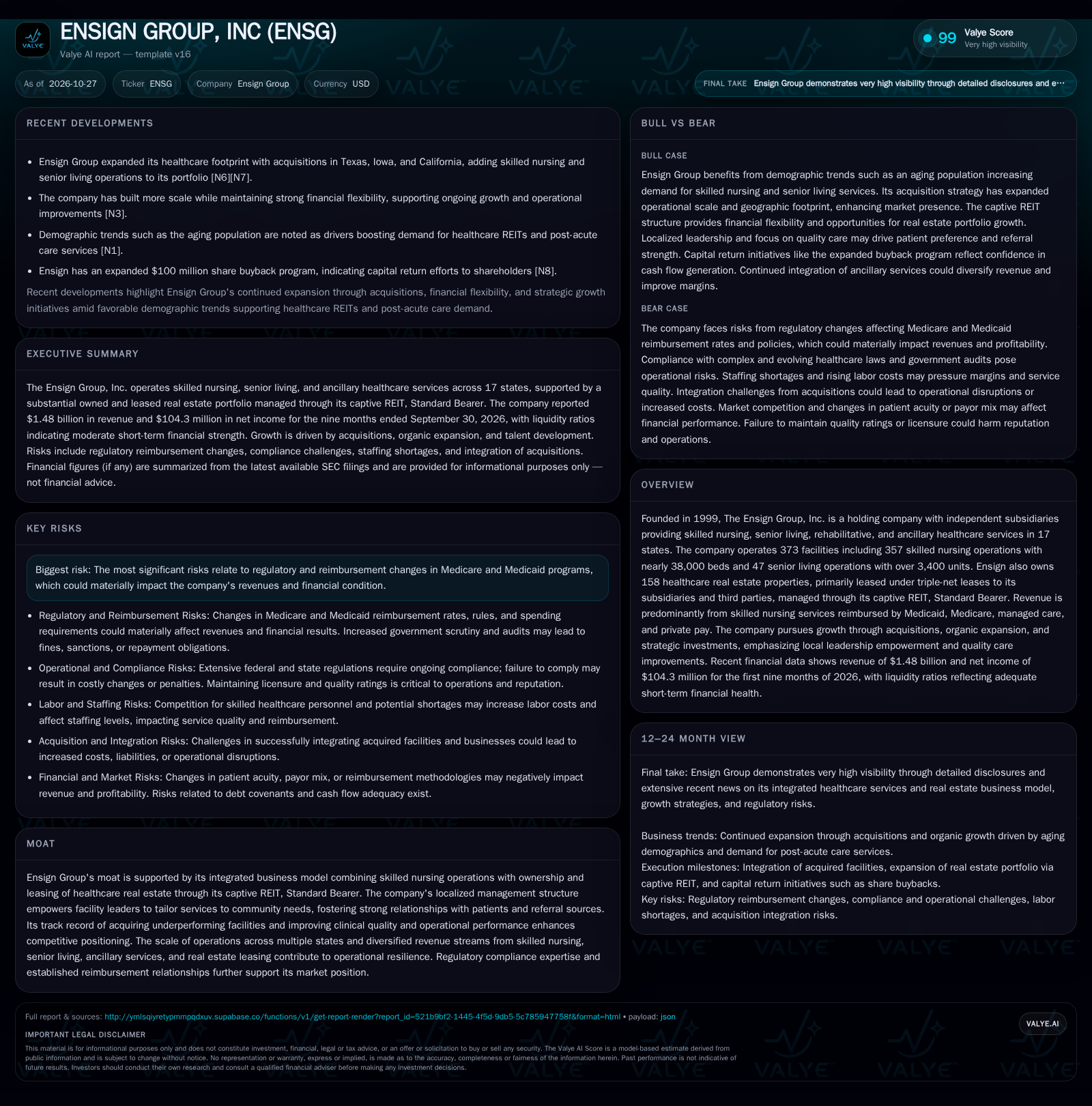
Ensign Group operates a scaled network of skilled nursing and senior living facilities, supported by owned real estate and a captive REIT structure. Recent acquisitions in multiple states have expanded its footprint, with most revenue tied to government reimbursement. The company’s strategy relies on integrating new facilities, optimizing local management, and navigating regulatory and labor risks to maintain profitability. Performance will depend on continued acquisition discipline, reimbursement stability, and the ability to manage rising staffing and compliance costs. [S1] [S2] [N3] [N6] [N7]
The Ensign Group stands out in post-acute care by blending operational scale with real estate ownership, using a captive REIT to support both facility expansion and financial maneuverability. With a network spanning 373 facilities across 17 states, Ensign has recently accelerated its acquisition strategy, targeting underperforming assets for turnaround and leveraging demographic tailwinds from an aging U.S. population. The company’s future trajectory will be shaped by its ability to integrate new sites, navigate regulatory volatility, and extract value from its real estate assets—while managing the persistent risks of labor shortages and reimbursement pressure.
Recent Acquisitions and Real Estate Structure Define the Current Landscape
Ensign Group has expanded its healthcare footprint in 2026 through acquisitions in Texas, Iowa, and California, adding to its already large network of skilled nursing and senior living facilities. As of September 30, 2026, the company operated 373 facilities, including 357 skilled nursing operations with nearly 38,000 beds and 47 senior living operations with over 3,400 units. The company’s real estate portfolio includes 158 owned properties, 120 of which are operated by Ensign and 38 leased to third parties, managed through its captive REIT, Standard Bearer. Most of the company’s revenue—approximately 95.6%—is generated from skilled nursing, with Medicaid and Medicare accounting for over 70% of that mix. Ensign reported $1.48 billion in revenue and $104.3 million in net income for the first nine months of 2026, with liquidity metrics indicating $337.6 million in cash and a current ratio of 1.2. [S1] [S2] [N3] [N6] [N7]
How Scale, Payer Mix, and Real Estate Ownership Shape Ensign’s Profit Model
Ensign’s business model is anchored in high-volume skilled nursing operations, with revenue driven by occupancy, acuity, and the payer mix of Medicaid, Medicare, managed care, and private pay. Medicaid (46.6%) and Medicare (24.7%) are the dominant sources, exposing the company to regulatory and rate-setting risk but also ensuring a consistent demand base in an aging society. Fixed costs include staffing, facility operations, and compliance overhead—costs that rise with labor scarcity. However, facility ownership via the captive REIT enables the company to capture landlord economics, reduce third-party rent exposure, and create additional profit streams from leasing to outside operators. The triple-net lease structure pushes operating costs and capital expenditures onto tenants, stabilizing real estate returns and providing a platform for further acquisition and expansion. Operating leverage is achieved as incremental occupancy and improved payer mix (e.g., higher-acuity or private-pay patients) can drive margin expansion, provided labor and compliance costs are controlled.
Integration, Local Autonomy, and Real Estate Depth: Can Ensign Sustain Its Edge?
Ensign’s competitive position is built on operational scale, geographic diversity, and a unique blend of services and real estate ownership. Its local leadership model empowers facility operators to tailor services to community needs, which may support stronger referral relationships and clinical outcomes—a potential advantage over more centralized or less nimble peers. The captive REIT structure not only insulates Ensign from rent increases but also enables opportunistic acquisition of underperforming properties. Major competitors include national skilled nursing chains, regional post-acute care operators, and healthcare-focused REITs. However, the business faces industry-wide threats: labor shortages, wage inflation, regulatory scrutiny, and the risk of new care models (e.g., home health, telemedicine) eroding skilled nursing demand. The company’s ability to rapidly integrate acquired facilities and improve both clinical and financial metrics is central to maintaining its edge. If integration falters or regulatory pressures mount, Ensign’s scale and real estate depth may not be enough to offset margin compression.
Accelerated Facility Integration and Favorable Demographics Drive Outperformance
Ensign’s upside scenario is predicated on three reinforcing factors: successful integration of newly acquired facilities, continued demographic-driven demand for post-acute care, and stable or improving reimbursement rates. If Ensign can consistently raise occupancy and clinical quality in acquired sites—leveraging its local leadership and operational playbook—margin expansion and earnings growth could exceed expectations. Further, if Medicaid and Medicare rates are maintained or improved (for example, through policy adjustments recognizing higher acuity or inflation), the company’s heavy public-payer mix becomes a stabilizing asset rather than a vulnerability. Additional ancillary service penetration (e.g., in diagnostics or pharmacy) could diversify revenue and boost margins if scaled successfully. Confirmation of the upside would come from sustained increases in same-facility occupancy, upward trends in EBITDAR margins, and evidence of successful ancillary service rollout. Watch for public disclosures of improved facility performance and positive government reimbursement trends.
Disciplined Expansion Meets Persistent Regulatory and Labor Headwinds
The most plausible trajectory is continued disciplined expansion via acquisitions and selective facility upgrades, offset by ongoing regulatory, labor, and integration challenges. Ensign is likely to maintain single-digit organic growth, with incremental contributions from new facilities as they are integrated. Reimbursement rates may remain largely stable but subject to periodic volatility, while labor costs and staffing shortages persist as structural challenges. Ancillary services and real estate leasing will provide incremental profit streams but are unlikely to materially shift the revenue mix in the near term. The company’s financials will reflect moderate margin pressure from wage inflation and compliance costs, balanced by occupancy gains and real estate scale. Evidence supporting this scenario would include stable to modestly rising net income, continued facility acquisition activity, and no major regulatory or compliance disruptions.
Regulatory Cutbacks and Labor Crisis Undermine Integration and Margins
A negative outcome could unfold if federal or state governments implement meaningful cuts to Medicaid or Medicare rates, directly reducing Ensign’s top-line and squeezing margins. Simultaneously, if labor shortages worsen or wage inflation accelerates, staffing costs could outpace reimbursement increases, leading to operational stress and potential quality shortfalls. Integration failures—either from overextension in acquisitions or inability to upgrade underperforming facilities—could compound these pressures, resulting in lost referrals, regulatory penalties, or even facility closures. Ancillary services, while a potential offset, are not currently large enough to materially change the company’s risk profile. Downside confirmation would come from falling occupancy rates, deteriorating EBITDAR margins, regulatory findings or sanctions, and stalled or negative net income trends.
Milestones That Will Clarify Ensign’s Real Earnings Power and Risk
Occupancy rates and payer mix trends across the skilled nursing portfolio—especially in newly acquired facilities—would help test the company’s ability to drive operational improvement after acquisitions.
EBITDAR margins by operating segment, if disclosed, would clarify whether integration and scale efficiencies are translating into sustainable profitability.
Changes in Medicaid and Medicare reimbursement rates or policy at the federal and state level, as these directly impact the bulk of Ensign’s revenue.
Labor cost trends, including wage inflation and staffing ratios, as persistent shortages or rising costs could offset operating leverage.
Regulatory or compliance findings, audits, or penalties that may indicate operational or integration risks materializing.
Progress on ancillary service revenue growth—such as mobile diagnostics, pharmacy, or transportation—would help test the thesis that these can meaningfully diversify and raise margins.
Facility acquisition pace and post-acquisition performance improvement, as evidence of continued discipline and execution in the company’s core growth strategy.
Disclosures on capital allocation—including real estate investments, REIT expansions, and potential buybacks—to gauge management’s flexibility and return orientation.
Disclaimer: This is research-only, informational analysis and not investment advice. It may include AI-generated interpretation and general industry context. Always verify important details using primary sources.

Comments