
Enphase Energy: Liquidity, Profitability, and the Competitive Demands of Solar Technology
Enphase Energy enters the final quarter of 2026 with a reported liquidity position, positive net income, and heightened market attention—but faces sector-wide headwinds from shifting incentives and intensifying competition in solar technology. The company’s ability to translate financial strength into sustained innovation and market share will determine its future trajectory.
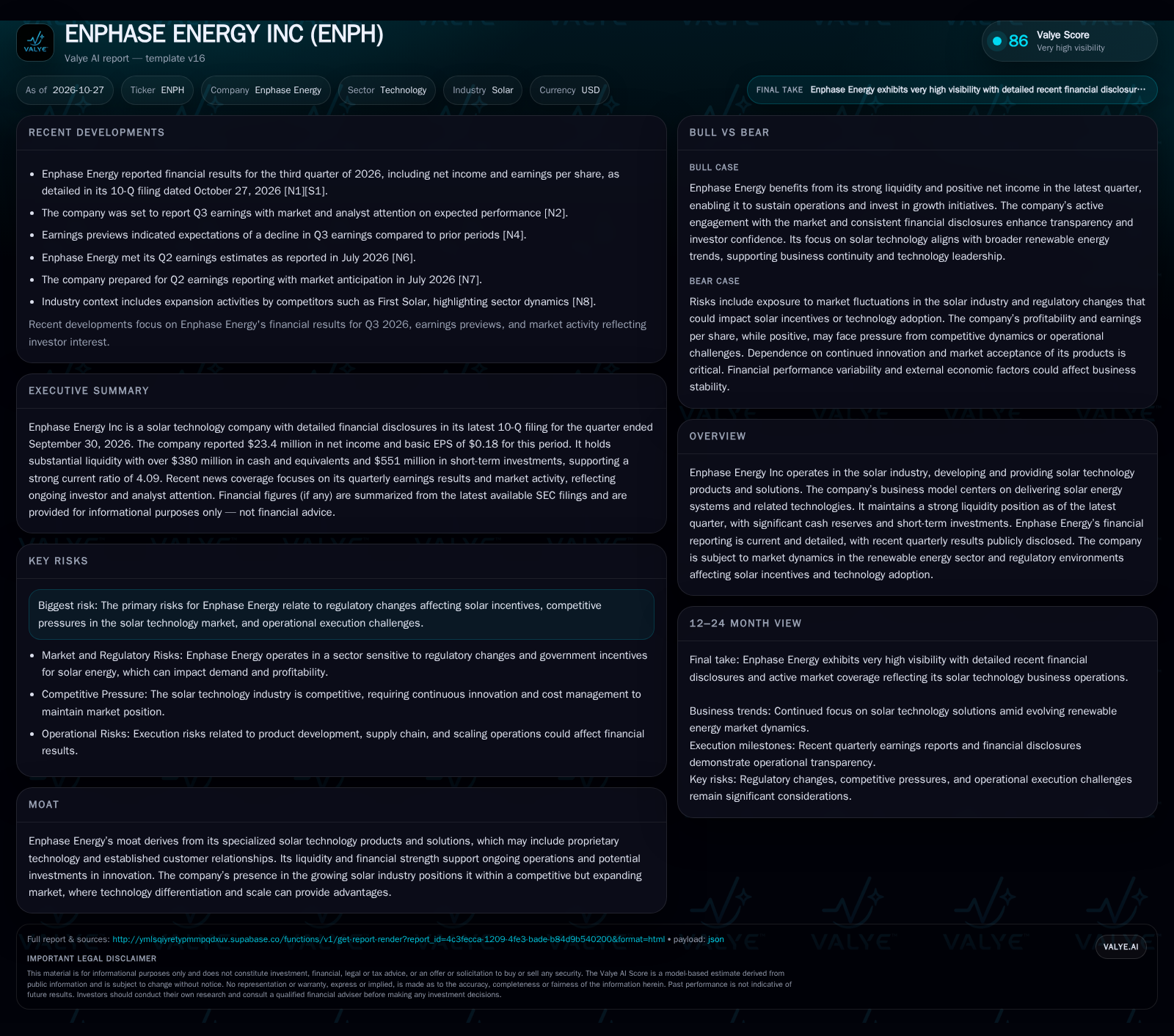
However, analyst expectations of a Q3 earnings decline and ongoing competitive and regulatory pressures highlight the need for continued product innovation and operational agility. The company’s performance in navigating these external and internal forces will be pivotal in defining its growth prospects. [S1] [N1] [N2] [N4]
Enphase Energy’s latest quarterly results highlight both enduring strengths and unfolding challenges for one of the solar sector’s most visible technology providers. Yet, market sentiment is tempered by expectations of declining earnings and the realities of a fiercely competitive landscape. Success for Enphase will hinge not just on current liquidity, but on the company’s ability to adapt to evolving regulatory incentives and deliver differentiated solar solutions that win in an increasingly crowded field. [S1] [N1] [N2] [N4]
Q3 2026 Snapshot: Financial Strength in a Cautious Market
Enphase Energy reported $23.4 million in net income for the third quarter of 2026, translating to $0.18 in basic and $0.17 in diluted earnings per share. As of September 30, the company held $380.4 million in cash and cash equivalents and $551.4 million in short-term investments, with current assets of $1.88 billion and current liabilities of $460.1 million. This results in a current ratio of 4.09 and a cash ratio of 2.03—signaling ample near-term financial resources. However, analyst coverage leading up to the report anticipated a Q3 earnings decline, reflecting sector headwinds and investor caution about future earnings power. The combination of reported liquidity position and moderated expectations sets the stage for Enphase’s next strategic moves. [S1] [N1] [N2] [N4]
How Enphase Converts Solar Innovation into Profits
Enphase Energy’s business model is anchored in developing and commercializing solar technology products—traditionally microinverters, energy storage systems, and solar management software. The company’s economics depend on a blend of product sales, potential service or software revenues, and the ability to capture value across residential and commercial solar installations.
Revenue growth in solar generally depends on volume expansion (more systems deployed), mix shifts toward higher-value integrated solutions, and pricing power derived from technological differentiation. Gross margins in this industry are sensitive to input costs (notably semiconductors and energy storage components), supply chain efficiency, and the degree of vertical integration. Fixed costs are significant in R&D and go-to-market infrastructure, while manufacturing and distribution contain both fixed and variable elements.
Enphase’s reported profitability, despite sector volatility, suggests some degree of operating leverage—fixed costs are being absorbed by a sufficiently large revenue base. However, future margin expansion will likely require either further product mix enhancement (e.g., storage, software, services) or cost reductions through scale and supply chain optimization. The company reported cash and liquidity metrics for the period; these figures do not by themselves establish operating runway, investment capacity, financial flexibility, or financing capacity.
Solar Technology’s Crowded Playing Field: Differentiation and Defensibility
Enphase operates in a highly competitive solar technology market, facing established inverter and storage providers, vertically integrated solar module manufacturers, and new entrants leveraging digital and grid-integration capabilities. The company’s competitive position hinges on product reliability, system integration, ease of installation, and the ability to offer a seamless platform experience for installers and end-users.
Switching costs in this segment can be moderate: while initial installer training and system compatibility may create some friction, solar customers and installers are often price- and performance-sensitive. Enphase’s potential moat is rooted in proprietary technology (e.g., microinverter design, software integration), established installer relationships, and a reputation for quality. However, these advantages can be eroded if competitors achieve parity in performance, cost, or integration—or if regulatory changes shift incentives toward alternative technologies such as string inverters, DC optimizers, or fully integrated solar-plus-storage platforms.
The company also faces substitution risk from broader energy technology trends, including distributed energy management, virtual power plants, and utility-scale solar solutions that may bypass residential-scale platforms altogether. To maintain share and pricing power, Enphase must continuously invest in innovation and value-added features that competitors cannot easily replicate.
Unlocking Growth: When Liquidity Fuels Technological Leadership
A favorable scenario for Enphase would see the company leveraging its substantial liquidity to accelerate product innovation, expand its platform, and capture share as the solar market grows. Should regulatory environments remain supportive—through tax credits, net metering, or grid modernization mandates—end-market demand for advanced residential and commercial solar systems could re-accelerate.
In this scenario, Enphase successfully differentiates with new microinverter generations, integrated energy storage, and software solutions that drive higher revenue per installation and better customer retention. Operating leverage would improve as R&D and go-to-market investments yield outsized top-line growth. Evidence for this scenario would include above-peer revenue growth, margin expansion, successful new product launches, and increased attachment rates for storage and software across its installed base. Regulatory stability and positive industry sentiment would further reinforce the growth trajectory.
Sustaining Share in an Evolving Regulatory and Competitive Landscape
The most plausible outlook for Enphase is one of measured growth amid sector volatility.
In this middle path, Enphase continues to roll out incremental product improvements and retains a core base of installers and customers, but revenue growth is uneven and margins are periodically squeezed by price competition and supply chain dynamics. Regulatory changes could slow demand in certain regions, offset by adoption gains elsewhere. Confirmation would come from continued, if modest, profitability, a stable or slowly growing installed base, and regular—but not transformative—product updates. Falsification would involve sustained revenue or margin contraction, or a significant loss of key installer relationships.
When Incentives Fade and Rivals Catch Up: The Threat to Enphase’s Model
A negative scenario materializes if regulatory support for solar weakens (e.g., reduced tax credits, unfavorable net metering changes), leading to demand contraction or a shift toward lower-cost solutions. If competitors close the technology gap or undercut pricing, Enphase could face margin compression and loss of share—especially if it cannot match cost reductions or product innovation pace.
Further downside would stem from operational missteps: supply chain disruptions, delayed product launches, or quality issues that erode installer and customer trust. In such a scenario, liquidity may be consumed by restructuring or defensive investments, and profitability could turn negative. Confirmation would include declining sales volumes, shrinking gross margins, or evidence of major customer defections. A useful red flag would be guidance cuts or warnings related to regulatory headwinds or competitive pricing pressure.
Critical Evidence to Track as Enphase Navigates Solar’s Next Phase
Gross margin trends by product category—if disclosed—would reveal Enphase’s ability to defend pricing and manage input costs.
Installer and customer retention rates, or any commentary on churn, would help test the durability of customer relationships.
Quarterly revenue growth and segment mix (microinverters vs. storage vs. software) would indicate underlying demand and product strategy effectiveness.
Any disclosed backlog, order book, or forward-looking demand indicators would provide visibility into near-term revenue.
R&D spending as a percentage of revenue would signal commitment to innovation and future differentiation.
Regulatory developments—especially changes to solar incentives or net metering policies in major markets—should be closely monitored for impact on demand.
Competitive product launches and pricing moves by leading inverter and storage providers would help gauge the intensity of sector rivalry.
Supply chain or manufacturing updates, including lead times and cost trends, would be important for assessing operational resilience.
Disclaimer: This is research-only, informational analysis and not investment advice. It may include AI-generated interpretation and general industry context. Always verify important details using primary sources.

Comments