
Range Resources at a Strategic Crossroads: Merger Uncertainty, Capital Discipline, and Commodity Headwinds
With a pending merger, operational discipline in the Appalachian basin, and mounting liquidity pressures, Range Resources faces a pivotal period where commodity prices, integration execution, and legal exposures will dictate the next phase of value creation—or erosion.
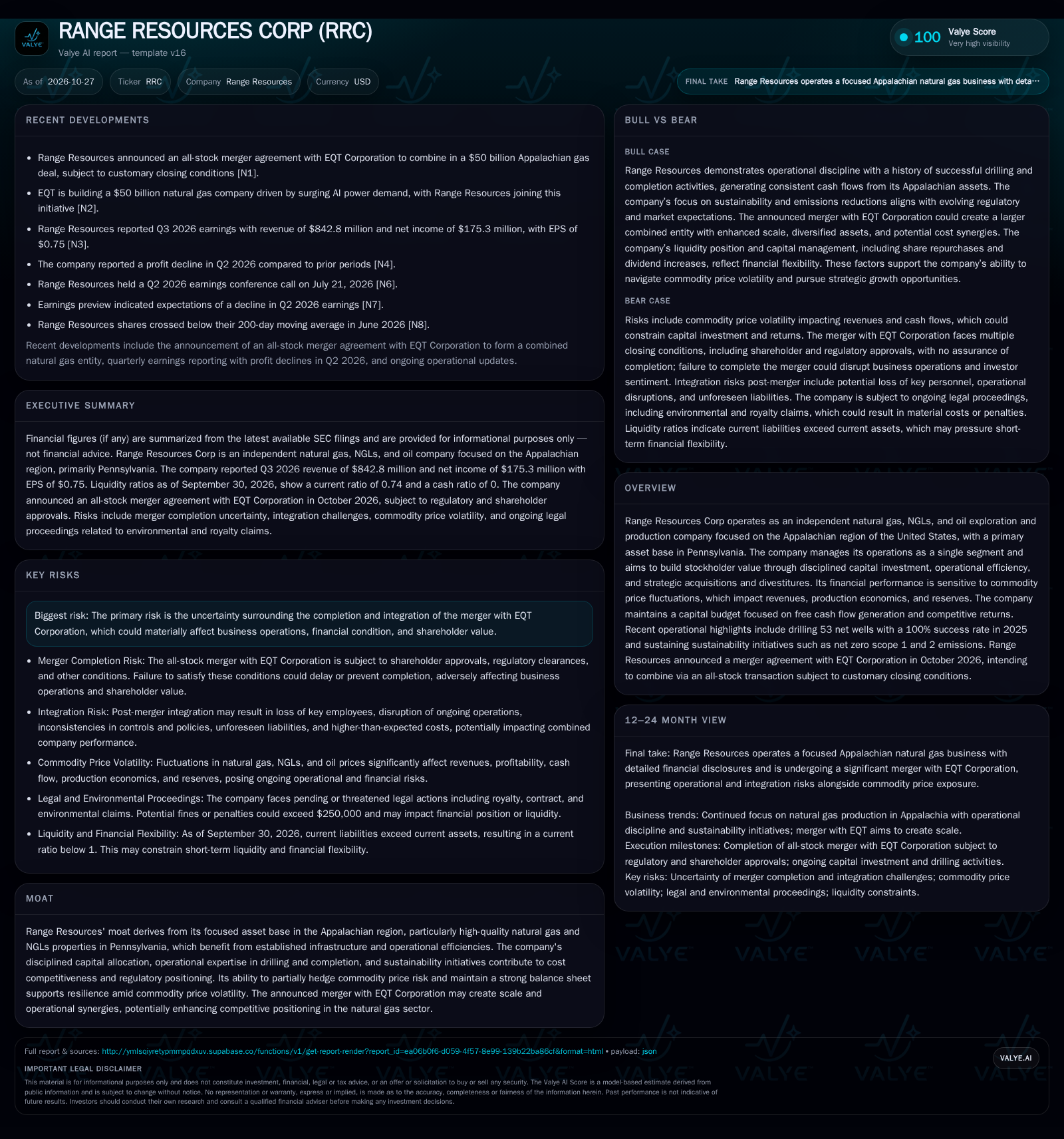
Range Resources is navigating a transformative period marked by a pending $50B merger with EQT, recent profit declines despite strong 2025 results, and constrained short-term liquidity. The company’s disciplined capital approach, sustainability initiatives, and Appalachian focus remain strengths, but commodity price volatility and integration risks loom large as near-term determinants of shareholder value. [S2] [N1] [N4]
Range Resources finds itself at a strategic inflection point as it prepares to merge with EQT in a $50B deal that could reshape the Appalachian natural gas landscape. While the company has delivered operationally—drilling 53 net wells with a 100% success rate in 2025 and boosting annual dividends by 12.5%—recent profit declines, short-term liquidity pressures, and unresolved legal exposures cloud the near-term outlook. The path forward depends on commodity price resilience, successful merger execution, and maintaining capital discipline under new ownership, all while navigating regulatory and sustainability expectations.
Merger, Profit Decline, and Liquidity: The Immediate Backdrop
Range Resources is in the midst of a high-profile $50B merger agreement with EQT that, if completed, would create one of the largest natural gas producers in the U.S. Appalachian basin. This pending transaction imposes restrictions on alternative transactions and certain business activities until closing, introducing both strategic opportunity and operational constraint. [N1] [S2]
Operationally, Range Resources reported a 27% revenue increase in 2025, driven by a 24% lift in realized commodity prices and modest 2% production growth. However, the company saw a profit drop in Q2 2026, reflecting the sector’s exposure to commodity price volatility and possibly higher costs or lower margins in the near term. [S2] [N4]
Liquidity is under pressure: as of September 30, 2026, current liabilities exceeded current assets, yielding a current ratio of 0.74 and a cash ratio of zero. This signals limited short-term potential financial flexibility as the company navigates both ongoing operations and merger-related uncertainty. [S2]
How Range Resources Turns Drilling Into Cash—And Where It Gets Squeezed
Range Resources’ core business economics are dictated by the interplay of commodity prices, production volumes, and operating costs. Revenues are directly tied to realized prices for natural gas, NGLs, and oil—making price swings the dominant driver of cash flow and profitability. The company’s ability to deliver a 27% revenue increase in 2025 was primarily a function of a 24% improvement in average realized prices, illustrating the high operational leverage inherent in the model. [S2]
The capital structure is asset-heavy, with annual capital budgets ($650–$700 million for 2026) allocated to drilling, completion, and maintenance of reserves. Fixed costs for land, infrastructure, and overhead create a baseline operating leverage, while variable costs scale with drilling intensity and production. High drilling success rates (100% in 2025) and operational efficiency are essential to maintaining competitive full-cycle costs.
The company reported cash and liquidity metrics for the period; these figures do not by themselves establish operating runway, investment capacity, financial flexibility, or financing capacity.
Sustainability initiatives—such as net zero operational emissions and water recycling—may reduce regulatory risk and position the company favorably for ESG-sensitive investors, but are unlikely to materially alter the underlying commodity-driven economics in the near term.
Appalachian Scale and Operational Discipline Versus Industry Headwinds
Range Resources’ competitive position is rooted in its concentrated Appalachian asset base, particularly in Pennsylvania, where scale, infrastructure, and geological knowledge confer cost and operational advantages. The company’s history of operational discipline—evidenced by a 100% well success rate in 2025 and ongoing capital efficiency—enables it to compete on full-cycle costs with other leading U.S. gas producers. [S2]
The pending EQT merger would, if completed, create greater economies of scale, potential for enhanced marketing leverage, and improved access to infrastructure. However, this scale can be a double-edged sword: integration risk, organizational complexity, and the challenge of sustaining efficiency across a larger portfolio may erode some of these advantages.
Competitive threats include other Appalachian producers (both public and private), as well as non-Appalachian U.S. shale operators. Substitute risk from renewables and longer-term electrification trends remains a structural overhang, though natural gas is likely to remain a key transition fuel for the next decade. Regulatory scrutiny, environmental litigation, and stakeholder activism add further complexity, especially as sustainability becomes a market and policy expectation.
What Could Go Right: Price Recovery, Smooth Integration, and Operational Outperformance
A favorable scenario for Range Resources involves a sustained recovery or stabilization in natural gas and NGL prices, which would expand margins and restore cash generation capacity. If the EQT merger closes smoothly, the combined entity could realize cost synergies, operational best practices, and stronger negotiating power with midstream and downstream partners.
Successful integration would depend on retaining key personnel, harmonizing operational processes, and avoiding major disruptions to drilling or production. Evidence of synergy capture—such as lower per-unit operating costs or enhanced drilling productivity—would confirm this scenario.
Improving liquidity metrics and a reversal of the Q2 2026 profit decline would also support the bull case.
Falsification of this scenario would come from merger delays, integration missteps, or a renewed slump in commodity prices that erodes cash flow even in a larger, theoretically more efficient, entity.
Most Likely Trajectory: Commodity Volatility and Merger Execution Challenges
The most plausible outlook for Range Resources is a period of heightened uncertainty and moderate operational performance. Commodity prices are likely to remain volatile, with upside capped by incremental U.S. supply and potential demand uncertainty from weather and macroeconomic factors. The company will continue to focus on disciplined capital allocation and operational efficiency, but may face margin compression if prices remain soft or costs rise.
The EQT merger is likely to proceed, but not without challenges: regulatory approval, cultural integration, and systems harmonization could create short-term disruption. The combined company may realize some synergies, but these could be offset by the complexities of merging two large organizations.
Liquidity constraints may persist, particularly if commodity prices weaken further or if integration costs run higher than expected. The company will need to carefully manage working capital and may have reported liquidity metrics that do not by themselves establish financial flexibility.
Confirmation of this scenario would include steady but unspectacular production levels, continued focus on cost control, and incremental improvements in liquidity. Falsification would come from either a major commodity price rally (enabling outsized returns) or a severe operational or integration setback.
How Things Could Unravel: Prolonged Price Slump, Integration Failures, and Legal Shocks
A negative trajectory for Range Resources could be triggered by a sustained decline in natural gas and NGL prices, compressing cash flows and forcing cuts to capital spending, drilling activity, and shareholder distributions. In this scenario, the company’s already-pressured liquidity position could deteriorate further, potentially leading to asset sales or increased reliance on external financing at unfavorable terms.
Merger execution risk is acute: delays, regulatory hurdles, or failure to integrate operations could disrupt business relationships, lead to loss of key talent, and create operational inefficiencies. If cost synergies fail to materialize or if integration costs spike, the combined entity could underperform expectations.
Legal and environmental proceedings represent another risk vector. Material adverse judgments or settlements in royalty or environmental cases could drain cash and distract management, especially if they coincide with weak commodity prices.
Downside confirmation would include continued profit declines, deteriorating liquidity ratios, missed drilling or production targets, and/or negative headlines related to regulatory or legal actions.
Signals That Will Reveal Range Resources’ Post-Merger Value Trajectory
Progress toward regulatory and shareholder approval for the EQT merger, including the anticipated closing timeline and any disclosed integration plans.
Quarterly trends in realized commodity prices and differentials versus benchmark indices, as these directly impact revenue and margin.
Reported per-unit operating and capital costs; a useful metric would be whether combined company synergies are reflected in improved cost structure (if disclosed).
Liquidity and working capital metrics, including current and cash ratios, as well as any new debt or equity financing events.
Well drilling and completion rates, including any changes in success rates or delays post-merger.
Updates on legal and environmental proceedings, especially any disclosures of material settlements, judgments, or regulatory actions.
Retention of key technical and operational personnel through the merger process and integration phase.
Disclaimer: This is research-only, informational analysis and not investment advice. It may include AI-generated interpretation and general industry context. Always verify important details using primary sources.

Comments