
Pentair: Navigating Segment Divergence While Betting on Water Solutions Expansion
Pentair’s latest results reveal a business at a crossroads—weathering persistent Pool segment softness while doubling down on Water Solutions through acquisitions. With operational diversification and a reaffirmed outlook, the company’s ability to integrate new assets and manage evolving end-market dynamics will shape its forward trajectory.
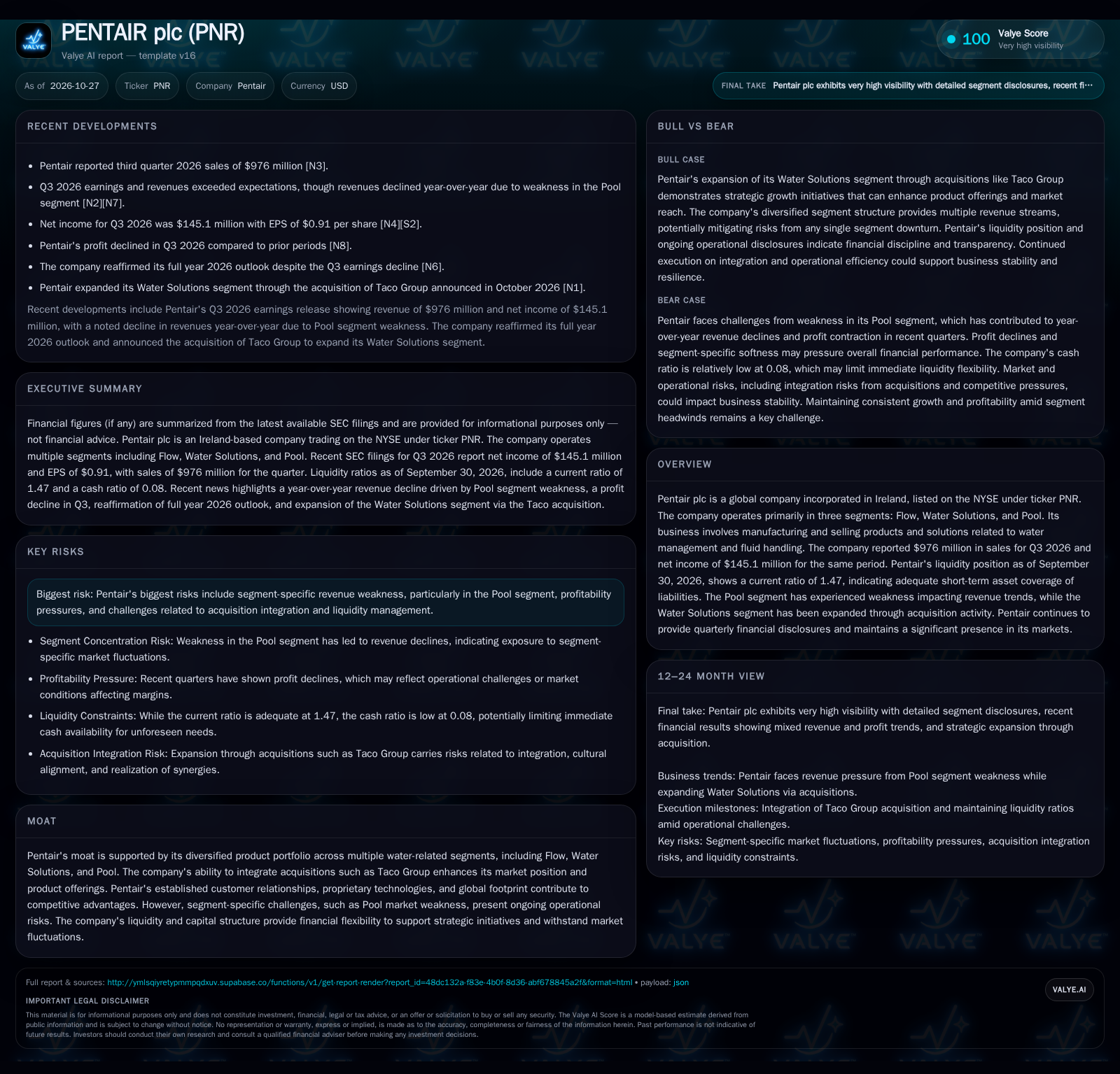
Pentair reported Q3 2026 sales of $976 million and net income of $145.1 million, as Pool segment weakness pulled down overall revenue despite outperformance relative to expectations. The company reaffirmed its full-year outlook and continues to expand Water Solutions via acquisitions, but faces profitability pressure and integration risks as it seeks to rebalance growth drivers across its portfolio. [N2] [N3] [N6] [N8] [S2]
Pentair’s third-quarter 2026 results underscore a business wrestling with mixed fortunes across its portfolio. While the Pool segment’s persistent weakness has caused year-over-year revenue and profit declines, the company beat some expectations and reaffirmed its full-year outlook. Pentair is pressing ahead with its Water Solutions strategy, leveraging acquisitions to diversify away from cyclical Pool exposure. As the company manages integration challenges and shifting end-market trends, the next phase will test whether operational diversification can offset continued segment volatility and margin pressure.
Recent Performance Underscores Segment Imbalances and Strategic Priorities
In Q3 2026, Pentair reported sales of $976 million and net income of $145.1 million, translating to $0.91 in earnings per share. Revenues declined year-over-year, largely due to ongoing weakness in the Pool segment, which has been a material drag on top-line performance. Despite these headwinds and a profit contraction compared to prior periods, Pentair reaffirmed its full-year 2026 outlook, signaling management’s confidence in its diversified segment approach and recent Water Solutions expansion. The company reported cash and liquidity metrics for the period; these figures do not by themselves establish operating runway, investment capacity, financial flexibility, or financing capacity. [N2] [N3] [N6] [N7] [N8] [S2]
How Pentair’s Revenue Mix and Capital Structure Shape Its Earnings Power
Pentair’s business generates revenue across three main segments: Flow, Water Solutions, and Pool. While the company’s product portfolio spans pumps, filtration, and water management systems, segment contributions can vary meaningfully with end-market demand. The Pool segment, historically a high-margin contributor, is subject to cyclical demand tied to residential construction, discretionary consumer spending, and weather patterns—driving recent volatility.
The Water Solutions segment, bolstered by acquisitions, offers exposure to more stable, infrastructure-oriented demand, where municipal, industrial, and commercial customers often operate on longer investment cycles. This segment can support more predictable revenue streams and potentially higher operating leverage if integration is managed effectively. However, the mix shift towards Water Solutions may require ongoing capital investment and integration costs, and the realization of acquisition synergies is not automatic.
Operating leverage is a key dynamic: as fixed manufacturing and SG&A expenses are spread over fluctuating revenues, margin expansion depends on volume recovery or successful cost management. [S2]
Assessing Pentair’s Edge in Diversified Water Technologies amid Market Pressures
Pentair’s competitive positioning draws on its diversified segment structure, established customer relationships, and proprietary technologies in water management. In its Flow and Water Solutions segments, the company competes against global industrial conglomerates and specialized water technology firms, where breadth of offering and service reliability are crucial. The Pool segment faces both branded and private-label competitors, with price sensitivity and consumer demand volatility as persistent challenges.
The company’s ability to integrate acquisitions like Taco Group could deepen its product suite and cross-selling opportunities, but integration risk remains a real counterforce. Furthermore, technological substitution—such as smart water management or disruptive filtration solutions—may alter the competitive landscape, pressuring incumbents to innovate or risk share loss. Switching costs in industrial water applications can provide some stickiness, but in consumer-facing Pool products, loyalty is less durable.
Sustained competitive advantage will likely hinge on the company’s ability to maintain operational efficiency, deliver value-added solutions, and leverage its scale while managing the risk of overextension across disparate end-markets.
Operational Integration and End-Market Recovery Could Catalyze Margin Upside
A favorable outcome for Pentair would see the Water Solutions segment successfully integrating recent acquisitions, realizing meaningful cost and revenue synergies, and capturing share from less diversified competitors. If management can drive operating discipline while expanding recurring revenue streams (e.g., through service contracts or aftermarket sales), the business could achieve improved margin stability.
A recovery in the Pool segment—potentially driven by macroeconomic improvement, consumer confidence, or weather-related demand spikes—would further bolster results, allowing fixed costs to be leveraged more efficiently. Confirmation of this scenario would require evidence of sequential or year-over-year revenue growth in both Pool and Water Solutions, margin expansion, and positive free cash flow trends, ideally with management commentary highlighting integration milestones and pipeline visibility.
Portfolio Diversification Offsets Segment Weakness, but Margin Expansion Remains Elusive
The most plausible near-term scenario is that Pentair’s Water Solutions and Flow segments provide enough stability to offset continued Pool segment softness, resulting in modest overall revenue growth or stabilization. Integration costs and competitive pricing pressure may continue to dampen margin expansion, while the company’s reaffirmed full-year outlook suggests no dramatic deterioration or acceleration is expected.
This base case would be confirmed by steady revenue contributions from Water Solutions, ongoing but narrowing declines in Pool, and management reiterating guidance without major revisions. However, persistent low cash ratios or signs of working capital strain would challenge this scenario, as would any indication that integration of acquisitions is failing to deliver anticipated synergies.
Integration Stumbles and Prolonged Pool Weakness Could Erode Earnings Quality
A more adverse outcome would involve continued or worsening declines in the Pool segment, coupled with operational challenges in integrating acquired businesses within Water Solutions. If anticipated synergies from acquisitions are delayed or unrealized, and if cost inflation or competitive pricing erode margins, Pentair’s earnings quality and cash generation could deteriorate.
This scenario would be evidenced by further year-over-year revenue and profit declines, negative revisions to guidance, or increases in short-term borrowing to fund operations. Signs of missed integration milestones, restructuring charges, or customer attrition in either segment would further validate this downside trajectory.
Milestones and Metrics That Will Shape Pentair’s Strategic Outcome
Trends in segment-level revenue and margin, particularly Pool versus Water Solutions, as disclosed in quarterly filings.
Evidence of acquisition integration progress, including synergy realization and cost savings, if disclosed in earnings calls or filings.
Changes in free cash flow generation and capital expenditure levels, which would indicate the balance between reinvestment and operational efficiency.
Management commentary on pricing power, customer retention, and pipeline visibility across segments.
Any revisions to full-year outlook or forward guidance, especially in response to macroeconomic or end-market changes.
Disclosures regarding new product launches, technological differentiation, or strategic partnerships in Water Solutions.
If disclosed, customer concentration or contract renewal rates in major segments, to assess revenue durability.
Disclaimer: This is research-only, informational analysis and not investment advice. It may include AI-generated interpretation and general industry context. Always verify important details using primary sources.

Comments