
Knowles Corporation: Specialty Components and Strategic Drivers Behind Margin Goals
Knowles Corporation’s Q3 2026 results highlight its positioning at the intersection of defense, medtech, and electrification trends, while margin expansion targets and customer concentration set the stakes for its specialty components strategy.
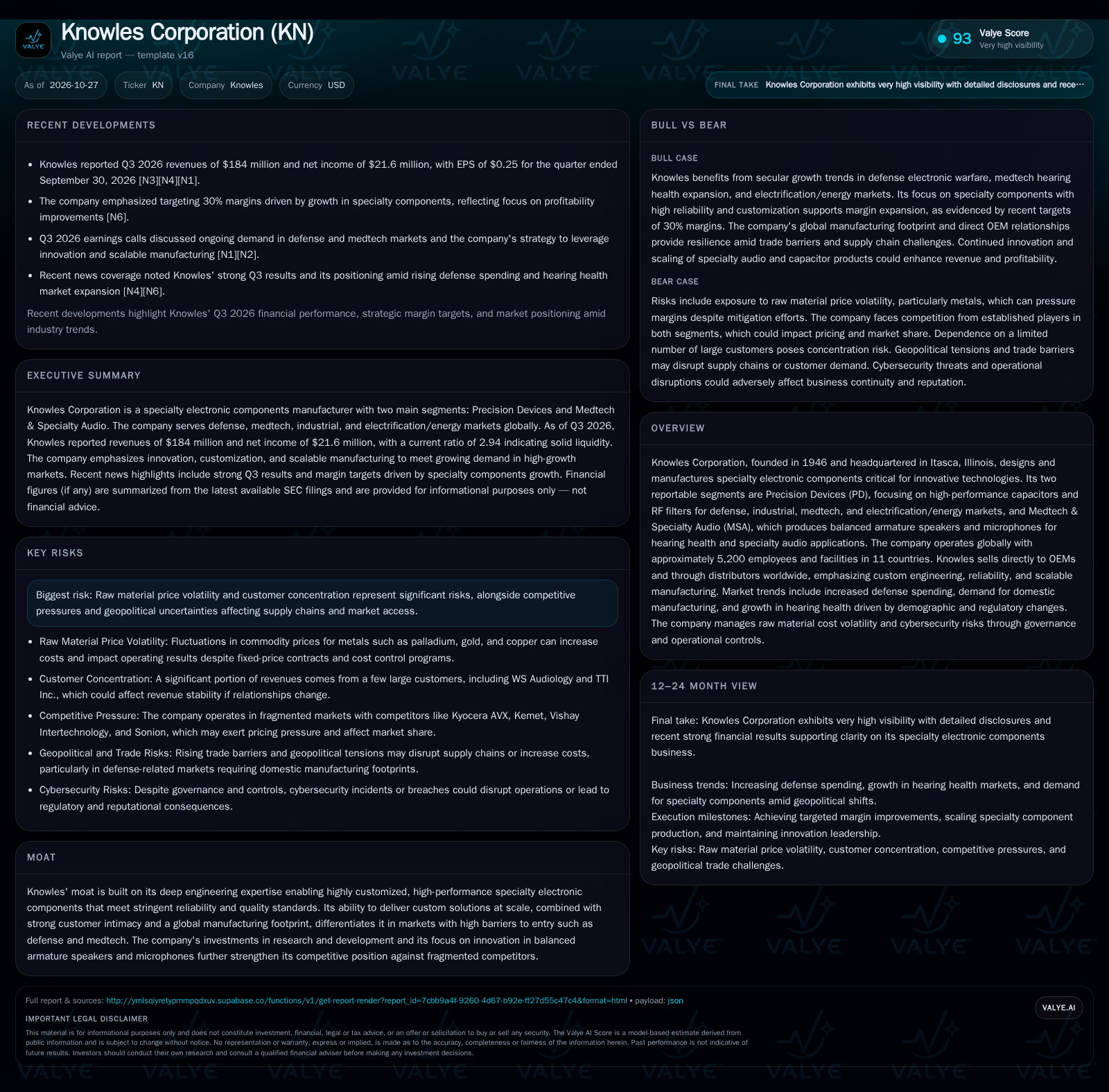
Knowles reported Q3 2026 revenues of $184 million and net income of $21.6 million, with a renewed focus on achieving 30% margins driven by specialty components. The company’s dual-segment model—Precision Devices and Medtech & Specialty Audio—targets secular growth markets like defense and hearing health, but faces raw material volatility and customer concentration risks. The path to sustainable margin expansion depends on execution in customization, operational scale, and diversification away from large customer dependencies. [S2] [N3] [N6]
Knowles Corporation’s recent quarter underscores its evolution from a traditional component supplier to a specialty electronics and medtech partner, leveraging customization and global reach to pursue margin expansion. As the company pivots towards high-value niches in defense, hearing health, and electrification, its ability to scale innovation, manage supply chain risks, and reduce dependency on a few large customers will be central to sustaining its financial targets. The next phase for Knowles is defined less by pure volume growth and more by its capacity to capture value in markets where reliability, customization, and regulatory complexity create enduring barriers.
Q3 2026 Insights on Margins and Customer Concentration
Knowles reported Q3 2026 revenues of $184 million and net income of $21.6 million, reflecting continued demand for its specialty electronic components across defense, medtech, and industrial verticals. The company has publicly targeted 30% margins, with management highlighting specialty components as the primary lever for profitability improvement. This margin ambition is set against a context in which two customers—WS Audiology A/S and TTI, Inc.—each represented at least 10% of 2025 revenues, underscoring a meaningful concentration risk. The company reported cash and liquidity metrics for the period; these figures do not by themselves establish operating runway, investment capacity, financial flexibility, or financing capacity. [S2] [N3] [N6]
Specialty Components as the Core of Knowles’ Economic Model
Knowles generates revenue through two principal segments: Precision Devices (high-performance capacitors and RF filters) and Medtech & Specialty Audio (balanced armature speakers and microphones). The economic foundation of both segments is built on custom engineering, high reliability, and product quality—attributes that typically could support premium pricing and customer stickiness, especially in regulated or mission-critical end-markets such as defense and hearing health.
The move toward a 30% margin target suggests a strategic pivot to higher-value, specialty products with lower commoditization risk. These products often entail higher engineering content and lower direct competition, but may also come with increased R&D and specialized manufacturing costs. Fixed costs associated with global facilities (11 countries, 5,200 employees) create operating leverage potential: as volumes in high-margin niches grow, incremental gross profit can scale disproportionately if overhead is well managed.
Capital needs are moderate for a component manufacturer, though investments in automation, quality assurance, and regulatory compliance (especially for medtech) could pressure free cash flow if not matched by pricing power or volume growth. Raw material costs—particularly for metals like palladium, gold, and copper—are a variable input that the company attempts to hedge through fixed-price contracts, but volatility can still flow through to gross margins if market shifts outpace contractual protections. [S1]
Competing for Leadership through Customization and Scale in Specialty Electronics
Knowles’ competitive differentiation rests on its ability to deliver highly customized, high-reliability components at global scale. In defense and medtech—where product qualification cycles are long and switching costs are high—incumbency and engineering intimacy with OEM customers can create real barriers to entry. The company’s direct OEM relationships, global distribution (notably the Penang, Malaysia hub), and reputation for quality are cited as competitive strengths.
However, Knowles operates in fragmented markets with entrenched competitors such as Kyocera AVX, Kemet, Vishay Intertechnology, and Sonion. These rivals can exert pricing pressure, especially for less differentiated products or in regions with overcapacity. Moreover, technological substitution—such as advances in MEMS microphones or alternative capacitor chemistries—could erode Knowles’ product relevance if innovation lags. The need to balance customization with scalable manufacturing is a double-edged sword: it can protect margin in specialist niches but may limit addressable volume relative to broader, lower-margin commodity categories. [S1]
Accelerating Specialty Demand Fuels Margin Improvement
The most favorable scenario for Knowles is one in which secular growth in defense electronics, hearing health, and electrification/energy markets drives sustained demand for the company’s high-margin specialty components. If Knowles executes on its margin expansion strategy—reaching or exceeding the 30% margin target—this would likely be accompanied by a mix shift toward more customized, higher ASP products, operational efficiencies from global scale, and successful mitigation of raw material cost volatility.
Confirmation of this scenario would include: evidence of rising gross and operating margins in subsequent quarters; new or expanded multi-year OEM relationships in defense and medtech; product launches or design wins in growth markets (e.g., over-the-counter hearing aids, electronic warfare systems); and a declining proportion of revenue from top customers, indicating successful diversification. Accelerated adoption of regulatory changes (such as expanded OTC hearing aid access) or government incentives for domestic manufacturing could further catalyze Knowles’ growth and margin profile.
Niche Growth Continues Amid Input Cost Fluctuations and Customer Dynamics
The most plausible outlook is that Knowles continues to grow in line with secular trends in its core verticals, but margin expansion is gradual and episodic, constrained by periodic swings in raw material costs and ongoing customer concentration. Incremental gains in specialty component penetration and operational scale allow for modest improvement in profitability, but headline margin targets may be achieved only in favorable quarters or specific product lines, rather than across the board.
Supporting evidence would include stable or slowly rising revenue and net income, intermittent margin improvement offset by raw material headwinds, and continued reliance on a handful of large customers. Any progress in diversifying the customer base or reducing input cost exposure would reinforce the base case. Conversely, persistent flatness in margins, or a lack of new OEM wins in targeted growth sectors, would challenge the ability to break out of this steady-state dynamic.
Commodity Price Surges and Customer Reliance Challenge Margins
In a negative scenario, commodity price volatility—particularly in metals like palladium and copper—outpaces Knowles’ ability to manage costs through contracts or operational efficiencies, driving gross margin compression. At the same time, a loss or pullback from a major customer (such as WS Audiology or TTI, Inc.) could create a double hit to both revenue and operating leverage, amplifying downside risk given the company’s fixed cost base.
Confirmation of this outcome would be seen in declining gross and operating margins, sequential revenue drops tied to customer churn, and negative surprises in quarterly results. External shocks—such as new trade barriers, supply chain disruptions, or regulatory hurdles in medtech—could further exacerbate these pressures. A spike in working capital needs, or evidence of delayed or scaled-back investments in automation and R&D, would also signal stress on the company’s economic model.
Margin and Diversification Progress Tracked Through Company-Specific Signals
Quarterly and annual gross and operating margin progression, especially in relation to the 30% target, will be the clearest indicator of strategic execution.
Revenue mix by segment and end-market—particularly the proportion attributable to defense, medtech, and electrification versus commodity or legacy products—would help test the shift toward specialty niches, if disclosed.
Concentration metrics: tracking the share of revenue from the top two or five customers over time would clarify progress on diversification.
New product launches, design wins, or OEM contract announcements in defense, medtech, or high-growth energy applications would validate innovation and market penetration.
Raw material cost trends and the effectiveness of hedging or fixed-price contracts, as disclosed, will directly impact margin resilience.
Capital expenditure levels and R&D investment trends should be monitored for signs of either strategic reinvestment or financial constraint.
Any changes in regulatory environments (such as OTC hearing aid rules or defense procurement requirements) could serve as leading indicators of demand inflection or new barriers.
Disclaimer: This is research-only, informational analysis and not investment advice. It may include AI-generated interpretation and general industry context. Always verify important details using primary sources.

Comments