
DMC Global’s Multi-Segment Model: Managing Commodity Volatility, Cycles, and Diversification Bets
DMC Global Inc. faces margin headwinds from commodity price volatility and cyclical demand—yet operational improvement in Arcadia, backlog gains at NobelClad, and diversification at DynaEnergetics suggest multiple levers for recovery. The company’s ability to offset macro pressures through cost actions, market expansion, and project execution will shape its earnings trajectory.
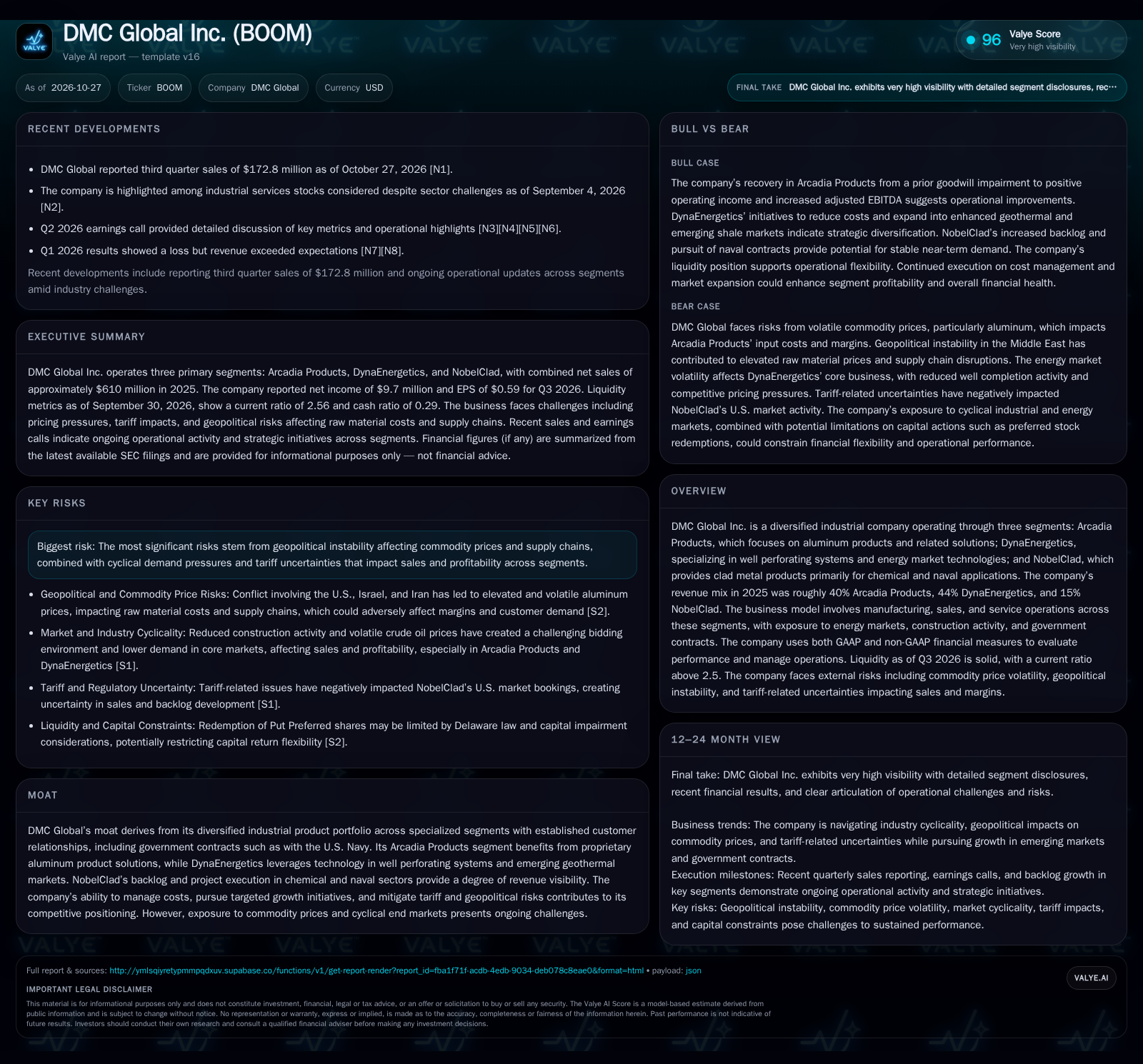
DMC Global’s 2026 results show a company contending with declining sales and tighter margins, driven largely by external pricing and demand shocks. However, Arcadia Products’ turnaround, NobelClad’s project wins, and DynaEnergetics’ push into new energy markets point to a business model with built-in options. The next phase will test whether diversification and cost discipline can counteract persistent volatility in input costs and customer demand cycles. [S1] [S2]
DMC Global Inc. stands at a strategic crossroads as its three-segment model absorbs shocks from commodity price swings, cyclical demand, and global instability. While top-line and margin pressure persisted into 2026, the company’s operational improvements at Arcadia, NobelClad’s international project wins, and DynaEnergetics’ diversification initiatives provide critical test cases for its multi-pronged approach. The central challenge: can DMC Global’s cost, portfolio, and market actions outpace the headwinds of volatility and sector cyclicality to deliver sustainable earnings growth?
Recent Performance Highlights Margin Pressure and Segment Variability
DMC Global’s consolidated net sales fell 5% in 2025, with DynaEnergetics and NobelClad seeing 6% and 11% declines respectively, attributed to a combination of pricing pressures, industry consolidation, tariffs, and project timing. Gross profit margin dropped from 23.4% to 22.2%, reflecting a less favorable project and regional mix and lower absorption of fixed manufacturing costs [S1]. Despite these setbacks, Arcadia Products delivered a notable turnaround, moving from a significant goodwill impairment in 2024 to $4.2 million in operating income for 2025, and helping drive a 12% increase in adjusted EBITDA [S1]. NobelClad’s backlog grew, underpinned by a record international chemical project, while DynaEnergetics is actively targeting cost reductions and new market segments. As of September 30, 2026, the company reported $37.96 million in cash, a current ratio of 2.56, and a cash ratio of 0.29 [S2].
Economic Outcomes Shaped by DMC Global’s Diverse Portfolio
DMC Global’s economics are shaped by its three distinct but interconnected segments: Arcadia Products (aluminum construction solutions), DynaEnergetics (well perforating and energy technologies), and NobelClad (clad metals for chemical/naval use). Each segment faces different pricing and volume dynamics: Arcadia is sensitive to aluminum input costs and construction cycles, DynaEnergetics to oil/gas activity and technology adoption, and NobelClad to project-based demand and tariff regimes.
The company’s revenue mix—roughly 40% Arcadia, 44% DynaEnergetics, and 15% NobelClad—implies a balance between cyclical exposure and project-based revenue streams [S1]. Fixed costs are significant in manufacturing, so volume shortfalls or unfavorable mix (as seen in 2025) can quickly erode margins. Pricing power is limited by commodity pass-through and competitive bidding, especially in energy and construction markets. Capital needs are moderate, with working capital requirements tied to project cycles and raw material inventories. Operating leverage can swing both ways: cost actions (as in DynaEnergetics’ initiatives) help, but persistent volume/mix pressure can outpace savings, as evidenced by recent margin declines.
DMC Global’s Position Within the Industrial Value Chain and Potential Disruptors
DMC Global’s competitive standing is rooted in its ability to serve niche industrial needs across construction, energy, and specialty chemicals/naval. In Arcadia, proprietary aluminum solutions and established relationships provide some insulation, but input cost volatility and construction cycles limit pricing power. DynaEnergetics competes with other well perforating and completion tool providers, facing substitution threats from alternative completion technologies and the broader shift in energy mix. NobelClad’s value proposition rests on technical expertise and project execution, with backlog visibility somewhat mitigating project timing risks.
The company’s diversification across industrial, energy, and government segments offers risk-mitigation, but also exposes it to a wide array of external shocks—commodity prices, tariffs, and geopolitical events prominent among them. Government contracts (e.g., U.S. Navy) and international projects can offer higher-margin, longer-term opportunities, but are lumpy and subject to policy risk. The company’s challenge is to defend niche advantages while adapting to rapid shifts in both input markets and customer demand.
Margin Momentum Could Return Through Diversification and Cost Measures
An upside scenario materializes if DMC Global’s segment-level initiatives gain traction. Arcadia Products could sustain its earnings rebound if aluminum prices stabilize and construction activity recovers, leveraging its proprietary solutions and operational improvements. DynaEnergetics might offset North American oil/gas volatility through successful expansion into enhanced geothermal and emerging shale markets, particularly if cost cuts translate into improved margins. NobelClad’s record international project and pursuit of U.S. Navy contracts could deliver sustained backlog growth and pricing discipline.
Evidence supporting this scenario would include a sequential uptick in gross margin (reflecting better mix and overhead absorption), growth in non-traditional energy revenue at DynaEnergetics, continued operating income expansion at Arcadia, and further backlog wins at NobelClad. A narrowing gap between GAAP and adjusted EBITDA would also signal improved core profitability. These improvements would likely be visible in quarterly segment disclosures and project award announcements.
Ongoing Volatility’s Impact on DMC Global’s Operational Path
The most plausible outcome over the next several quarters is a company that continues to battle external volatility—especially in input costs and customer demand—while extracting incremental gains from cost actions and selective project wins. Arcadia’s recent improvement may be tempered by continued aluminum price fluctuations and uneven construction demand. DynaEnergetics’ diversification efforts may yield gradual adoption but remain subject to oil/gas sector cycles. NobelClad’s backlog offers some near-term visibility, but project lumpiness and tariff risks persist.
Confirmation of this scenario would come from stable or modestly improving gross margins, relatively flat to slightly growing sales, and continued focus on cost containment in management commentary. A lack of sustained momentum in new market segments or margin inflection would falsify the more bullish case, indicating that diversification and cost actions are not yet outpacing external headwinds.
Commodity and Geopolitical Shocks Pose Risks to Diversification Success
The primary risk is that persistent or worsening commodity price spikes—especially in aluminum—combined with geopolitical instability and continued tariff uncertainty, further compress margins and dampen demand, particularly in Arcadia and NobelClad. If DynaEnergetics is unable to offset North American oil/gas weakness with new market wins, segment earnings could decline further. Project delays or cancellations (especially in NobelClad) would exacerbate revenue and margin pressure.
Evidence for this scenario would include further declines in gross margin, negative operating leverage, rising inventory or receivable balances (suggestive of slower customer demand or project delays), and guidance revisions downward. Additional goodwill or asset impairments, or a widening gap between GAAP and non-GAAP profitability, would also signal deeper structural challenges.
Events That Could Confirm or Challenge DMC Global’s Margin and Diversification Prospects
Quarterly gross margin trends by segment—especially Arcadia and DynaEnergetics—will reveal whether cost and mix actions are working.
Sequential changes in NobelClad’s backlog and new project announcements (if disclosed) will help gauge demand visibility and execution.
Revenue and profit share from non-traditional energy markets at DynaEnergetics would help assess the success of diversification efforts.
Aluminum input cost trends and management commentary on supply chain stability will be critical for Arcadia’s outlook.
Operating cash flow and working capital swings, particularly in quarters with large project activity, would illuminate underlying health.
Progress or setbacks in securing and executing U.S. Navy and international government contracts (if disclosed) at NobelClad would test the government/defense growth thesis.
Magnitude and rationale of any future asset impairments or restructuring charges would signal stress or proactive portfolio management.
Disclaimer: This is research-only, informational analysis and not investment advice. It may include AI-generated interpretation and general industry context. Always verify important details using primary sources.

Comments