
Phillips Edison & Company: Necessity Retail Anchors, Lease Rollovers, and the Realities of Shopping Center REIT Economics
With a portfolio built on necessity-based retail tenants and high occupancy, Phillips Edison & Company enters a pivotal period as significant lease rollovers approach. The company’s ability to capture rent spreads, manage renewal risk, and navigate interest rate headwinds will determine whether its steady cash flows can translate into durable shareholder returns.
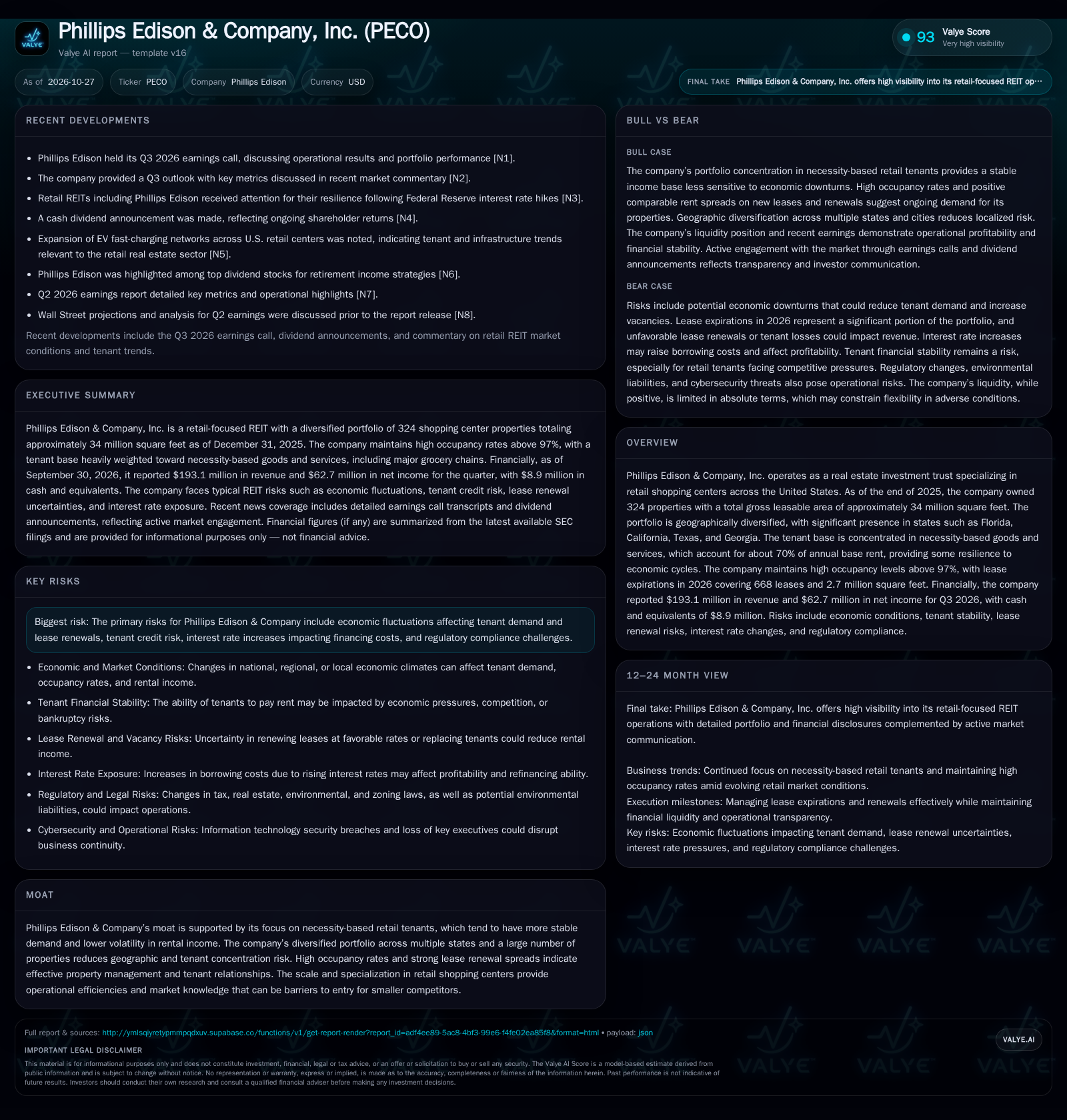
Phillips Edison & Company (PECO) operates 324 retail shopping centers totaling 34 million square feet, with over 97% occupancy and a tenant mix dominated by necessity-based retailers as of late 2025. The company reported $193.1 million in revenue and $62.7 million in net income for Q3 2026, but faces a material lease rollover in 2026 and modest cash liquidity. Its future performance will depend on sustaining high lease renewal spreads, limiting vacancy, and managing capital costs in a changing macro environment. [S1] [S2]
Phillips Edison & Company stands at an inflection point typical for mature shopping center REITs: its high-occupancy, necessity-anchored retail portfolio offers stability, but a significant block of leases expiring in 2026 will test its ability to maintain cash flow and capture incremental rent growth. The company’s geographic diversification and focus on essential retail tenants provide ballast against cyclical consumer weakness, yet rising interest rates and the evolving retail landscape mean that successful navigation of upcoming lease negotiations and capital allocation decisions will determine whether Phillips Edison’s steady fundamentals translate into lasting shareholder value.
Lease Rollovers and Rent Spreads Define Near-Term Outlook
As of December 31, 2025, Phillips Edison owned 324 shopping centers totaling roughly 34 million square feet and maintained a portfolio occupancy rate above 97% [S1]. This high utilization is supported by a tenant base concentrated in necessity-driven retailers—major grocery chains and essential service providers—which together generate about 70% of annual base rent [S1]. In Q3 2026, the company reported revenue of $193.1 million and net income of $62.7 million, with cash and equivalents of $8.9 million [S2]. The most material near-term operational event is the scheduled expiration of 668 leases in 2026, representing 2.7 million square feet (nearly 8% of portfolio GLA), with an average base rent of $18.20 per square foot [S1]. Notably, in 2025, new leases and renewals achieved robust comparable rent spreads of 30.9% and 20.7%, respectively [S1]. These figures suggest strong recent demand for space, but the scale of upcoming expirations means that renewal rates and spreads in 2026 could materially affect both occupancy and rental income.
How Phillips Edison’s Shopping Center Model Generates Cash—and Where the Pressure Points Lie
Phillips Edison’s economics rely on stable, recurring rental income from a geographically and tenant-diversified portfolio. Base rent is the primary revenue driver, typically structured as multi-year leases with built-in escalators and, sometimes, percentage rent clauses. Fixed costs—property taxes, insurance, and maintenance—are significant, but economies of scale in property management can mitigate per-property overhead. Variable costs are largely related to leasing commissions and tenant improvement allowances, which spike during periods of elevated lease rollover activity.
Operating leverage is favorable in periods of rising occupancy or rent per square foot, as incremental revenue from rent increases or higher utilization largely drops to the bottom line after fixed expenses. However, this leverage works both ways: lost tenants or lower renewal spreads can quickly erode margins, especially if backfilling vacant space requires concessions or capital investment.
Capital needs are persistent, as shopping centers require periodic reinvestment to remain competitive and attractive to tenants. As a REIT, Phillips Edison must distribute most taxable income as dividends, limiting retained earnings for growth or upgrades. This structure makes access to capital markets—both debt and equity—vital for funding acquisitions, redevelopment, or refinancing. The company reported cash and liquidity metrics for the period; these figures do not by themselves establish operating runway, investment capacity, financial flexibility, or financing capacity. [S2]
Necessity Retail Focus Shields Against E-Commerce, but Competitive Pressures Remain
Phillips Edison’s competitive advantage lies in its focus on neighborhood and community shopping centers anchored by necessity-based tenants—primarily grocery stores and daily services. This positioning reduces exposure to discretionary retail cycles and e-commerce substitution, as grocery and essential services remain predominantly in-person experiences.
However, the company still faces competitive threats from other retail REITs, private owners, and, to a lesser extent, mixed-use and lifestyle center developers. While smaller operators may struggle to match Phillips Edison’s scale and tenant relationships, larger peers with greater access to capital or more aggressive redevelopment strategies could compete for high-quality tenants or acquisition opportunities.
Alternative land uses (such as residential or logistics redevelopment) could also raise the opportunity cost of maintaining retail assets in lower-growth markets. The company’s geographic diversification helps mitigate localized demand shocks, but the broader retail landscape remains in flux, with tenant consolidation and evolving consumer preferences posing ongoing challenges.
Capturing Renewal Spreads and Retaining Tenants Drives Outperformance
If Phillips Edison can renew or re-lease the bulk of its 2026 expirations at spreads similar to those seen in 2025 (20–30% rent increases on renewals and new leases), the company could realize material growth in same-property net operating income and maintain or improve occupancy.
Several factors could drive this upside: continued demand for well-located necessity retail space, limited new supply in core markets, and tenants’ willingness to pay higher rents for access to established foot traffic. Confirmation of this scenario would come from reported renewal and new lease spreads in 2026, sustained or rising occupancy, and evidence that major grocers and anchor tenants are extending commitments rather than vacating. Falsification would be evident if renewal spreads compress sharply, large tenants exit, or overall occupancy declines despite portfolio churn.
Portfolio Stability Offsets Lease Rollover Risk, but Growth Moderates
The most plausible trajectory is that Phillips Edison successfully renews the majority of its expiring leases, but at more moderate rent spreads than the unusually strong levels reported in 2025. Occupancy remains high, but incremental rent growth slows as tenants push back on increases or demand more concessions.
In this scenario, the company continues to benefit from its necessity retail focus and geographic diversification, offsetting isolated tenant losses or regional demand softening. A shift to negative rent spreads, a step-down in occupancy, or a need to cut dividends would invalidate the stability thesis.
Renewal Headwinds and Higher Rates Squeeze Cash Flows
The adverse scenario materializes if Phillips Edison faces significant pushback from tenants during the 2026 lease rollover, resulting in lower renewal rates, negative rent spreads, or prolonged vacancies. This could occur if consumer demand softens, retailers rationalize footprint, or competing landlords offer more attractive terms. Higher capital expenditures may be needed to re-tenant space or upgrade properties, further pressuring margins.
Compounding this, if interest rates remain elevated or rise further, the company could see increased debt service costs on refinancings, reducing free cash flow available for dividends or reinvestment. Evidence confirming this downside would include a drop in occupancy below the historical average, reported negative rental spreads, increases in property-level expenses, or a need to reduce dividend payouts. A resilient outcome would be falsified by stable or rising occupancy and minimal impact on cash distributions.
Testing the Phillips Edison Thesis: Lease Outcomes, Tenant Mix, and Capital Costs
Renewal and new lease spreads reported for the 2026 rollover cohort, especially for anchor and major specialty tenants.
Portfolio occupancy rate, with particular attention to any step-down below the 97% historical threshold.
Tenant retention statistics and the identity of any major anchor tenants choosing not to renew or downsizing their footprint.
Changes in capital expenditures, tenant improvement allowances, or leasing commissions—if disclosed—as signals of increased re-tenanting or competitive pressure.
Trends in same-property net operating income (NOI) growth and margin, particularly in comparison to prior years.
Debt maturity schedule, refinancing activity, and weighted average interest rate—if disclosed—to gauge exposure to higher capital costs.
Shifts in the portfolio’s geographic or tenant concentration, especially any move away from necessity-based anchors.
Disclaimer: This is research-only, informational analysis and not investment advice. It may include AI-generated interpretation and general industry context. Always verify important details using primary sources.

Comments