
STAG Industrial: Capital Deployment and Portfolio Trends in Industrial Real Estate
STAG Industrial reported solid third-quarter 2026 results and authorized a $250 million share repurchase program, reinforcing its focus on portfolio expansion and shareholder returns. As the industrial real estate sector faces evolving macroeconomic and demand conditions, STAG’s performance hinges on acquisition execution, tenant quality, and prudent leverage management.
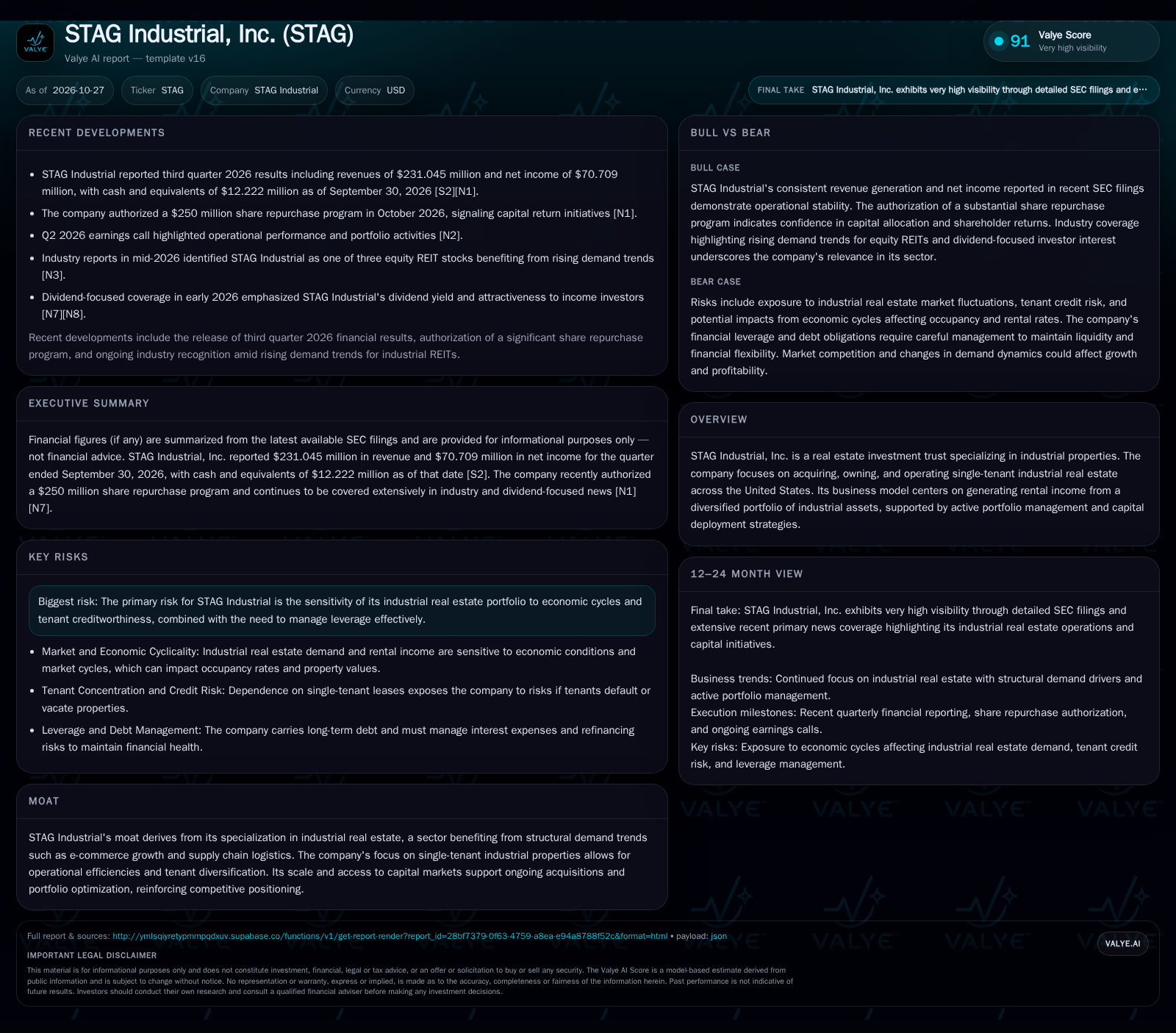
STAG Industrial delivered $231 million in Q3 2026 revenue and $70.7 million in net income, while launching a $250 million share repurchase program. Ongoing acquisitions and portfolio optimization remain central to the company’s strategy as it navigates industrial property demand trends and economic headwinds. The sustainability of growth will depend on maintaining occupancy, managing tenant risk, and balancing leverage in a potentially volatile macro environment. [S2] [N1]
STAG Industrial, Inc. stands at a pivotal juncture as industrial real estate demand trends, capital market conditions, and macroeconomic uncertainty converge. The company’s latest quarterly results demonstrate operational strength, while the newly authorized $250 million share repurchase program signals a commitment to shareholder value. However, as STAG pursues further portfolio expansion through acquisitions, it must balance tenant risk, leverage, and the cyclical nature of industrial property markets. The next phase will test STAG’s ability to generate stable cash flows and capitalize on evolving logistics and supply chain requirements.
Recent Results and Capital Initiatives Shape Strategic Priorities
STAG Industrial reported $231.045 million in revenue and $70.709 million in net income for the third quarter of 2026, reinforcing its position as a scaled player in the U.S. industrial real estate sector. The company’s cash and cash equivalents stood at $12.222 million as of September 30, 2026, suggesting a reliance on ongoing cash flows and capital market access for funding growth and commitments. Notably, in October 2026, STAG authorized a $250 million share repurchase program—an explicit capital return initiative that reflects management’s confidence in the company’s valuation and future prospects. Meanwhile, active portfolio management and continued acquisitions remain central to STAG’s growth strategy in a market characterized by shifting demand and heightened competition. [S2] [N1]
How STAG Monetizes Industrial Real Estate: Leases, Scale, and Capital Structure
STAG’s business model revolves around acquiring, owning, and operating single-tenant industrial properties, with rental income as the primary revenue source. Lease structures are typically long-term, offering some income visibility, but also exposing STAG to tenant-specific credit risk—especially since single-tenant assets lack the buffer of multi-tenant diversification within a property. The company’s ability to grow cash flow depends on a combination of external growth (acquisitions) and internal growth (rental rate increases, occupancy optimization, and selective development).
Operating leverage is inherent in the REIT structure: fixed costs such as property management and corporate overhead are spread across a growing asset base, which can enhance margins as the portfolio scales. However, the high capital intensity of industrial real estate means that ongoing acquisitions and development typically require external capital—whether through debt, equity issuance, or asset recycling. If interest rates rise further or capital market conditions tighten, the economics of acquisitions and overall portfolio returns could be pressured.
Dividend distributions are a structural feature of the REIT model, aligning with income-focused shareholders but also constraining internal capital retention. As a result, capital allocation—including the decision to repurchase shares or reinvest in new properties—remains a central determinant of long-term value creation.
Competitive Landscape: Industrial REIT Scale, Tenant Mix, and Market Reach
STAG operates in a competitive U.S. industrial REIT sector, where scale, portfolio diversification, and tenant quality are key differentiators. Its focus on single-tenant assets across diverse geographies and industries may reduce exposure to localized market downturns, but also introduces concentration risk at the individual tenant level. Larger peers or diversified REITs may possess greater bargaining power, lower cost of capital, and broader tenant relationships, potentially enabling more efficient portfolio growth or risk mitigation.
Structural tailwinds—including e-commerce expansion, supply chain reconfiguration, and increased demand for last-mile logistics—have benefited industrial property owners. However, these trends also attract new capital and fuel competition for high-quality assets, which may compress acquisition yields and challenge returns. Technology-driven warehouse automation and evolving tenant requirements could further alter the competitive landscape, rewarding landlords that can adapt their properties and services accordingly.
Potential substitutes exist in both alternative real estate asset classes and direct ownership by logistics firms, especially if property pricing becomes uncompetitive or tenant needs shift rapidly. STAG’s ongoing ability to source accretive acquisitions and maintain high occupancy will be essential to sustaining its competitive position.
Acquisition Execution and Demand Resilience Drive Outperformance
If STAG successfully deploys capital into high-quality, well-located industrial assets at attractive yields, and tenant demand for logistics space remains robust, the company could deliver above-trend rent growth and occupancy.
The recently authorized $250 million share repurchase program could also signal undervaluation and drive per-share FFO (funds from operations) accretion if executed at attractive prices. Outperformance would be confirmed by sustained growth in rental income, high occupancy rates, stable or improving tenant credit metrics, and evidence of successful integration and value creation from new acquisitions.
Falsification would occur if acquisition yields compress to levels that erode returns, if tenant demand softens materially, or if capital constraints limit growth and capital return initiatives.
Portfolio Expansion Balances Growth with Tenant and Market Risks
The most plausible trajectory for STAG involves steady portfolio expansion through selective acquisitions and disciplined capital management, with rental income growth moderating as the industrial property market becomes more competitive. Occupancy is likely to remain high but could soften modestly if economic growth slows or if tenants consolidate space in a less expansionary environment.
Dividend distributions are expected to remain a core feature, appealing to income-focused investors, while the share repurchase program may be opportunistically utilized depending on market conditions and capital needs. The company’s ability to manage leverage prudently—rolling over debt at reasonable rates and maintaining compliance with covenants—will be critical to potential financial flexibility.
Confirmation of this scenario would come from steady core FFO, stable occupancy, manageable tenant turnover, and continued acquisition activity, albeit at a measured pace. A meaningful deviation—such as a spike in tenant defaults, a sharp drop in acquisition activity, or an inability to refinance maturing debt at reasonable rates—would challenge this outlook.
Tenant Defaults and Market Corrections Pressure Cash Flow and Asset Values
A negative chain of events could be triggered by a broad economic slowdown or sector-specific headwinds (e.g., a pullback in e-commerce or manufacturing). In this scenario, tenant bankruptcies or non-renewals could result in elevated vacancy rates and increased leasing costs, directly pressuring rental income and property values. The single-tenant focus amplifies this risk, as the loss of a major tenant can leave an asset entirely unoccupied until a replacement is found.
If capital market conditions deteriorate—manifested by higher interest rates or reduced lender appetite—STAG may face higher debt service costs, refinancing challenges, or reduced capacity to acquire new assets. The low on-balance-sheet reported cash balance could exacerbate liquidity strains if operating cash flow falters or unexpected capital needs arise.
This downside would be confirmed by a drop in occupancy, rising tenant receivables or credit losses, asset impairments, and evidence of distressed asset sales or suspended dividends. Early warning signs include increased tenant concentration, declining lease renewal rates, and negative trends in industrial property valuations.
Factors That Will Determine STAG’s Value Creation Trajectory
Quarterly occupancy rates and trends in same-property net operating income, if disclosed, to gauge the health of the core portfolio and internal growth.
Acquisition volume, pricing, and targeted yields—especially whether new purchases are accretive to FFO and consistent with stated strategy.
Weighted average lease term (WALT) and tenant concentration metrics, which would clarify exposure to lease rollovers and single-tenant risk.
Changes in total leverage, maturity schedule, and interest coverage to assess potential financial flexibility and refinancing risk.
Execution and pace of the $250 million share repurchase program, including average repurchase price and impact on per-share metrics.
Disclosure of tenant credit ratings or watchlists, if provided, to monitor emerging credit risk in the portfolio.
Trends in industrial property cap rates and transaction activity in STAG’s core markets, offering context for acquisition competitiveness and asset values.
Disclaimer: This is research-only, informational analysis and not investment advice. It may include AI-generated interpretation and general industry context. Always verify important details using primary sources.

Comments