
Reliance, Inc.: Scale, Spot Market Agility, and the Dynamics of a Fragmented Metals Service Center Industry
Reliance, Inc.’s industry leadership, broad diversification, and spot market pricing flexibility have delivered resilient earnings and margin management in a volatile metals environment. The company’s growing market share and operational scale provide leverage, but ongoing cyclicality, competition, and acquisition integration remain central variables in the investment case.
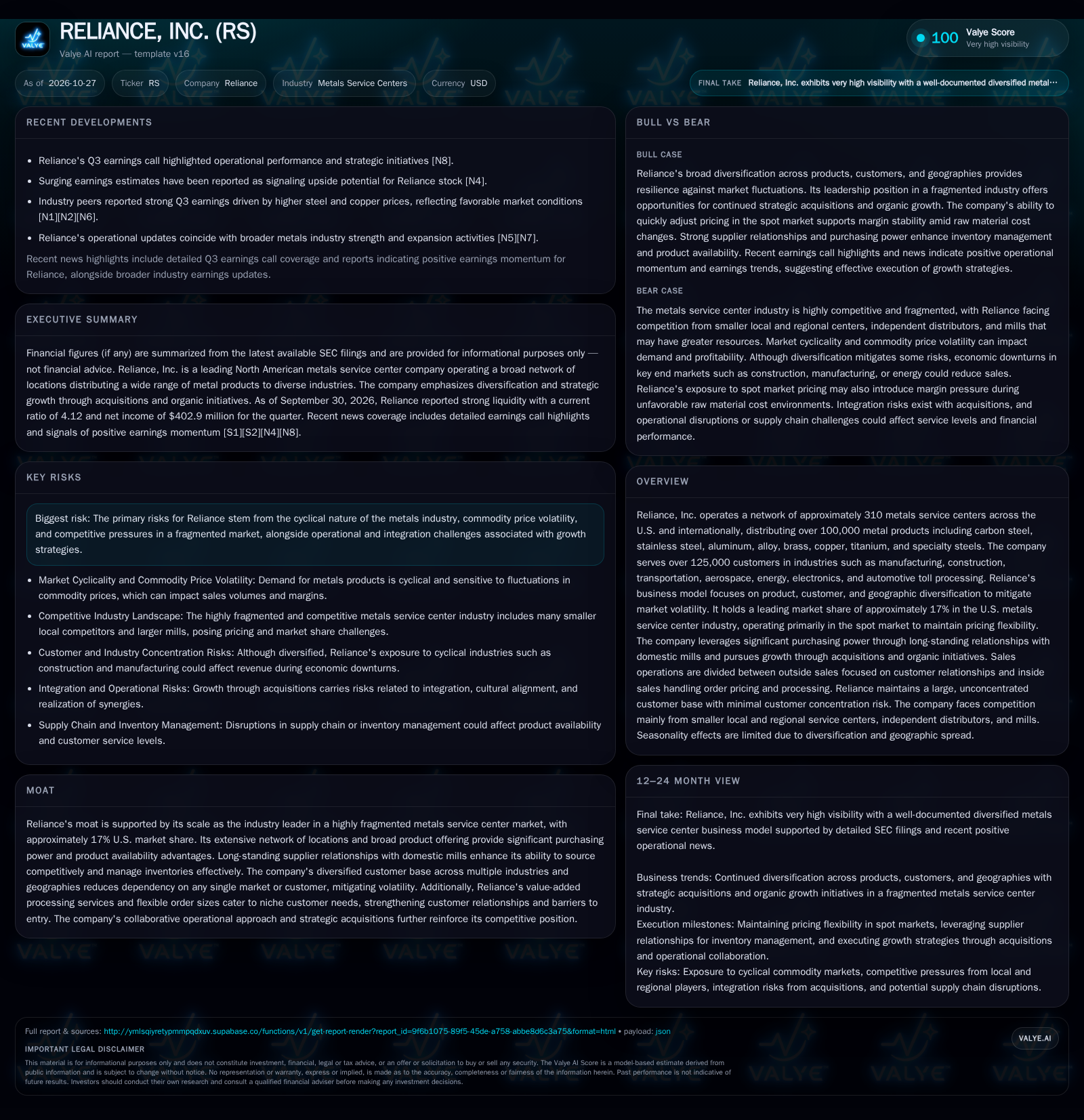
Reliance, Inc. holds a 17% share of the U.S. metals service center market, operates a vast network across 41 states and 10 countries, and serves over 125,000 customers. Recent quarters have seen strong earnings and margin performance, supported by pricing agility and supply chain scale. The company’s growth strategy relies on continued diversification and acquisitions, but faces persistent risks from commodity cycles, integration, and industry fragmentation. Key forward drivers include acquisition execution, spot market margin management, and shifts in industrial demand.
Reliance, Inc. stands as the largest U.S. metals service center operator, with a network of 310 locations and a customer base exceeding 125,000 across diverse industries. Its 17% market share marks a notable gain in a fragmented sector, achieved through a combination of organic growth and strategic acquisitions. Recent earnings highlight the company's ability to manage margins and adapt pricing in real time via spot market agility—an advantage in the often-volatile world of metals distribution. As Reliance continues to pursue scale and diversification, the interplay between acquisition execution, competitive intensity, and end-market cyclicality will define the next stage of value creation.
Recent Performance and Strategic Positioning: What Matters Now
Reliance, Inc. has solidified its position as the U.S. market leader in metals service centers, reaching a 17% share of tons sold in 2025, up from 15% in the prior year—a notable gain in a sector where fragmentation is the norm [S1]. This expansion reflects both organic growth and the integration of acquired businesses, reinforcing the company’s ability to capture incremental share even as industry competition remains intense.
For the quarter ended September 30, 2026, Reliance reported net income of $402.9 million and diluted EPS of $7.84 [S2]. These earnings reflect effective margin management, achieved in part through real-time pricing adjustments enabled by the company’s spot market orientation. Strong operational performance has been highlighted in recent earnings calls and news coverage, with surging earnings estimates signaling continued upside [N4] [N8].
The company’s customer base remains highly diversified, with no single customer accounting for even 1% of net sales in 2025. This breadth, spanning over 125,000 accounts across multiple industries, underpins Reliance’s resilience to sector-specific downturns [S1].
How Reliance Monetizes Scale and Spot Market Flexibility
Reliance’s business model is fundamentally built on the distribution of over 100,000 metal products, sourced primarily from domestic mills and delivered through a national and international network of service centers [S1]. The company’s economics are shaped by its ability to buy and sell metals on a spot basis, allowing for rapid price adjustments in response to commodity swings. This spot market orientation provides margin protection during periods of input price volatility, though it can also expose the company to margin compression when prices move sharply against inventory positions.
Revenue is driven by a mix of product volume, price per ton, and the value-added services (such as processing, cutting, and just-in-time delivery) provided to customers. The large, unconcentrated customer base enables small-lot, frequent orders—reducing reliance on any single industry and smoothing revenue streams. However, the high degree of operating leverage inherent in warehouse, logistics, and labor costs means that profitability can swing significantly with changes in volume and price levels.
Growth capital is typically allocated toward acquisitions, incremental capacity, and process automation, with working capital needs fluctuating alongside metals prices and customer demand. While Reliance’s reported current ratio is high (4.12 as of September 30, 2026), this reflects the capital-intensive nature of the business and the need to maintain substantial inventories to meet just-in-time delivery requirements [S2].
Fragmentation, Scale, and the Realities of Metals Distribution Competition
Reliance’s competitive advantage stems from its scale, extensive geographic reach, and the breadth of its product offering. In a fragmented industry where many competitors are local or regional firms, Reliance’s purchasing power with mills and ability to offer a wider array of products and value-added services can drive both cost advantages and customer retention [S1].
However, barriers to entry are not insurmountable: smaller incumbents can compete on local relationships and service, while mills themselves are increasingly bypassing distributors in select segments. The company’s strategy of maintaining acquired trade names and localized sales teams helps preserve customer loyalty, but also introduces complexity and integration risk.
Peer categories include regional service centers, national independent distributors, and direct sales from primary mills. Each poses different threats—smaller players can undercut on price or service niche markets, while mills may leverage scale or vertical integration. The key question is whether Reliance can continue to win share and margin in this environment without eroding its own pricing discipline.
If Scale and Diversification Drive Margin Expansion
A favorable scenario for Reliance involves continued consolidation of the U.S. metals service center market, with the company leveraging its scale to negotiate better purchasing terms and expand value-added services. Successful integration of acquisitions could yield both revenue synergies (cross-selling, expanded product lines) and cost efficiencies (shared logistics, procurement, and technology platforms).
Spot market agility could enable Reliance to expand gross margins in periods of rising metals prices, provided inventory is managed tightly and customer demand remains robust. Diversification across end markets—especially growth in less cyclical industries such as aerospace or electronics—could dampen the impact of downturns in construction or energy.
Evidence that would confirm this scenario includes sustained gains in market share, rising gross profit margins despite commodity volatility, and successful execution of acquisitions with limited integration costs or disruptions. Positive news flow around earnings estimates and margin trends, as seen recently, would further support the upside case [N4] [N8].
What Continuity Looks Like in a Cyclical, Diversified Business
The most plausible path forward sees Reliance maintaining its leadership position, with incremental share gains balanced by persistent competitive and cyclical pressures. Revenue and margins would likely fluctuate with metals prices and industrial demand, but the company’s diversification and spot market pricing flexibility should limit extreme volatility.
Organic growth would come from steady demand across a variety of sectors, supplemented by periodic acquisitions that are integrated with moderate efficiency. Gross margin levels may remain stable, with occasional compression during sharp commodity downturns or inventory misalignment, but rebound as pricing adjusts and demand normalizes.
Confirmation of this scenario would be visible in relatively stable annual revenue and earnings, moderate swings in gross margin, and continued broad customer and product diversification. Falsification would involve either a significant deterioration in margins (suggesting loss of pricing power or inventory risk) or an inability to integrate acquisitions smoothly, leading to operational disruptions.
When Cyclicality and Integration Risks Overwhelm Scale Advantages
A negative outcome could unfold if commodity price volatility and end-market weakness outpace Reliance’s ability to adjust pricing or manage inventory. Prolonged downturns in key sectors like construction, manufacturing, or energy could sharply reduce volumes, while spot market exposure could amplify margin compression if input costs are rising faster than selling prices.
Integration missteps—whether from cultural clashes, technology mismatches, or customer attrition—could erode the benefits of acquisitions and increase operating costs. Supply chain disruptions, if prolonged, could exacerbate inventory mismatches and delay deliveries, damaging customer relationships.
This scenario would be confirmed by a pronounced decline in gross and operating margins, negative earnings surprises, and reports of acquisition or operational challenges. Evidence might also include significant write-downs of acquired assets or a marked loss of market share to regional competitors or mills.
Signals That Will Shape Reliance’s Strategic Trajectory
Quarterly gross margin trends, especially relative to spot metals price movements and peer results, would help test the company’s margin management capabilities.
Market share in tons sold—both absolute and relative to regional/national peers—will indicate the effectiveness of scale and acquisition strategies.
The pace, size, and integration cost of new acquisitions; post-acquisition margin and revenue contribution would help assess execution risk.
Revenue and volume exposure by end market (if disclosed) could clarify resilience to sector cyclicality and diversification benefits.
Inventory turns and days sales of inventory would provide insight into supply chain agility and exposure to commodity price swings.
Customer retention rates and average order size (if disclosed) would help gauge the strength of Reliance’s relationship-based sales model.
Changes in supplier terms and the share of domestic versus imported inputs could affect both cost structure and supply chain risk.
Any material operational disruptions, such as logistics delays or supply chain outages, would be important to monitor for real-time execution risk.
Disclaimer: This is research-only, informational analysis and not investment advice. It may include AI-generated interpretation and general industry context. Always verify important details using primary sources.

Comments