
GE HealthCare: Expanding Theranostics, AI Integration, and the Race for Diagnostic Leadership
Recent acquisitions, global collaborations, and AI-driven product advances are repositioning GE HealthCare at the nexus of imaging, diagnostics, and digital workflow. The challenge: converting innovation and portfolio breadth into durable growth amid regulatory, integration, and competitive risks.
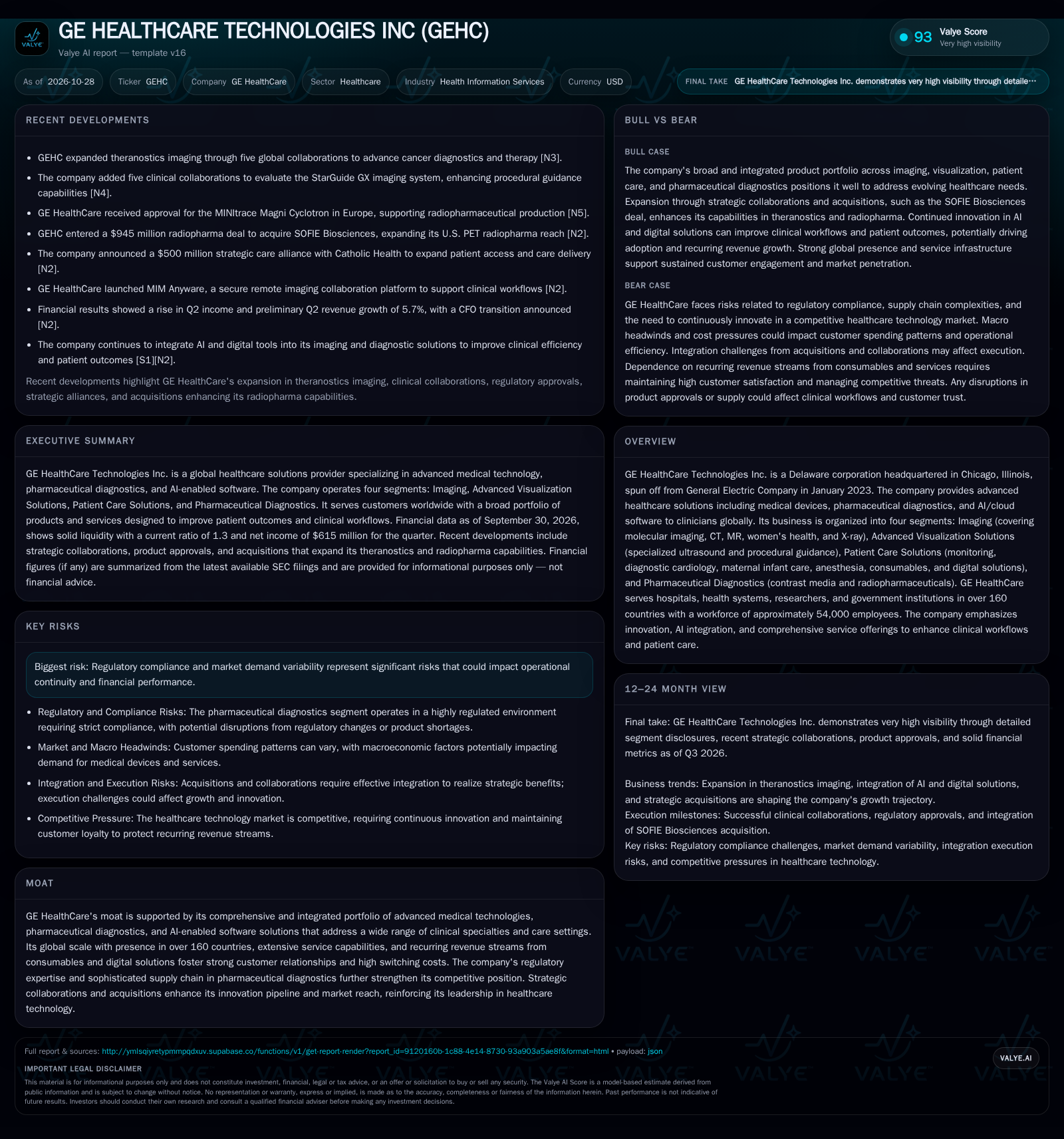
GE HealthCare is accelerating its push into theranostics and radiopharmaceuticals with the $945 million SOFIE Biosciences acquisition, while deepening AI and digital integration in its imaging and diagnostics portfolio. Strong Q3 2026 earnings and major alliances signal momentum, but the company must navigate complex regulatory, integration, and market dynamics to realize its full potential. Execution on recent deals, adoption of new AI-enabled products, and resilience of recurring revenue streams will be critical for sustained outperformance. [S2] [N2] [N3]
GE HealthCare Technologies is making decisive moves to cement its leadership in medical imaging, diagnostics, and digital health. The recent $945 million acquisition of SOFIE Biosciences and a $500 million alliance with Catholic Health exemplify the company’s commitment to expanding its reach in radiopharmaceuticals and care delivery partnerships. The next phase will test its ability to execute on complex integrations, navigate regulatory hurdles, and maintain its competitive edge in a rapidly evolving healthcare technology landscape. [S2] [N2] [N3]
Strategic Acquisitions and Alliances Reshape the Competitive Landscape
GE HealthCare’s latest quarter was marked by several transformative moves: the $945 million acquisition of SOFIE Biosciences to expand PET radiopharma capabilities in the U.S., the announcement of a $500 million care alliance with Catholic Health, and five new global collaborations in theranostics imaging. These initiatives are designed to build out the company’s portfolio across imaging, diagnostics, and precision medicine, while deepening clinical partnerships and expanding patient access. Financially, GE HealthCare reported Q3 2026 net income of $615 million, with $2.826 billion in cash and a current ratio of 1.3. While these moves reinforce the company’s leadership ambitions, they also elevate execution and integration risks as GE HealthCare extends its reach across the care continuum. [S2] [N2] [N3]
How GE HealthCare’s Multi-Segment Model Drives Revenue and Margin Dynamics
GE HealthCare’s business model is built on a diversified, multi-segment structure: Imaging, Advanced Visualization Solutions (AVS), Patient Care Solutions (PCS), and Pharmaceutical Diagnostics (PDx). Imaging and AVS are capital-intensive, offering high-value equipment and increasingly, AI-powered workflow tools. These segments historically capture large upfront sales with periodic replacement cycles, but the company is driving toward greater recurring revenue through digital subscriptions and managed services. PCS and PDx, meanwhile, generate steady streams from consumables, maintenance, and pharmaceutical diagnostics—products with regulatory moats and high switching costs.
The economics of the SOFIE Biosciences acquisition are likely to be margin-accretive if GE HealthCare can leverage its scale and distribution to expand PET radiopharma reach. However, integration costs, regulatory compliance, and the complexity of radiopharmaceutical supply chains may pressure near-term margins. The ongoing shift to AI and digital solutions could unlock operating leverage if adoption accelerates, but requires significant upfront R&D and integration investment. The balance between high-margin recurring revenues and the capital intensity of innovation will determine the company’s long-term profitability trajectory.
The interplay between capital expenditure cycles in Imaging and AVS and the recurring revenue streams in PCS and PDx segments creates a nuanced margin profile for GE HealthCare. Capital-intensive segments typically face lumpy demand tied to hospital budget cycles and reimbursement policies, which can lead to short-term margin volatility. In contrast, consumables and pharmaceutical diagnostics benefit from more predictable, contractually based revenue, often insulated from capital spending downturns. This dynamic necessitates a careful allocation of investment between sustaining innovation in capital equipment and scaling recurring revenue businesses to smooth overall financial performance.
Moreover, the success of AI integration hinges on the company's ability to demonstrate clear clinical and operational value to healthcare providers. Adoption rates will likely depend on the ease of integration with existing hospital information systems, regulatory acceptance of AI-driven diagnostics, and the tangible impact on workflow efficiency or patient outcomes. If GE HealthCare can effectively navigate these factors, the resulting data-driven insights could enhance predictive maintenance, personalized treatment protocols, and resource optimization, thereby reinforcing customer loyalty and justifying premium pricing.
Portfolio Breadth and Digital Depth: Assessing GE HealthCare’s Market Defenses
GE HealthCare’s competitive position is anchored by its broad and integrated product suite, serving over 160 countries and spanning imaging, diagnostics, and patient care solutions. This breadth enables the company to offer end-to-end solutions to large health systems, potentially deepening customer relationships and raising switching costs. Its regulatory expertise and global supply chain in pharmaceutical diagnostics provide barriers to entry for new rivals.
However, the healthcare technology market remains intensely competitive. Major multinational peers and specialized medtech firms are investing aggressively in AI, cloud, and digital workflow—areas where customer adoption curves can be unpredictable and where interoperability with hospital IT systems is critical. The recent push into theranostics and radiopharma through acquisitions and collaborations could create differentiation if GE HealthCare can translate these assets into clinically validated, commercially scalable solutions. The question is whether the company’s scale and integration capabilities can outpace both nimble digital-first entrants and entrenched global competitors.
The competitive landscape is further complicated by the increasing convergence of healthcare technology with broader digital ecosystems. GE HealthCare’s ability to offer interoperable solutions that integrate seamlessly with electronic health records, telehealth platforms, and data analytics tools could serve as a critical differentiator. However, this requires ongoing investment in software development, cybersecurity, and compliance with evolving data privacy regulations. Failure to keep pace with these digital demands may expose the company to disintermediation by more agile, cloud-native competitors who can rapidly iterate and deploy innovative solutions.
Additionally, the company’s global footprint exposes it to diverse regulatory regimes and reimbursement environments, which can both protect and challenge its market position. While regulatory barriers may deter new entrants, they also impose significant compliance costs and slow time-to-market for new products. GE HealthCare’s ability to leverage its regulatory expertise and local market knowledge to navigate these complexities will be instrumental in sustaining competitive advantages, particularly in emerging markets where healthcare infrastructure and digital maturity vary widely.
If Integration and AI Adoption Accelerate, Margin Expansion Could Follow
The most favorable outcome for GE HealthCare would result from successful integration of SOFIE Biosciences and other recent acquisitions, rapid adoption of its AI-enabled imaging and diagnostics platforms, and expanded utilization of its pharmaceutical diagnostics portfolio. This scenario would see both top-line growth from new product launches and deeper recurring revenue from digital and service contracts.
Evidence that would confirm this trajectory includes sustained increases in digital solution uptake, margin expansion in the PDx and AVS segments, and new multi-year contracts with major health systems. Regulatory approvals—such as the recent MINItrace Magni Cyclotron clearance in Europe—would further validate the company’s innovation pipeline. If customers demonstrate measurable workflow or outcome improvements from AI-enabled solutions, GE HealthCare could see accelerated share gains and improved pricing power. [N2] [N5]
Portfolio Integration Yields Gradual Growth Amid Macro and Regulatory Headwinds
The central expectation is that GE HealthCare will deliver moderate organic growth as it integrates SOFIE Biosciences and executes on its recent alliances and clinical collaborations. AI and digital adoption will likely progress unevenly, with some flagship customers moving quickly while others remain cautious. Recurring revenues from consumables, services, and diagnostics should provide a buffer against capital spending cycles and macro headwinds.
This scenario would be supported by continued profitability in core segments, steady cash generation, and incremental gains from portfolio expansion. Signs of execution—such as timely integration of new acquisitions, stable regulatory compliance, and maintenance of service levels—would confirm the base case. However, delays in realizing synergies, slower-than-expected digital adoption, or episodic regulatory or supply-chain disruptions would challenge this outlook. [S2]
Integration Setbacks or Regulatory Disruptions Undercut Growth Ambitions
The primary risk lies in the complexity of integrating SOFIE Biosciences and other recent deals, alongside executing a multi-segment strategy in a highly regulated environment. If integration proves more costly or protracted than planned, or if regulatory hurdles delay product launches or disrupt pharmaceutical diagnostics supply, GE HealthCare could face margin compression and customer attrition.
Additional evidence of a downside unfolding would include missed synergy targets, negative surprises in compliance or supply chain reliability, or contraction in high-margin recurring revenues. Competitive encroachment—particularly from digital-first or lower-cost rivals—could also erode pricing and retention in core segments. In this scenario, the company may need to revisit its investment pace or pursue further restructuring to stabilize performance.
Milestones That Will Define GE HealthCare’s Next Phase
Progress and milestones in the integration of SOFIE Biosciences, including realized synergies and PET radiopharma revenue contribution.
Adoption rates and growth in AI-enabled imaging, digital workflow, and diagnostic platforms—particularly new contracts or expansions with large health systems.
Regulatory approvals and successful launches of new products, such as the MINItrace Magni Cyclotron and other radiopharmaceutical innovations.
Margin trends and recurring revenue share in the PDx and PCS segments, as these segments are key to sustainable profitability.
Execution and renewal rates in major clinical collaborations and strategic care alliances, such as the $500 million Catholic Health partnership.
Supply chain stability and compliance performance in pharmaceutical diagnostics, especially in light of global regulatory complexity.
If disclosed, customer retention and net promoter scores in core imaging and diagnostics offerings would help test competitive stickiness.
Disclaimer: This is research-only, informational analysis and not investment advice. It may include AI-generated interpretation and general industry context. Always verify important details using primary sources.

Comments