
Robinhood’s Product Expansion and International Push: Can Diversification Outrun Regulatory and Competitive Pressures?
Robinhood’s latest results show robust topline growth and sustained profitability, underpinned by new product launches and international expansion. Yet, as the company leans into complex offerings like crypto futures, prediction markets, and underwriting, the core question is whether this diversification can overcome intensifying regulatory scrutiny and competition from entrenched financial giants.
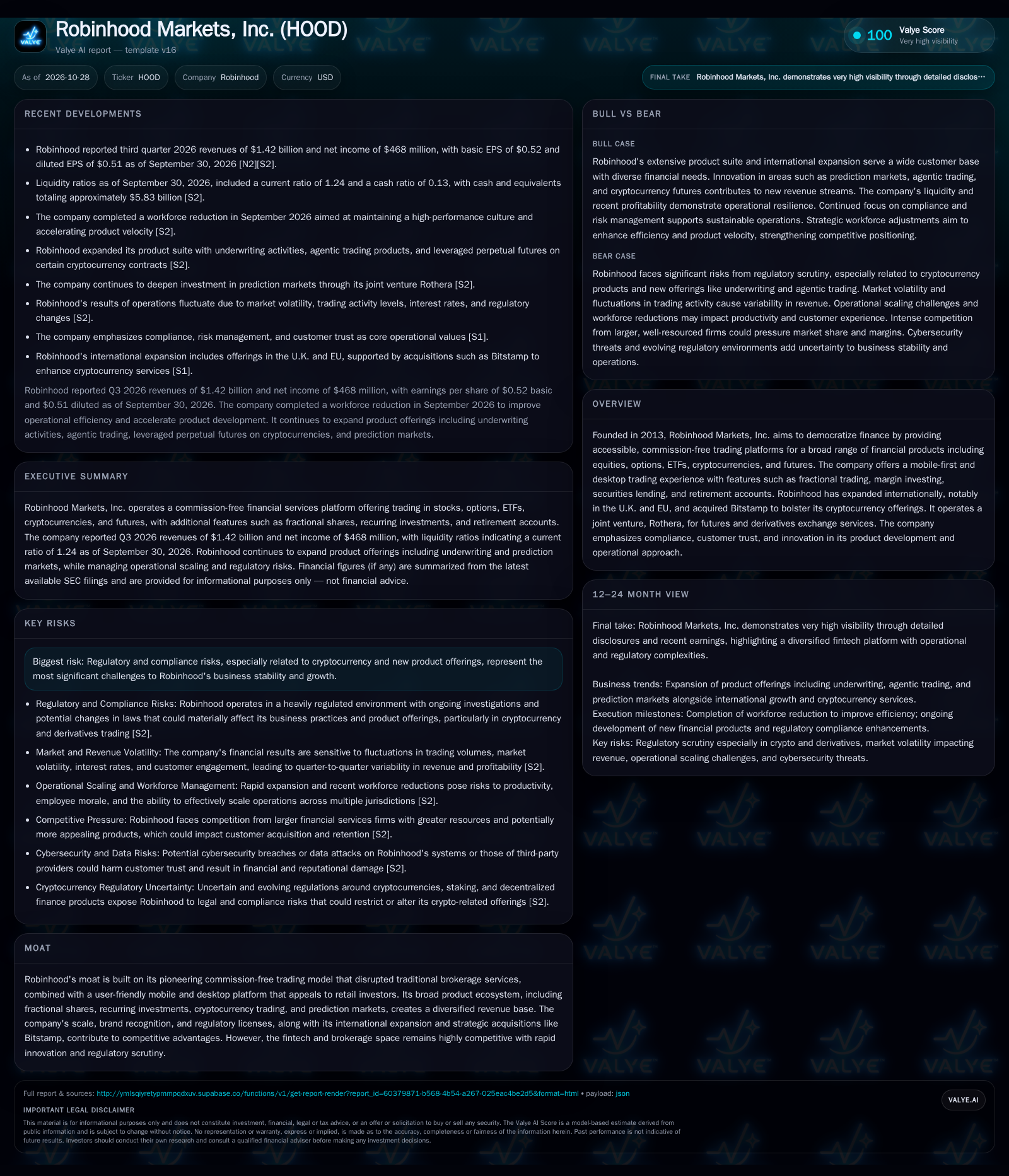
Robinhood reported Q3 2026 revenues of $1.42 billion and net income of $468 million, while completing a workforce reduction and adding new products such as crypto futures and prediction markets. The company’s broadening portfolio and international reach signal ambition, but regulatory risks and heavyweight competition remain formidable counterforces. The thesis hinges on whether Robinhood can translate diversification into durable, defensible revenue streams.
Robinhood’s evolution from a disruptor in commission-free equity trading to a multi-asset, internationally active fintech platform is reaching a critical juncture. The company’s Q3 2026 performance demonstrates both financial momentum and the operational impact of recent streamlining efforts. However, as Robinhood aggressively moves into new product domains—including underwriting and complex crypto derivatives—the sustainability of its growth story will depend on its ability to manage regulatory headwinds, defend its customer base against better-capitalized rivals, and turn product breadth into recurring, defensible earnings.
Recent Results Signal Both Expansion and Operational Realignment
Robinhood reported Q3 2026 revenues of $1.42 billion and net income of $468 million, a performance that underscores the company’s ability to remain profitable while scaling up its platform [S2] [N2]. The completion of a workforce reduction in September 2026 was aimed at improving operational efficiency and accelerating product development, suggesting a strategic pivot toward leaner operations [S2]. The company’s product portfolio has broadened to include underwriting, agentic trading, leveraged perpetual crypto futures, and prediction markets, reflecting an effort to diversify revenue streams and attract a wider range of customers [S2]. International expansion, notably via Bitstamp and new offerings in the U.K. and EU, is now a pillar of Robinhood’s growth strategy [S1]. The company reported cash and liquidity metrics for the period; these figures do not by themselves establish operating runway, investment capacity, financial flexibility, or financing capacity. [S2]
How Robinhood’s Revenue Model Evolves as Product Complexity Increases
Robinhood’s traditional economics have centered on high-volume, low-cost transactions—earning revenue primarily through payment for order flow (PFOF), margin interest, securities lending, and ancillary services. The commission-free model, while disruptive, relies on scale, user engagement, and ancillary monetization rather than per-trade fees. As Robinhood introduces new offerings such as underwriting and crypto derivatives, the revenue mix may shift toward higher-margin, but potentially more volatile, streams. Underwriting and prediction markets can, in theory, command better economics per transaction than basic brokerage—if volumes materialize and regulatory barriers are managed.
The addition of leveraged crypto futures and agentic trading features could drive both transaction-based and net interest income, but these products tend to be more sensitive to market volatility and regulatory risk. Operational leverage is plausible if Robinhood can grow transaction volumes and assets under custody without proportionately increasing fixed costs—a rationale behind the recent workforce reduction. However, these gains could be offset if new products require substantial compliance, technology, or risk management investments. The international push adds further complexity, as profitability in new geographies may lag initial investments and face region-specific regulatory costs.
Ultimately, the company’s economic model is increasingly tied to its ability to balance rapid innovation with disciplined risk and compliance management.
Competitive Pressures Intensify as Robinhood Targets New Market Segments
Robinhood’s early advantage stemmed from its mobile-first, commission-free platform, which attracted a new generation of retail investors. However, the competitive landscape has since shifted: legacy brokerages, fintech startups, and crypto-native platforms now all offer low-cost trading and increasingly sophisticated tools. Robinhood’s expansion into underwriting and prediction markets places it in direct competition with established investment banks, specialty trading shops, and decentralized finance (DeFi) protocols.
While the company’s brand and technology stack remain strengths, larger financial institutions can often match or undercut Robinhood’s pricing while offering greater breadth, trust, and balance sheet strength. In crypto and derivatives, specialized exchanges and DeFi platforms may appeal to the most active or risk-tolerant traders, especially if regulatory uncertainty constrains Robinhood’s product innovation. Switching costs in retail brokerage remain modest, as users can transfer assets or open parallel accounts with relative ease. The company’s main defenses are its integrated product suite, user experience, and regulatory licenses, but these may not offset the scale and resource advantages of larger incumbents or the agility of crypto-native challengers.
If Diversification Drives Durable Engagement and Margin Expansion
The most favorable Robinhood outcome hinges on new products catalyzing sustained user growth and higher engagement, with underwriting, prediction markets, and crypto derivatives generating meaningful incremental revenue. If Robinhood can leverage its brand and technology to cross-sell these offerings, average revenue per user (ARPU) could rise, and the company might capture share from less nimble incumbents. International expansion could further boost active accounts and transaction volumes, especially if the Bitstamp integration enables a seamless global crypto trading experience.
To validate this scenario, evidence would include a rising proportion of revenue from new products, increasing ARPU, and positive net asset inflows in international markets. Further, if operating expenses rise more slowly than revenue, margin expansion would confirm operating leverage. Regulatory clarity—particularly in crypto—would remove a major overhang and could accelerate product adoption. Conversely, if new product launches stall or regulatory barriers disrupt rollout, the upside case would weaken.
Diversification Brings Growth but Also Volatility and Execution Risk
A more probable outcome is that Robinhood’s broadening platform drives moderate growth, but with substantial quarter-to-quarter variability tied to market conditions, regulatory developments, and execution challenges. Trading activity—and thus revenue—may remain correlated with volatility in equities and crypto markets. New products such as underwriting and prediction markets could contribute, but may not achieve scale quickly, especially under persistent regulatory scrutiny.
This scenario would be confirmed by continued profitability, but with fluctuating margins and a revenue mix that remains heavily reliant on core trading and interest-based income. The company’s international efforts may deliver gradual gains, but also introduce compliance and localization costs that dampen near-term returns. If workforce reductions result in noticeable improvements in product velocity or cost discipline, that would support the base case. However, if operational complexity increases faster than revenue, margin pressure could persist.
Regulatory or Operational Setbacks Could Disrupt Momentum
The principal risk is that regulatory intervention—especially in crypto or derivatives—forces Robinhood to curtail or suspend high-growth product lines, directly impacting top-line growth and customer engagement. Investigations, fines, or mandated changes to business practices could also raise compliance costs or trigger negative headlines, undermining customer trust. Operational missteps in scaling new products or international operations could further erode profitability.
This scenario would be confirmed by sharp declines in revenue from new products, adverse legal or regulatory outcomes, or customer attrition following negative news. If expenses rise without corresponding revenue growth—due to compliance, technology, or remediation costs—margins could compress and net income could turn negative. A material cybersecurity breach could accelerate customer outflows and trigger regulatory scrutiny, compounding the downside.
Milestones to Gauge Whether Robinhood’s Expansion Is Building a Defensible Platform
Revenue contribution from new products such as underwriting, prediction markets, and crypto derivatives—if disclosed—would help test the thesis that diversification is driving sustainable growth.
ARPU (average revenue per user) trends, particularly in international markets, would indicate whether cross-selling and engagement are increasing.
Net new funded accounts and active user metrics, especially outside the U.S., would reveal the effectiveness of international expansion.
Operating expense growth relative to revenue—a key test of whether operational leverage from workforce reduction is materializing.
Regulatory developments or enforcement actions in major markets, especially related to crypto and derivatives, could alter the risk/reward balance.
Customer asset inflows and outflows, especially following the launch of new products or major news events, would indicate market trust and platform stickiness.
Incidence and severity of cybersecurity events—if disclosed—would test operational resilience and customer confidence.
Disclaimer: This is research-only, informational analysis and not investment advice. It may include AI-generated interpretation and general industry context. Always verify important details using primary sources.

Comments