
UniFirst’s Merger with Cintas: Integration Stakes, Recurring Revenue, and the Realities of Uniform Services Economics
UniFirst’s pending merger with Cintas marks a pivotal moment for the North American uniform and facility services market. The company’s vertically integrated model, multi-year contracts, and diverse customer base offer both stability and exposure to competitive and operational risks. The coming quarters will hinge on merger execution, cost management, and retention of customer and employee loyalty.
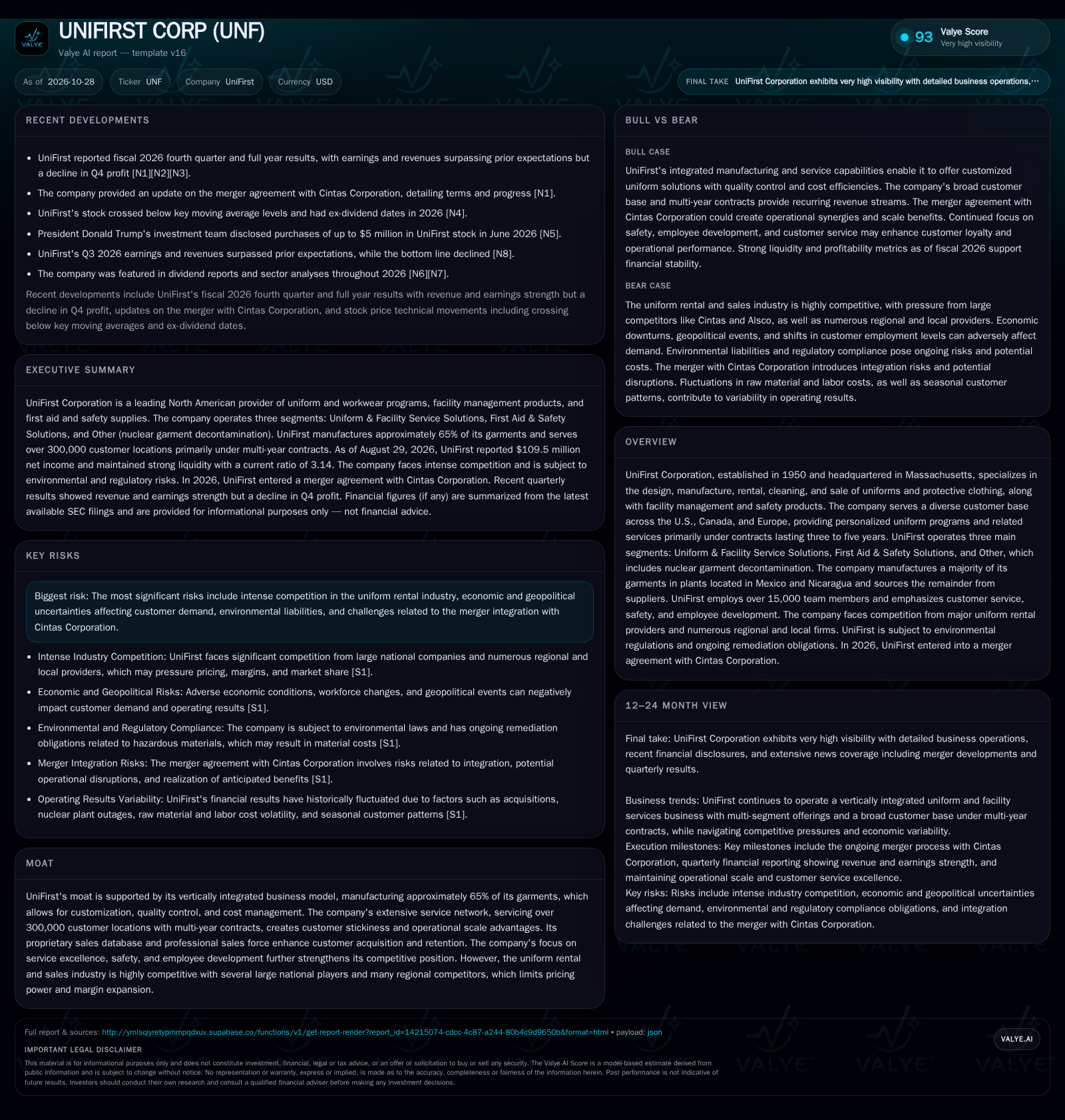
UniFirst is a leading uniform and facility services provider with a vertically integrated model and over 300,000 customer locations under multi-year contracts. The company faces intense competition and operational variability, but a merger agreement with Cintas could reshape its strategic trajectory. Key variables include merger integration, margin management, and contract retention in a highly competitive sector. [S1] [N1] [N2]
UniFirst’s position as a major North American provider of uniforms, facility, and safety solutions is at a turning point. With a pending merger with Cintas, the company’s combination of vertical integration, diversified contracts, and a broad service portfolio faces new scrutiny. While multi-year contracts and in-house manufacturing underpin revenue stability and cost control, highly competitive dynamics and operational variability remain persistent challenges. The success of the merger—and UniFirst’s ability to maintain customer and employee loyalty through the transition—may determine whether the company secures or surrenders strategic ground in a consolidating industry.
Merger with Cintas and Financial Snapshot: The State of Play
As of October 2026, UniFirst operates across three segments—Uniform & Facility Service Solutions, First Aid & Safety Solutions, and nuclear garment decontamination—serving over 300,000 customer locations across North America and Europe. The company manufactures approximately 65% of its garments in-house, with facilities in Mexico and Nicaragua, while sourcing the remainder from suppliers. In March 2026, UniFirst entered a merger agreement with Cintas Corporation, offering a mix of cash and stock consideration to shareholders—a move poised to reshape the competitive landscape. For fiscal 2026, UniFirst reported net income of $109.5 million and a current ratio of 3.14, with Q4 results showing revenue and earnings above expectations but a decline in quarterly profit. These developments set the stage for major operational and strategic decisions, particularly as integration with Cintas approaches. [S1] [N1] [N2] [N3]
How UniFirst’s Integrated Model Drives Revenue and Margin Dynamics
UniFirst generates revenue predominantly through multi-year (three to five year) service contracts for uniform rental, facility management, and safety solutions. The company’s vertically integrated operations—manufacturing a majority of garments in-house—may allow for tighter quality control, lower procurement costs, and customization that supports customer retention. These factors could help buffer margin pressures, especially given volatility in raw material and labor costs. The recurring nature of service contracts provides revenue visibility and some operating leverage, though margins are exposed to fluctuations in input costs and wage inflation.
Capital needs are moderate but ongoing, driven by investment in manufacturing facilities, service delivery infrastructure, and environmental remediation. The nuclear garment decontamination segment, while niche, requires regulatory compliance and specialized capital. UniFirst’s large professional sales force and proprietary database support customer acquisition and retention, but also contribute to fixed costs. The company’s 2026 financials suggest that while revenue growth outpaced expectations, margin compression remains a risk—possibly due to rising costs or competitive pricing. [S1] [N1] [N2] [N3]
The integrated manufacturing approach also introduces operational complexity that can influence margin stability. For instance, fluctuations in production efficiency, equipment downtime, or supply chain disruptions at in-house facilities can have outsized impacts compared to pure outsourcing models. This operational leverage means that effective capacity planning and maintenance are critical to maintaining cost advantages. Additionally, the balance between in-house production and external sourcing must be dynamically managed to optimize costs and responsiveness to demand shifts, especially given the variability in raw material prices and labor market conditions across different geographies.
Moreover, the multi-year contract model, while providing revenue visibility, requires continuous investment in customer service and innovation to prevent contract attrition. The recurring revenue streams depend heavily on maintaining service quality and adapting to evolving client needs, which may include sustainability requirements or digital service enhancements. Failure to innovate or respond to changing customer expectations could erode renewal rates, thereby impacting long-term revenue predictability. Conversely, successful deployment of technology-enabled service improvements could enhance customer stickiness and provide incremental margin benefits through operational efficiencies.
Competitive Intensity and the Limits of Differentiation in Uniform Services
UniFirst faces intense competition from both large national players—most notably Cintas, Alsco, and Vestis Corporation—and a fragmented pool of regional/local providers and direct sales competitors. The industry’s barriers to entry are moderate, with logistical scale, customer service, and route density as key differentiators. UniFirst’s integrated manufacturing and broad product/service offering may confer advantages in cost management, speed, and customization. However, pricing power is limited by the commoditized nature of uniform rental and facility services, as well as frequent contract renegotiations.
Switching costs for customers are not trivial—multi-year contracts and service integration create some stickiness—but are not insurmountable, especially if competitors offer better pricing or service. The pending merger with Cintas, the sector’s largest player, could either strengthen UniFirst’s position through scale or create integration frictions that competitors exploit. Environmental regulations and compliance costs are additional factors that could impact competitive dynamics, especially for specialized segments like nuclear decontamination. [S1]
In evaluating competitive positioning, it is important to consider the role of network effects and route density in the uniform rental business. Higher route density can lower per-unit delivery costs and improve service frequency, which are significant competitive advantages. However, achieving such density requires substantial upfront investment and careful geographic planning. The merger with Cintas could potentially unlock these benefits through network consolidation, but realizing them depends on the successful integration of logistics systems and harmonization of service protocols. Failure to do so could negate expected scale advantages and leave the combined entity vulnerable to more agile regional competitors.
Furthermore, environmental regulations and compliance costs represent a growing area of competitive differentiation and risk. Companies that proactively invest in sustainable manufacturing processes and waste reduction may gain favor with environmentally conscious clients and regulators, potentially commanding pricing premiums or avoiding costly penalties. Conversely, lagging in environmental compliance could result in increased operational costs or reputational damage, which competitors could exploit. The nuclear garment decontamination segment, with its specialized regulatory environment, exemplifies the need for rigorous compliance frameworks that can also serve as a barrier to entry for less capable competitors.
Merger Synergies, Retention, and Margin Expansion: What Could Go Right
A favorable outcome for UniFirst hinges on a smooth merger with Cintas, realization of operational synergies, and retention of key customers and personnel. If integration is executed effectively, the combined entity could achieve greater scale efficiencies in procurement, logistics, and back-office operations. Enhanced bargaining power with suppliers and improved route density could drive margin expansion. The merged company may also be able to cross-sell services, deepen customer relationships, and leverage best practices in sales and service delivery.
Confirmation of this scenario would include disclosure of realized cost synergies, stable or rising customer retention rates, and margin improvement in post-merger financials. Evidence of minimal customer attrition, positive employee engagement metrics, and successful cross-segment sales initiatives would further support the upside case. Conversely, early signs of integration delays, customer loss, or rising costs would challenge this thesis.
Sustaining Recurring Revenue Amid Competitive and Operational Challenges
The most plausible trajectory for UniFirst is continued revenue stability from its large, diversified contract base, offset by ongoing pressure on margins due to competition and cost inflation. The company is likely to maintain its core business model, leveraging vertical integration and customer service to defend market share. Integration with Cintas, if completed, may be gradual, with synergies realized over time but offset by one-time costs and operational disruptions.
Evidence supporting this scenario would include steady contract renewal rates, modest revenue growth, and stable but pressured margins. If disclosed, metrics such as customer churn, contract pricing trends, and segment-level profitability would provide further validation. Adverse developments would include spikes in customer attrition, sustained margin erosion, or significant integration setbacks.
Integration Risks, Margin Compression, and Customer Attrition: The Bearish Chain
The downside scenario is defined by merger integration challenges, customer or employee defections, and an inability to offset rising costs. If the merger with Cintas disrupts operations, the combined entity could lose customers to aggressive regional or national competitors, especially if service quality falters or pricing becomes less competitive. Environmental liabilities or regulatory issues could further increase costs or result in operational constraints.
Confirmation of this scenario would involve disclosure of integration delays, significant one-time costs, customer or employee loss, and sustained margin compression. Negative trends in contract renewals, customer complaints, or regulatory fines would reinforce the downside view.
Milestones and Metrics That Will Shape the UniFirst–Cintas Thesis
Progress and disclosures related to the Cintas merger integration process, including cost synergy realization and organizational restructuring.
Customer retention and contract renewal rates, especially among top recurring accounts—if disclosed—as signs of post-merger stability or attrition.
Trends in segment-level margins and operating costs, particularly for Uniform & Facility Service Solutions and First Aid & Safety Solutions.
Employee turnover and engagement, particularly among sales and service personnel, as a potential indicator of integration success or disruption.
Updates on environmental remediation costs and regulatory compliance, which could influence both margins and reputation.
Volume and pricing trends for new contracts, especially in the context of a consolidating industry and potential market share shifts.
Disclosures of any material customer losses or competitive wins by regional or national peers.
Disclaimer: This is research-only, informational analysis and not investment advice. It may include AI-generated interpretation and general industry context. Always verify important details using primary sources.

Comments